

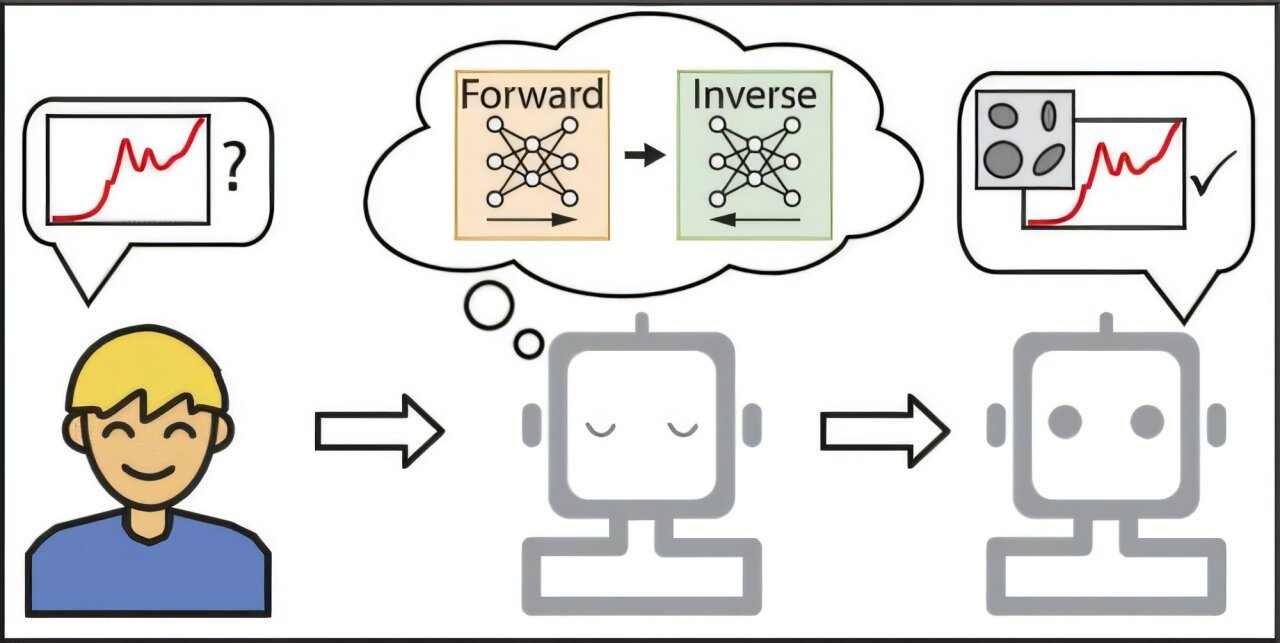

Engineers at Duke University have constructed a group of AI bots that together can solve complex design problems nearly as well as a fully trained scientist. The results, the researchers say, show how AI might soon automate straightforward but niche design problems, opening opportunities for explosive advancements.


The research appears in the journal ACS Photonics.
“A few years ago, a colleague described a really challenging problem in modeling chemical reactions to me. I knew it was something a standard deep learning AI program could solve, but didn’t have time to help myself,” said Willie Padilla, the Dr. Paul Wang Distinguished Professor of Electrical and Computer Engineering at Duke. “But it got me thinking, if we could create a group of AI agents that could solve these types of problems autonomously, it could greatly speed up the rate of advancement in many fields.”
The general type of challenge in question is called an ill-posed inverse design problem. This means researchers know the result they want to achieve but have an infinite number of solutions to explore with no guidance as to which might be the best.
In previous work, Padilla and his lab found ways to solve this challenging problem for dielectric (metal-free) metamaterials that produce a specific electromagnetic response. Metamaterials are synthetic materials composed of many individual engineered features—with lots of design parameters—which together produce properties not found in nature through their structure rather than their chemistry.
In that work, the researchers first designed a type of AI called a deep neural network that used tens of thousands of simulated data points to discover the relationships between various design parameters and their effects. They then designed what they dubbed a “neural-adjoint” AI method that chose random starting points and worked backward toward optimal solutions for a desired outcome.
In the new paper, the researchers essentially followed the same recipe, except they programmed a suite of large language model (LLM) AI agents to complete all the legwork rather than having a graduate student go through all the steps. “The idea was to create an ‘artificial scientist’ that could learn metamaterial physics and work out solutions on its own,” said Padilla.
Called an “agentic system,” the group of LLMs were designed to handle several specific tasks. One ensures that it has all the data it needs accounted for and organized. Another writes a deep neural network code from scratch based on thousands of existing examples. Another checks the work for accuracy and passes it along to one more LLM that runs the results through the neural-adjoint method developed by the lab.
All these tasks are managed and guided by an overarching LLM that helps the various agents talk to one another. As the program works toward a solution, it can understand if more data points are needed to develop a better model or if its current model is making good enough progress toward the desired result. It can also tell the user at any time exactly what is going on in its process.
“It will literally tell you if it is running into diminishing returns and needs to generate more data or if it’s happy with how the error rate is dropping and needs to continue iterating,” said Dary Lu, a Ph.D. student in Padilla’s lab who led the project. “It’s similar to the intuition that a scientist needs to develop over time and was probably the hardest part to program.”
The researchers tested their “artificial scientist” by having it solve some of the same ill-posed inverse problems already tackled by their lab. While the AI did not perform as well as previous Ph.D. students on average over thousands of trials, its best solutions were very close. And although the AI’s average results didn’t beat the human experts, its best designs were comparable—and in this area, one great design is the goal.
Padilla says that this demonstration shows that agentic systems can solve even the most complex problems when thoughtfully and thoroughly programmed. He also believes this approach can be applied to many other fields outside of computational electromagnetics.
“We are right on the cusp of where systems like these will be able to enhance the productivity of highly skilled workers,” said Lu. “Being able to build these agentic systems is a valuable skillset to have going into the job market.”
“Having AI systems that can conduct their own research and improve on their own methods will start making significant gains to push human knowledge,” said Padilla. “At large scales and on significantly faster timelines, these systems will soon be able to produce truly novel results.”
More information:
Darui Lu et al, An Agentic Framework for Autonomous Metamaterial Modeling and Inverse Design, ACS Photonics (2025). DOI: 10.1021/acsphotonics.5c01514
Duke University
Citation:
AI bots could match scientist-level design problem solving (2025, October 23)
retrieved 23 October 2025
from https://techxplore.com/news/2025-10-ai-bots-scientist-problem.html
This document is subject to copyright. Apart from any fair dealing for the purpose of private study or research, no
part may be reproduced without the written permission. The content is provided for information purposes only.


