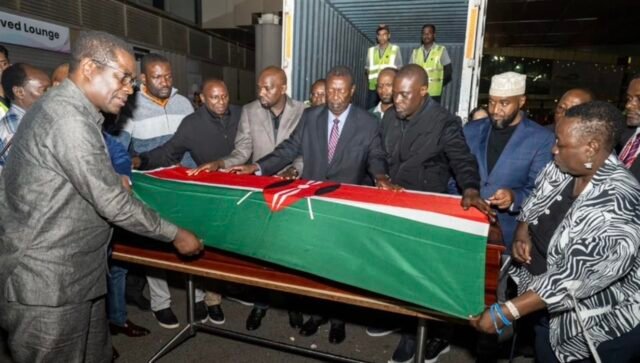
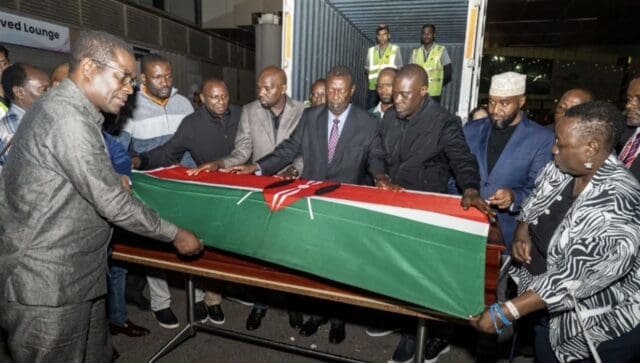
Raila Amolo Odinga, who passed away in October 2025, was a towering, complex, and often polarizing figure in Kenyan politics. For over four decades, he was at the heart of the country’s turbulent march toward democracy—detained without trial, exiled, celebrated, and vilified in equal measure.
Yet, despite five determined bids for the presidency, he never held the nation’s highest office. His political journey—marked by near-victories, mass protests, and historic compromises—cemented his legacy as the president who was never allowed to become.
– Advertisement –
The Perpetual Opposition Leader
Odinga’s political life was shaped by both legacy and struggle. The son of Jaramogi Oginga Odinga, Kenya’s first Vice President and a prominent opposition figure himself, Raila inherited not just a name but a mission: to push Kenya toward democratic accountability and justice. But it was a mission fraught with personal and political cost.
Over the years, Odinga became synonymous with opposition politics in Kenya. He ran for president five times—1997, 2007, 2013, 2017, and 2022. In each case, his campaigns electrified segments of the population, often promising radical change, constitutional reform, and a break from the entrenched dynastic political order.
But in each of those elections, the results were marred by controversy, legal battles, or allegations of rigging. Nowhere was this more explosive than in 2007.
– Advertisement –
2007: A Nation on the Brink
The 2007 presidential election marked the most traumatic moment in Kenya’s post-independence history—and in Odinga’s political career. Running against incumbent Mwai Kibaki, early tallies had Odinga in the lead. But when the final count was announced, Kibaki was declared the winner amid widespread allegations of vote manipulation.
The result sparked weeks of ethnic violence that left more than 1,000 people dead and displaced hundreds of thousands. It was the worst political crisis Kenya had seen since independence.
Faced with international pressure and domestic chaos, a power-sharing agreement was brokered by former UN Secretary-General Kofi Annan. Odinga was appointed Prime Minister in 2008—marking a historic but uneasy compromise. Though he held executive power, he never quite escaped the shadow of what many believed was a stolen victory.
The Long Road: 2013, 2017, 2022
Odinga’s later presidential bids followed a now-familiar pattern: charged campaigns, disputed results, and deep public frustration.
- In 2013, he lost to Uhuru Kenyatta. Though Odinga contested the outcome in court, the results were upheld.
- In 2017, he again faced Kenyatta. This time, Kenya’s Supreme Court took the unprecedented step of annulling the election due to irregularities—a victory for Odinga. But in the repeat poll, which he boycotted, Kenyatta won by a landslide amid low voter turnout.
- In 2022, Odinga made what would be his final attempt, backed by the outgoing president in an unusual alliance. But he narrowly lost to William Ruto, and once again, allegations of irregularities and legal challenges followed—without changing the outcome.
Each election cycle left Kenya more divided, and Odinga more entrenched as both a symbol of hope and a lightning rod for controversy.
A Legacy of Struggle and Reform
Despite never capturing the presidency, Odinga’s impact on Kenya was undeniable. He was instrumental in the passage of the 2010 constitution, which ushered in a new era of devolved governance and stronger checks and balances. He consistently advocated for electoral reform, greater transparency, and civil liberties.
He was, at times, both kingmaker and disruptor. In 2018, his surprise “handshake” with President Uhuru Kenyatta—an act of political reconciliation—reduced tensions but also alienated some of his traditional support base.
Odinga’s career was also a study in paradox. To his supporters, he was a warrior for justice, the embodiment of a people’s struggle against entrenched power. To his detractors, he was a perennial troublemaker, unwilling to accept defeat and too eager to exploit ethnic divisions.
Symbol and Symptom
Analysts have described Raila Odinga as both a symbol of democratic struggle and a symptom of Kenya’s deeper political dysfunction. His repeated near-misses at the presidency weren’t just personal tragedies—they reflected systemic failures in Kenya’s electoral institutions and the fragility of its democratic processes.
In many ways, Odinga’s life mirrored Kenya’s post-independence story: turbulent, unfinished, but always moving forward.
As Kenya reflects on his passing, it does so not just with mourning, but with a deeper question—what does it say about a democracy when its most persistent advocate is never permitted to lead it?
Raila Odinga may never have been president, but he was always at the center of the republic’s conscience. In the story of Kenya, his chapter will remain one of the most consequential ever written.