

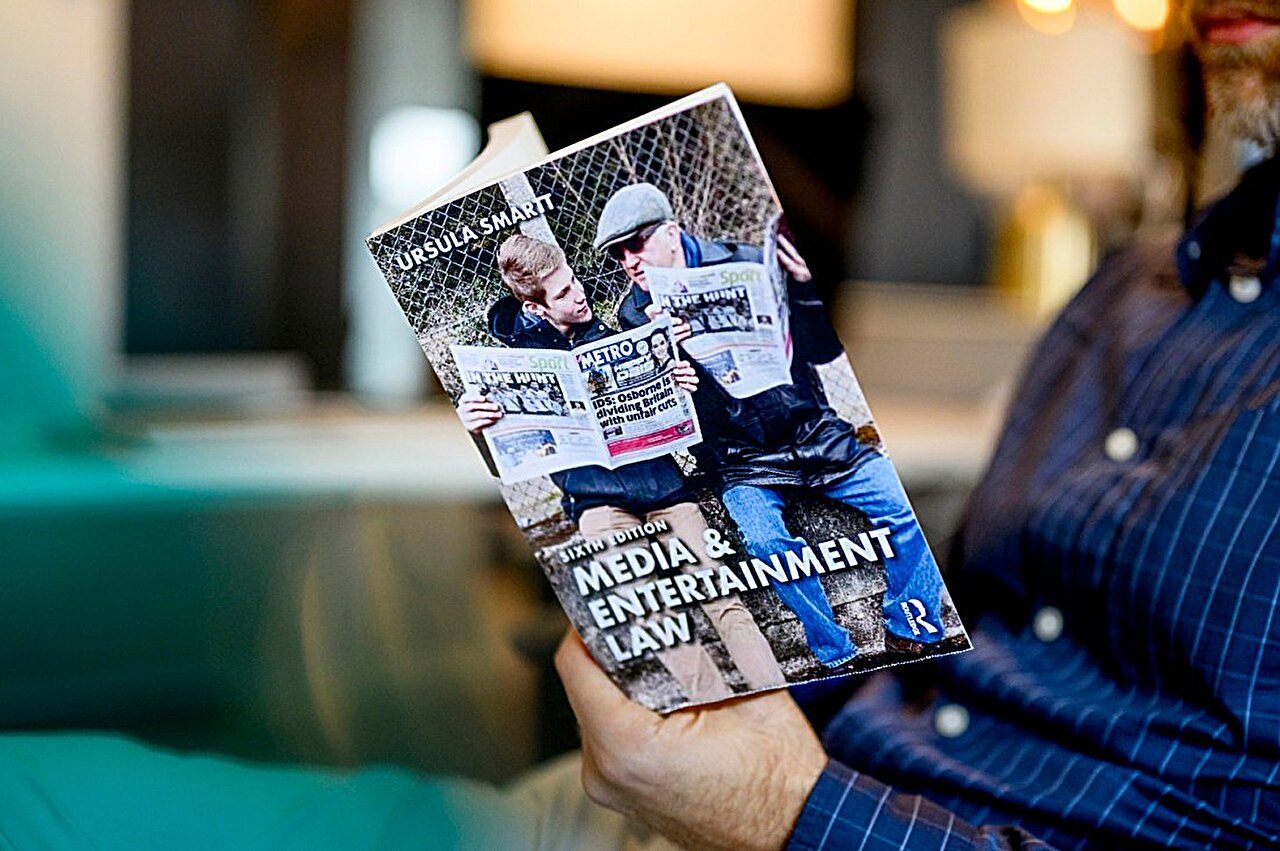

Ursula Smartt not only writes about media law but she acts like a journalist when she does it.


From scanning newspapers for new juicy court stories to include and pursue, to holding a wide array of sources close to her chest, this reporter-like activity is what fuels each new edition of her leading “Media and Entertainment Law” series.
Having just published the sixth edition of the textbook, the associate professor in law at Northeastern University in London says, with each two-to-three-year update, she is faced with the same fear about whether she will have enough to update its 700-odd pages.
But the fear is always unfounded, she finds. The way that the law is being tested and shaped by the likes of social media and the growing use of generative artificial intelligence means she has no problem pulling together new material. In fact, AI’s reach in society and in the law industry has grown so much in the past two years that its mention has been “woven into every chapter,” she remarks.
“Each time when the publishers start knocking on the door and say, ‘Hey, let’s do another edition,’ I always worry, “Have I got anything new?'” Smartt reveals.
“I work with the old edition, obviously, but then I collect new material all the time because, thankfully with the United Kingdom being a common law country, there will be case law—judge-made law—happening all the time.
“I cross-read all the newspapers and I look for stories and then I save them. And by the time I start writing the book, thank goodness, there is lots and lots of material—and interesting material too.”
As an experienced educator, Smartt has the added benefit of having former students working across the fields of law who offer her “tip-offs” of sensational cases or legal scandals to watch out for.
Baroness Helena Kennedy, one of Britain’s most prominent human rights lawyers, is full of praise for Smartt’s “comprehensive” and “widely respected” series. “Her texts,” writes Kennedy, “are highly regarded for their ability to balance theoretical analysis with practical application, providing a solid foundation for understanding the legal challenges that media and entertainment professionals face.”
Smartt has updated this latest edition, which will have an official launch on Dec. 4 at Northeastern’s Devon House, with everything from Prince Harry’s most recent privacy run-ins with Britain’s tabloid press, to artistic copyright fights pitting the likes of Dua Lipa and Paul McCartney against gen-AI developers.
It includes the details needed by every trainee reporter and aspiring media lawyer, such as explaining what contempt of court and defamation are, while also bringing in “much more United States’ law” than in previous versions to allow for a comparative contrast with U.K. legislation.
But there is one area in particular where Smartt has had a front row seat in her 14 years of publishing the “Media and Entertainment Law” series—attempts to regulate what happens on social media and in the communications industry.
“In my first two or three editions, the regulatory chapters were really thin,” she says. “But now the regulatory chapters are almost half of the book.”
Since Smartt’s last edition in 2023, it is in Europe where some of the biggest changes have come into force when it comes to controlling what happens on social media.
The U.K.’s Online Safety Act took effect in August and the European Union brought in the Digital Services Act last year.
Under the U.K.’s law, the sharing of AI-generated intimate images without consent has become illegal, websites containing potentially harmful content for children must introduce age verification methods and, once warned, platforms must take down offensive and harmful material or else face fines of up to 10% of annual net turnover.
Having watched it be put together step-by-step, Smartt, a former lay judge and prisons researcher, is not complimentary about the law’s scope, calling it “vast,” “huge” and “cumbersome.”
The EU’s law, which Smartt says has plenty of overlap with the U.K.’s regulatory move, is aimed at addressing illegal content, transparent advertising and disinformation, including in relation to e-commerce.
But policing the internet is close to an impossible task, Smartt argues. One of the main difficulties, she points out, is that lawmakers are attempting to control what is happening on servers outside their jurisdiction.
When it comes to a huge chunk of social media posts being held on U.S. servers and elsewhere, it is “often difficult-to-impossible to find the originator for indecent images or harmful and defamatory content.”
“Really, the question is, can you regulate the internet? And the short answer is no,” Smartt continues.
“There is now overregulation in Europe. All this legislation targets TikTok in China and social media platforms in the U.S. Are they really going to engage with this wealth of digital regulation in Europe? The answer is no.
“I think the Online Safety Act will not make much of a difference, and it might be one of those laws that is impossible to implement. We know that every 9-year-old knows about VPNs (a virtual private network) and that they will be able to circumvent the restrictions.”
Northeastern University
This story is republished courtesy of Northeastern Global News news.northeastern.edu.
Citation:
Can anyone really regulate the internet? (2025, October 15)
retrieved 15 October 2025
from https://techxplore.com/news/2025-10-internet.html
This document is subject to copyright. Apart from any fair dealing for the purpose of private study or research, no
part may be reproduced without the written permission. The content is provided for information purposes only.


