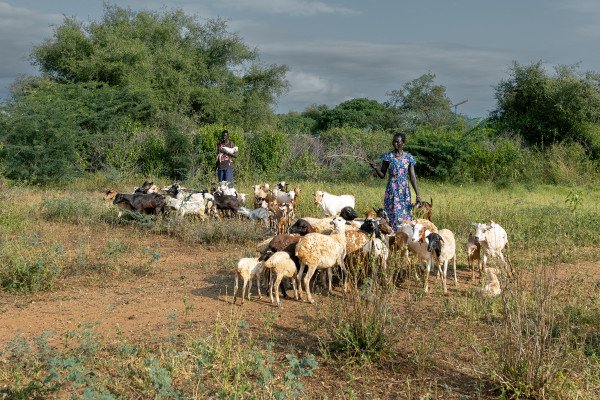
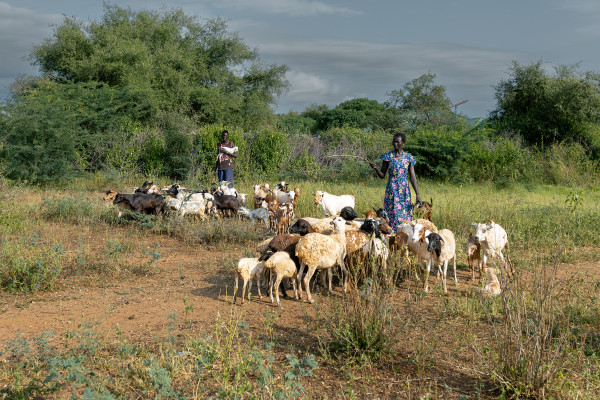
They supply an estimated 50% of Africa’s meat and 75% of its milk – yet Africa’s pastoralists remain largely invisible and misunderstood. A new documentary argues for a different way of seeing pastoralism: as resilient, adaptable, and central to the drylands’ future.
Filmed across remote parts of Kenya, Nigeria, and South Sudan, Charting new futures in Africa’s drylands interviews five pastoralist communities who are driving positive change: from a local NGO resolving farmer-herder conflicts, to pastoralist women who are turning climate shocks into new commercial opportunities.
Innovation in the Face of Adversity
The film directly challenges common myths about Africa’s pastoralists as tech averse, conflict-prone, and unable to cope with modern-day challenges. Instead, it spotlights their capacity for adaptation and innovation:
- South Sudan’s New Women-led Fishing Community: In Bor, South Sudan, widespread seasonal flooding is devastating traditional grazing land. The Dinka pastoralists haven’t retreated – they’ve pivoted. They are now transforming the floods into a lucrative fishing economy, with fish being transported as far as Uganda and the Democratic Republic of Congo. “Now at the riverside, the number of women is higher than the men. Many of them don’t have husbands: they are the men and they are the women in their lives,” notes Awur Thon Jok, a fishmonger.
- Nigeria’s NGO Resolving Farmer-Herder Conflicts: Nigerian pastoralist NGO the Fulbe Development and Cultural Organization (FUDECO) is helping Fulani pastoralist families access formal justice in the aftermath of farmer-herder conflicts. Their work is successfully bringing killers to court, and shows the role pastoralists can play in finding alternatives to tit-for-tat violence in farmer-herder conflict.
- Microchipping and Meat Traceability: Online livestock platform Livestock247 is working with pastoralists to create digital records for cattle, ensuring that meat is traceable and health-certified. The microchip tech – which was developed to be compatible with Fulani livestock customs – is generating new insights on meat traceability, and helping pastoralists access better prices for their animals.
Critical but Under-supported
According to Guy Jobbins, Executive Director of SPARC and co-producer of the documentary, these stories are the rule, not the exception:
“We should not be surprised that pastoralists are driving positive development. They are experts at navigating change. The real issue is that for decades, pastoralists frequently have been marginalised or subjected to interventions that actually ended up undermining their resilience.”
One example is the installation of boreholes in Oropoi village, Turkana. In the drylands, installing permanent water supplies sounds like a commonsensical solution to water scarcity – but many boreholes in Oropoi have ended up being abandoned as a result of poor placement or planning.
According to Sammy Ekal, executive director of the Turkana Pastoralists Development Organization (TUPADO), a lack of consultation was one of the key problems in places where boreholes were abandoned: “It’s very important to have these pastoralists involved in decision making here, because it affects them on a daily basis. A stakeholder will come, and make a decision that does not support people in this area.”
2026: A Pivotal Year for Policy Change
The United Nations’ declaration of 2026 as the International Year of Rangelands and Pastoralists (IYRP) provides a critical opportunity to reset the policy agenda.
Policymakers are being urged to realise the importance of rangelands and pastoralists for their role in restoring degraded lands, fostering sustainable food systems, advancing climate action and more.
Guy Jobbins commented:
“IYRP 2026 is a rare opportunity to shine a light on these regions, break down the myths about pastoralism, and truly champion the agency, knowledge, and resilience of people living in Africa’s drylands.” If there is one message from Charting new futures, it is that “Pastoralists do not need ‘saving’, but they do need to be part of the changes happening across the drylands.”
To explore these stories and insights further, listen to the companion podcast and documentary, which spotlight the realities, challenges, and innovations shaping the future of pastoralism in Africa.
Podcast: Dynamic Drylands (https://apo-opa.co/3KS9rlh)
Documentary: Charting new futures in Africa’s drylands (https://apo-opa.co/4qhqVYA)
Distributed by APO Group on behalf of Supporting Pastoralism and Agriculture in Recurrent and Protracted Crises (SPARC).
Images: https://apo-opa.co/3KKfOXX
For further information, interviews and to join the event mailing list please contact:
Marina Forsythe
marina@m2elevate.uk
Charlotte King
c.king@odi.org
About SPARC:
Since 2020, research from the Supporting Pastoralism and Agriculture in Recurrent and Protracted Crises (SPARC) programme has driven a significant shift in how international donors, governments, and the aid sector approach development in the drylands of Africa and the Middle East. By actively filling critical evidence gaps on the effectiveness of existing aid programmes and policies, SPARC is ensuring that investments more effectively and cost-efficiently build the long-term resilience of dryland communities facing recurrent crises.
SPARC is delivered by a consortium of organisations: Cowater International, the International Livestock Research Institute (ILRI), Mercy Corps and ODI Global. It is funded by UK aid from the UK government, and with the aid of a grant from the International Development Research Centre, Ottawa, Canada.
The views expressed herein do not necessarily represent those of SPARC, IDRC or its Board of Governors, or the official policies of the Canadian or UK governments.