

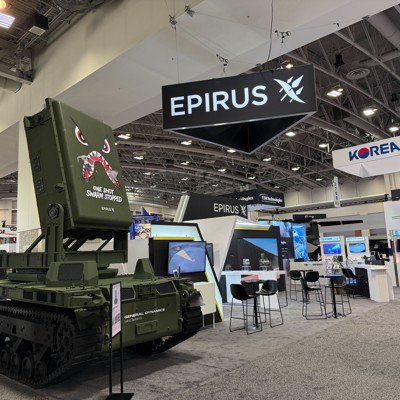
The defense industry must produce counterdrone technology quickly—and in high numbers—to stay ahead of a potential drone threat. But delicate supply chains can make it harder for some companies to meet demand—even if their tech meets the Army’s needs.
“I have a lot of niche capabilities that are out there, but we may be challenged in scaling from an industrial perspective,” Col. Marc Pelini, who leads the Army’s air and missile defense cross-functional team, said during a counterdrone panel at the Association of the U.S. Army’s annual conference Monday.


“If you look at some of the open source reporting on what’s been going on in Ukraine and Russia the last few months—I think this figure I saw, in August, the Russians used up to 30,000 first person view drones. So, the scale is absolutely one of the most critical elements, which gets to some of the other comments about being able to try multiple different approaches to be able to attack it from different vectors,” said Brig. Gen. Glenn Henke, commandant for U.S. Army Air Defense Artillery and deputy commanding officer for Fort Sill’s Fires Center of Excellence.
Eprius, which makes a series of high-powered microwave non-kinetic weapons, is acutely aware of how hard high-output production is, especially with supply chain constraints around high-powered amplifiers. But Andy Lowery, Epirus’ CEO, wants to be ready once the Army and other government customers decide on a program of record for counterdrone tech.
“Primarily this year has been about a year preparing to scale,” he said. “That is a major problem for us.”
The company, which has a manufacturing plant in Torrance, Calif., wants to expand capacity with a new facility that Lowery hopes to announce a final location for in the summer of 2026. But in the nearterm, Epirus is leaning on its partnership with General Dynamics to double production ability.
“We’ve got seven systems in progress right now. But if 70 were to be the ask? One of our systems has 148,000 parts in it—15,000 are build-to-print, 135,000 are commercial-off-the-shelf. It is not easy to swing from seven to 70,” Lowery previously told Defense One.
The details aren’t completely ironed out, but the goal is to have General Dynamics, which Epirus teamed up with for a manned and unmanned version of its high-powered microwave, do a lot of the metal work.
“As a manufacturing prime, we have substantial capacity to produce and ramp up at scale manufacturing of new equipment. Early on, our partnership with Epirus was far more just in the lines of ‘Hey, they had a powerful capability that they thought would integrate onto our Stryker,’”
G. Scott Taylor, who leads business development for General Dynamics Land Systems, told Defense One. “We would build a lot of the framework around it, and they would continue and focus on building the [line replaceable amplifier modules] themselves.”
If successful, Lowery hopes to replicate the model regionally, letting prime defense contractors do the “heavy lifting” more locally.
Established defense contractors partnering with newer companies isn’t new, but could become increasingly necessary as the Pentagon encourages more contracts with non-traditional companies that may not have the experience or capacity to make high quantities of what the military needs.
“If you didn’t already have the factory, a lot of these guys are saying, ‘Why do I want to build my own factory…So we step in at times,” even for larger companies like Boeing or Viasat, when “there’s synergy with our product line or with our customer base,” said Mike Sheehan, president and CEO for Thales Defense & Security, Inc. and security.
Besides doing metalwork, bigger contractors can shoulder some of the certification requirements, like auditable accounting systems.
“One sort of ironic thing about your traditional defense companies, and then your non-traditional defense companies: traditional defense contractors need to be certified. [Your] cost accounting system needs to be certified; you get audited regularly. DCMA, DCAA, they monitor your rates. They limit how much profit you can make on fixed-price jobs and all that. And it’s a tremendous amount of work and overhead on both the government side and industry side to keep that going.”


