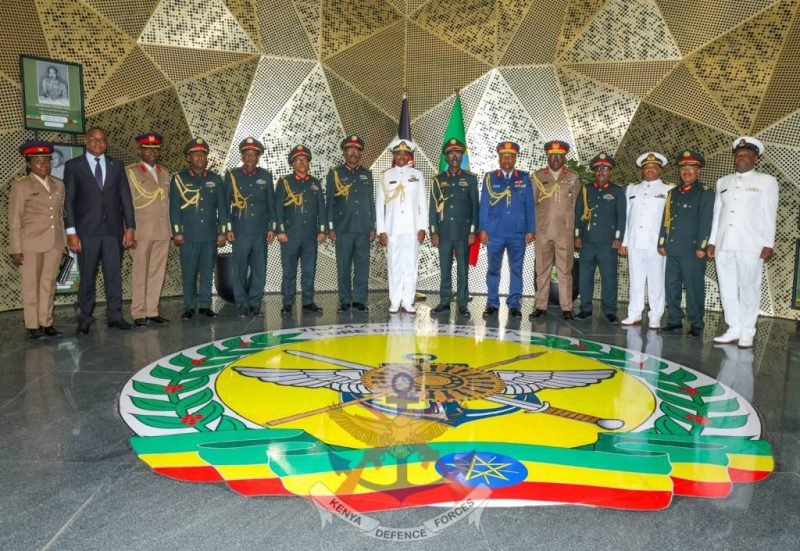
Addis Ababa’s Ministry of Defence headquarters served as the stage for a pivotal moment in East African security on September 24, 2025, when Kenya’s Chief of the Defence Forces, General Charles Kahariri, and his Ethiopian counterpart, Field Marshal Birhanu Jula, put pen to paper on a renewed Defence Cooperation Agreement.
This pact, the second of its kind in over six decades since the original in 1963, lays out a blueprint for joint military efforts along their 861-kilometre shared border, a frontier that has long tested the resolve of both nations. In a region plagued by porous boundaries and spillover conflicts, the agreement promises streamlined intelligence exchanges, synchronised training regimens, and boosted operational compatibility, all aimed at countering threats that neither country can tackle alone.
The document emerges against a backdrop of escalating cross-border frictions, where smuggling rings ferry arms, narcotics, and migrants through the arid badlands of northern Kenya and southern Ethiopia. Ethiopian authorities have flagged routes used by human traffickers exploiting drought-displaced herders, while Kenyan patrols grapple with al-Shabaab incursions from Somalia that occasionally bleed into Ethiopian territory. Jula, in his post-signing address, framed the deal as a natural extension of ties forged by geography and history; “It reflects our longstanding relationship, rooted in shared borders, history, and common challenges,” he stated, adding that the collaboration would foster not just bilateral peace but broader stability across the Horn of Africa.
Kahariri echoed this sentiment with a nod to continental autonomy: “This is a clear expression of African self-reliance; mastering our collective fate through cooperation, ingenuity, and shared action.” His words carried weight in a week dominated by defence dialogues, underscoring Kenya’s dual-track approach of bilateral pacts and multilateral frameworks.
Just days earlier, from September 22 to 24, experts from the East African Community’s eight member states convened in Arusha, Tanzania, for the Multi-Agency Experts Working Group on the Mutual Defence Pact. This gathering zeroed in on polishing the final draft of the EAC’s MDP, a treaty designed to bind the bloc in collective security obligations. Kenyan Brigadier S.M. Huria, representing Nairobi at the talks, described the pact as more than legalese; “It will not only be a legal agreement but a symbol of solidarity and shared commitment. By working together, we strengthen our collective defence capabilities, deter potential aggression, and foster a culture grounded in peace, cooperation, and mutual respect.” The MDP envisions rapid-response mechanisms for border incursions or internal threats, drawing lessons from past EAC interventions like the joint operations against the Lord’s Resistance Army in the Democratic Republic of Congo.
Arusha’s sessions highlighted the interconnected perils facing the community, from Islamist militants probing Kenya’s coast to ethnic clashes in Ethiopia’s Oromia region that displace communities toward the border. The EAC, expanded to include Somalia and South Sudan since 2016, now spans a patchwork of terrains where security vacuums invite exploitation. Delegates dissected scenarios like coordinated patrols to stem arms flows from Yemen via the Red Sea, or shared satellite feeds to track vehicle movements in the Chalbi Desert. Huria’s delegation pushed for interoperability standards, such as unified radio protocols and cross-compatible logistics, to ensure that a Kenyan mechanised unit could seamlessly link with Ethiopian infantry during a crisis.
Back in Addis, the Kenya-Ethiopia accord operationalises these ideals on a bilateral scale. Intelligence sharing takes center stage, with protocols for real-time alerts on suspect movements; think encrypted channels relaying drone footage of a convoy crossing the Dolo-Adi corridor, allowing preemptive interdictions. Joint exercises, slated for biannual runs starting next year, will simulate scenarios like hostage rescues in the Turkana Basin or anti-poaching sweeps along the Omo River. These drills build on existing ties, including the 2023 Lamu-Kenya-Ethiopia maritime exercise that tested naval coordination against piracy threats. Interoperability extends to equipment; both forces, reliant on a mix of Soviet-era holdovers and Western donations, will harmonise tactics for assets like Kenya’s PzH 2000 howitzers alongside Ethiopia’s ageing T-72 tanks.
The border itself demands such pragmatism. Stretching from the tripoint with South Sudan to Lake Turkana’s shores, it bisects nomadic grazing lands where Kenyan Borana and Ethiopian Gabra clans navigate water disputes amid climate strains. Recent flare-ups, including a May 2025 skirmish over livestock theft that left 12 dead, exposed gaps in communication; herders armed with AK-47s clashed before national troops intervened. Broader threats loom larger: al-Shabaab’s 2024 raids on Kenyan villages drew Ethiopian air support, while Ethiopian forces have pursued Oromo Liberation Front splinter cells into Kenyan territory. Smugglers exploit the flux, routing khat, ivory, and small arms through ungoverned wadis, fueling urban gangs in Nairobi and Dire Dawa alike. The pact’s rapid-response clauses could deploy mixed platoons within hours, backed by EAC observers to prevent escalations.
Historical context adds depth to the signing. The first DCA, inked in 1963 shortly after both nations’ independence, focused on anti-colonial solidarity but faded amid Cold War alignments; Kenya leaned West, Ethiopia East until the 1991 Derg fall. Revived ties since 2018, under Ethiopian Prime Minister Abiy Ahmed’s outreach, have yielded economic wins like the LAPSSET corridor linking Lamu port to Addis. Defence follows suit, with joint anti-terror ops in Somalia’s Jubaland yielding tactical intel that thwarted a 2024 Nairobi plot. Kahariri’s emphasis on “innovation and resilient infrastructure” hints at tech infusions; expect Ethiopian cyber units training Kenyan signals corps on jamming drone signals, or shared R&D for border sensors resilient to sandstorms.
For Ethiopia, the agreement bolsters a military stretched by Tigray’s aftermath and Amhara unrest; Jula’s forces, numbering over 150,000, seek partners to free resources for internal stabilisation. Kenya, with its 24,000-strong force honed in Somalia’s AMISOM, gains a northern flank ally amid fiscal pressures that cap equipment upgrades. Regionally, it feeds into the EAC MDP’s momentum; once ratified, the pact could invoke Article 5-like mutual aid, deterring adventurism from external actors like Eritrea’s border games.