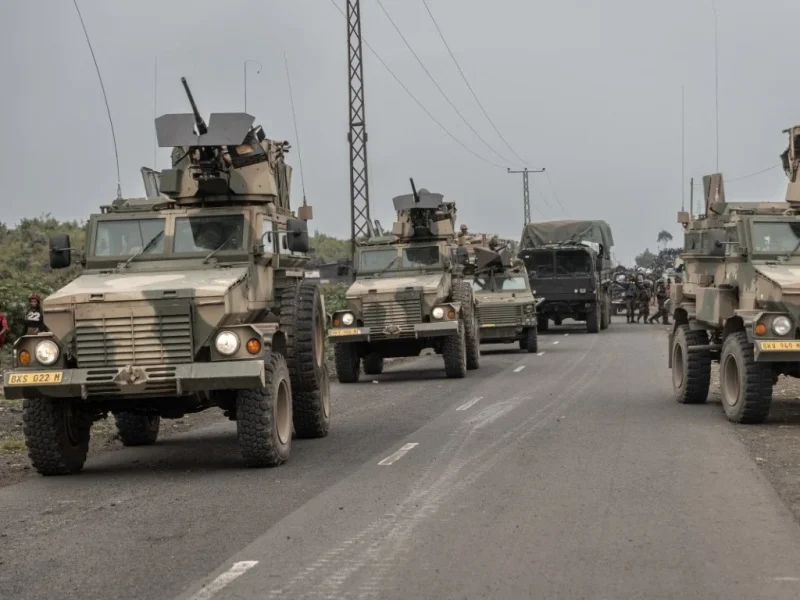
South Africa’s defense acquisition process took a concrete step forward last week when state-owned Armscor revealed it has selected a preferred supplier for a fleet of armored personnel carriers aimed at bolstering the South African National Defence Force’s border security operations.
According to DefenceWeb, this development, confirmed by Armscor’s corporate communications lead Liziwe Nkonyana, comes after more than a year of evaluations and adjustments to meet the army’s practical needs along its extensive frontiers. With financial approval pending from the South African Army, the contract could soon unlock deliveries of up to 500 vehicles, marking a vital upgrade for troops tasked with stemming illegal crossings, smuggling, and incursions in remote areas.
The tender, labelled ELWS/2024/71, targets a mix of configurations to support diverse missions: 210 section vehicles for standard patrols, 144 command posts for oversight, and 108 ambulances for medical evacuations. Each must handle a gross vehicle mass of 13.5 tons while carrying at least 1.5 tons of payload, including personnel, gear, and supplies. Protection standards demand NATO STANAG Level 1 ballistic resistance against 7.62x51mm and 5.56mm rounds from all angles, paired with Level 2 mine defence capable of surviving a 6 kg blast beneath the hull. These thresholds reflect the low-to-medium threat environment of South Africa’s borders, where small arms fire and improvised explosives pose the primary risks, rather than heavy combat scenarios.
Initial bids closed on August 23, 2024, with hopes of first deliveries by March 15, 2025, but the timeline stretched due to iterative refinements. Early specifications drew heavily from the Badger infantry combat vehicle requirements, which proved overly ambitious for patrol duties; Armscor dialed back the combat weight to better suit lighter, more agile platforms. Bid validity periods were extended repeatedly, the latest push on June 17, 2025, running through September 30 to allow for thorough reviews. Industry watchers like consultant James Kerr estimate that even after the award, the first 60 units might take a year to roll out, with the balance trailing over three more years, factoring in production ramps and testing.
This procurement replaces a stopgap fleet of over 400 Toyota Land Cruisers procured years ago as basic troop carriers, which lack the armour needed for sustained exposure to threats. The National Treasury earmarked R500 million in the 2024/25 budget to fund this shift, underscoring the priority placed on securing borders that span 4,800 kilometres, from the arid Namibian frontier to the Kruger Park’s elephant trails and the Indian Ocean coast. These vehicles will enable the army’s border units to maintain a persistent presence without relying on unarmored pickups, which have left soldiers vulnerable during ambushes or breakdowns in hostile terrain.
The selection process kicked off with a January 2023 Request for Information that drew responses from seven local firms: DCD Protected Mobility, Denel, OTT Solutions, Paramount Group, Automotive Investment Holdings in partnership with Integrated Convoy Protection, and SVI Engineering. Plans for field trials along the border in late 2023 and demos at the army’s Vuk’uhlome exercise fell through, shifting focus to desktop assessments and revised tenders. Among the contenders, DCD Protected Mobility stands out with its Springbuck family, offering variants tailored to the bid’s demands. The Springbuck SD, the lightest at 9 tons with a 1.5-ton payload, runs on a 6.45-litre MWM turbo diesel pumping out 194 horsepower for off-road prowess; it can ford 850 mm trenches, scale 400 mm steps, and tackle 40% side slopes, ideal for the rocky outcrops and sandy drifts of the Limpopo border. The heavier Springbuck HD seats a driver plus ten troops under B6 ballistic protection, while the Multi-Platform version integrates command-and-control suites from partner GC2T for real-time coordination. DCD even floated the veteran Husky mine-clearer, though its bulk might push payload limits.
OTT Solutions brings the Puma M36 Mk6 4×4, a V-hulled workhorse evolved from earlier mine-resistant designs. Powered by a 7.2-litre Mercedes-Benz OM 926 LA turbo-intercooled diesel yielding 205 kW and 1,200 Nm of torque through an Allison automatic transmission, it hauls ten personnel at speeds over 100 km/h on highways while maintaining stability in bushveld pursuits. Its modular armour kits allow quick swaps for ambulance or command roles, and the independent suspension smooths rides over the potholed tracks common along the Mozambique line. Paramount Group’s Maatla, a fresh 4×4 lightweight protected vehicle, emphasises reconfiguration with “Smart Floor” tech for rapid mission swaps; at under 10 tons, it cruises 600 km at 80 km/h, fords 750 mm of water, and shields against the specified calibres without sacrificing agility for patrols in flood-prone areas like the Pongola River valley.
Integrated Convoy Protection’s Reva V, teamed with Automotive Investment Holdings, traces its roots to combat-proven South African designs from the border wars era. This 16-ton beast, with a 3.5-ton payload, features a double-layered steel monocoque hull that disperses blasts effectively; it accommodates ten troops firing outward from protected ports and has logged service in multiple African theatres. SVI Engineering’s Max 3, built on the Toyota Land Cruiser 79 chassis, prioritises affordability and familiarity; its 4.5-litre V8 turbodiesel delivers 151 kW and tops 140 km/h, with bolt-on armour for quick field repairs and seating for eight in riot-control configs, though the border variant tunes for patrol endurance. Twiga opted out with its Nyati APC, judging the platform’s heavier specs better for infantry assaults than routine surveillance. Milkor’s unnamed 4×4 rounds out the field, focusing on cost-effective mine resistance.
Denel’s involvement adds intrigue, given its restructuring woes, but details on its offering remain sparse amid the firm’s pivot toward exports. The preferred bidder’s identity stays under wraps until the army greenlights the financials, a step Nkonyana pegged as imminent. Once approved, production could leverage South Africa’s mature defense industrial base, fostering jobs in Gauteng’s workshops and injecting local content into the supply chain.
This border APC push aligns with broader army modernisation, including a parallel tender for specialised 6×6 vehicles to equip the Special Forces Brigade. Issued earlier in 2024 as EWSD/2024/18, it calls for modified Toyota Land Cruiser single-cabs extended to six wheels for enhanced load-bearing in deep-penetration raids. SVI’s Max 9 and Armormax’s TAC-6 emerge as frontrunners; the former adapts the Max 3’s proven chassis with wider rear tracks for stability, while the TAC-6, already pitched to French elites, boasts independent suspension and a 5-ton payload for mounting heavy weapons or sensor arrays. These platforms promise to extend the Special Forces’ reach into high-threat zones, complementing the border fleet’s defensive role.
Delays in such programs are par for the course in South Africa’s fiscal climate, where competing priorities like personnel pay and maintenance siphon funds. Yet the border APC acquisition addresses a pressing gap: the SANDF’s ground forces have dwindled to under 40,000 effectives, stretched thin across nine provinces and multinational duties in Mozambique and the DRC. Armoured patrols will free up infantry for training, reduce casualty risks, and deter cross-border crime syndicates that fuel regional instability.
As the financial nod arrives, expect the winner to announce production milestones, perhaps at next year’s Africa Aerospace and Defence show. For now, the army eyes these vehicles as more than metal; they represent a recommitment to sovereignty over vast, vulnerable edges, where every reinforced hull could tip the balance against unseen threats in the veld.