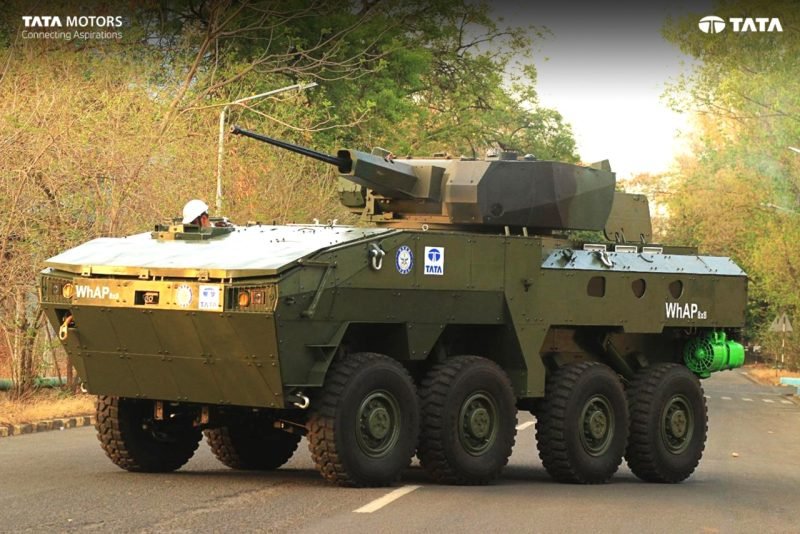
On September 23, 2025, the industrial zone of Berrechid, just outside Casablanca, India’s Tata Advanced Systems Limited (TASL) inaugurated its first overseas defense manufacturing facility.
The event, attended by India’s Defence Minister Rajnath Singh and Morocco’s Defence Minister Abdelatif Loudyi, marked the start of local production for the company’s 8×8 Wheeled Armoured Platform (WhAP), a versatile infantry vehicle designed for modern battlefields. This plant, branded Tata Advanced Systems Maroc (TASM), represents more than a factory opening; it signals Morocco’s push toward self-reliance in defense production and India’s strategic expansion into African markets. As global tensions rise—from Sahel insurgencies to Red Sea disruptions—such partnerships offer both nations a foothold in a continent where security demands outpace supply chains.
The agreement paving the way for TASM dates to September 30, 2024, when TASL and Moroccan counterparts inked a deal for WhAP assembly tailored to the Royal Moroccan Armed Forces (FAR). While exact numbers remain unconfirmed officially, defense officials cited by India’s Business Standard in 2024 estimated 150 units over three years, a figure that aligns with Morocco’s modernization drive. The facility, nestled in Berrechid’s expanding industrial park, begins with 35 percent local content—sourced from Moroccan steel, electronics, and composites—rising to 50 percent as supply chains mature. This localization not only cuts import costs but also seeds a broader defense ecosystem, potentially exporting to neighbors like Algeria or Tunisia. For TASL, the 10,000-square-meter site employs 200 initially, blending Indian engineering with Moroccan labor to produce vehicles suited for desert patrols and urban ops.
The WhAP, formerly known as the Kestrel, embodies this fusion of innovation and practicality. Co-developed with India’s Defence Research and Development Organisation (DRDO), it serves the Indian Army as the Infantry Protected Mobility Vehicle (IPMV), a role that extends to the paramilitary Central Reserve Police Force for internal security. Measuring 8 meters long with an 8×8 wheel configuration, the WhAP weighs 25 tons and reaches 100 kilometers per hour on roads, powered by a 550-horsepower diesel engine compliant with Euro 4 emissions. Its V-shaped hull deflects blasts from mines up to 10 kilograms of TNT, while STANAG 4569 Level 4 armor withstands 14.5mm rounds. The vehicle carries 12 troops plus a crew of three, with a central tire inflation system for sand traversal and amphibious kits for shallow fords. Modular turrets accommodate 30mm cannons, anti-tank missiles like the Nag, or remote weapon stations, making it adaptable for reconnaissance or fire support. In Indian service since 2021, over 100 units have logged thousands of kilometers in Rajasthan’s Thar Desert, proving reliability in high-heat, low-maintenance conditions.
Morocco’s embrace of the WhAP fits a deliberate strategy to diversify suppliers and build domestic capacity. Historically reliant on U.S. systems like the M1 Abrams tank or French Mirage jets, Rabat seeks alternatives amid geopolitical shifts; U.S. export delays in 2024, tied to Israel aid debates, prompted a pivot eastward. The FAR, numbering 200,000 active personnel, equips its mechanized brigades with aging French AMX-10s and Spanish Pegaso trucks, but modernization calls for 300 new armored vehicles by 2030, per a 2025 Jane’s report. TASM addresses this, with initial output slated for FAR’s southern commands facing Sahrawi threats. Beyond military use, the platform’s civilian variants—armored personnel carriers for police—align with Morocco’s internal security needs amid migrant flows and urban unrest.
This venture builds on prior ties. In December 2022, the Royal Moroccan Army took delivery of 92 Tata Light Specialist Pattern Trucks (LPTA), including 6×6 multi-axle models for heavy logistics and lighter 4×4 variants for rapid deployment. Shipped from Gujarat’s Pipavav port, these vehicles replaced Soviet-era relics, bolstering supply chains for exercises like African Lion. The LPTA’s 7.5-ton payload and all-terrain tires suited Morocco’s varied terrain, from Atlas Mountains to Sahara dunes, earning praise for durability in 2024 joint ops with the U.S. Marine Corps. TASM extends this success, transitioning from imports to co-production and positioning Morocco as a North African hub for Indo-African ventures.
For India, the Moroccan outpost advances a multifaceted Africa strategy. New Delhi’s defense exports hit $2.6 billion in 2024-25, up 78 percent year-over-year, with Africa claiming 20 percent via deals in drones, artillery, and small arms. The India-Africa Defence Dialogue, relaunched in 2025, facilitates training for 5,000 African officers annually, while exercises like the 2025 IBSAMAR with South Africa and Brazil emphasize maritime security. Morocco fits perfectly; its Mediterranean gateway complements India’s Indian Ocean focus, opening doors to EU markets. Recent trends show India’s pivot from buyer to builder; the 2025 Defence Production Policy targets $25 billion in exports by 2025, leveraging DRDO’s modular designs for customization. In Africa, this manifests in Kenya’s 2024 BrahMos missile purchase and Nigeria’s Akash air defense talks, but TASM breaks new ground as the first full Indian defense plant on the continent.
The Berrechid facility embodies this ambition. Spanning advanced welding bays, composite molding lines, and AI-assisted quality control, it produces chassis and hulls locally while importing engines from Cummins India. Initial runs focus on FAR-spec WhAPs with desert camouflage and sand filters, but export potential looms; Algeria’s interest in similar platforms for border security could yield follow-on orders. Local content ramps up through partnerships with Moroccan firms like SAMIR for steel and universities in Rabat for R&D on hybrid propulsion. This ecosystem fosters jobs—projected 1,000 by 2028—and technology transfer, aligning with Morocco’s 2025 Industrial Acceleration Plan, which allocates $10 billion to defense manufacturing.
Real-world examples illustrate the WhAP’s edge. In India’s 2024 Ladakh standoff with China, IPMV variants ferried troops over high-altitude passes, their independent suspension conquering 40-degree slopes where rivals bogged down. For Morocco, akin capabilities suit Western Sahara patrols, where FAR convoys face Polisario ambushes. The vehicle’s central drive shaft and portal axles enable 0.7-meter ground clearance, ideal for rocky escarpments, while run-flat tires sustain mobility post-hit. Armament options, including the 12.7mm NSV machine gun or Spike-LR missiles, provide standoff punch against light armor.
Broader Indo-African trends in 2025 amplify TASM’s role. India’s $5 billion line of credit for African infrastructure includes defense offsets. Morocco, hosting the 2025 Africa-India Forum, leverages TASM to attract investors. TASM’s launch coincides with heightened regional stakes. Morocco’s 2025 military budget rose 12 percent to $5.2 billion, funding 36 F-16 Block 72s and MQ-9 Reapers amid Algeria rivalry. India’s exports, now 75 percent indigenous, position TASL as a bridge; the WhAP’s DRDO roots ensure tech sovereignty, with Morocco gaining assembly know-how for future variants like mine-protected editions.
India has been working diligently to increase its presence in the arms trade and compete with powerhouse nations like Russia and China. This ambition has seen India focus its efforts on selling its domestically produced weapons to African militaries, which are often unable to afford Western-made equipment. India has already had some success in this sector and is now looking to build upon this as it hopes to become a major player in African arms deals.
India is hoping to capitalise on its growing presence in Africa to not only sell more of its domestically produced hardware but also to gain access to new markets and further strengthen its global presence. India has already made strong inroads into the African arms market and is confident that, with the right strategies in place, it can become a major player in the sector and compete with Russia and China for arms deals.
India’s arms sales to Africa have increased in recent years, as India has been looking to expand its influence on the continent. India’s arms exports to Africa have primarily been focused on small arms, ammunition, and other military equipment. However, India has also been able to secure some significant contracts for the sale of larger weapons systems, including naval vessels and aircraft.
As production ramps, TASM promises mutual benefits. Morocco gains autonomy, reducing U.S. dependence—its top supplier at 40 percent of imports—while India secures a North African base, eyeing exports to Tunisia or Libya. Joint ventures could spawn WhAP derivatives for peacekeeping, aligning with UN missions where Indian and Moroccan troops serve side-by-side in Congo. In a world of supply shocks, this facility exemplifies resilient partnerships, turning Berrechid’s assembly lines into engines of strategic depth.