The more than 40 million acres of state trust lands across the West include agricultural fields and natural recreation areas, mines and wind farms, tidal flats and forests. Under federal rules originally established more than two centuries ago, states are required to use these lands — some of them inside tribal reservations — to generate revenue for their beneficiaries, primarily public schools. At the same time, state constitutions often specify that they’re also held in trust for the public, and conservation groups argue that restoration and climate mitigation provide more long-term benefits to more people than timber sales do. Once again, the environment is pitted against the economy.
In late August, Washington Commissioner of Public Lands Dave Upthegrove shifted the balance a little more toward conservation: He announced that the state would conserve 77,000 additional acres of its 2.4 million acres of trust-held forest lands, including 10,300 acres of its most mature forests. Any lost timber income, he said, would be replaced with other strategies, including the sale of carbon credits and the purchase of private timber lands at risk of conversion to non-forested uses.
The announcement has been met with mixed reactions from the public, environmental groups, timber interests and local officials. “Everyone is rightfully advocating for their interests,” Upthegrove told High Country News. “My job is to try to figure out within that: What is the ‘public interest’?”
About half of Washington’s trust-held forest lands are already conserved, while the other half consists of working forests with commercially harvested timber. The state’s 1997 Habitat Conservation Plan requires that 10 to 15% of its state trust lands with harvestable timber be set aside as habitat for endangered species, such as the spotted owl and the marbled murrelet. Under current conservation measures, Upthegrove estimates, it will be decades before the state fully meets this goal.


Upthegrove ran for election last year on a promise to protect more old forests. But before the state could do anything else, it needed to find out how much ecologically mature forest it oversees and exactly where it is located. When Upthegrove took office Jan. 15, he ordered a six-month pause on trust land timber sales to allow time for a survey.


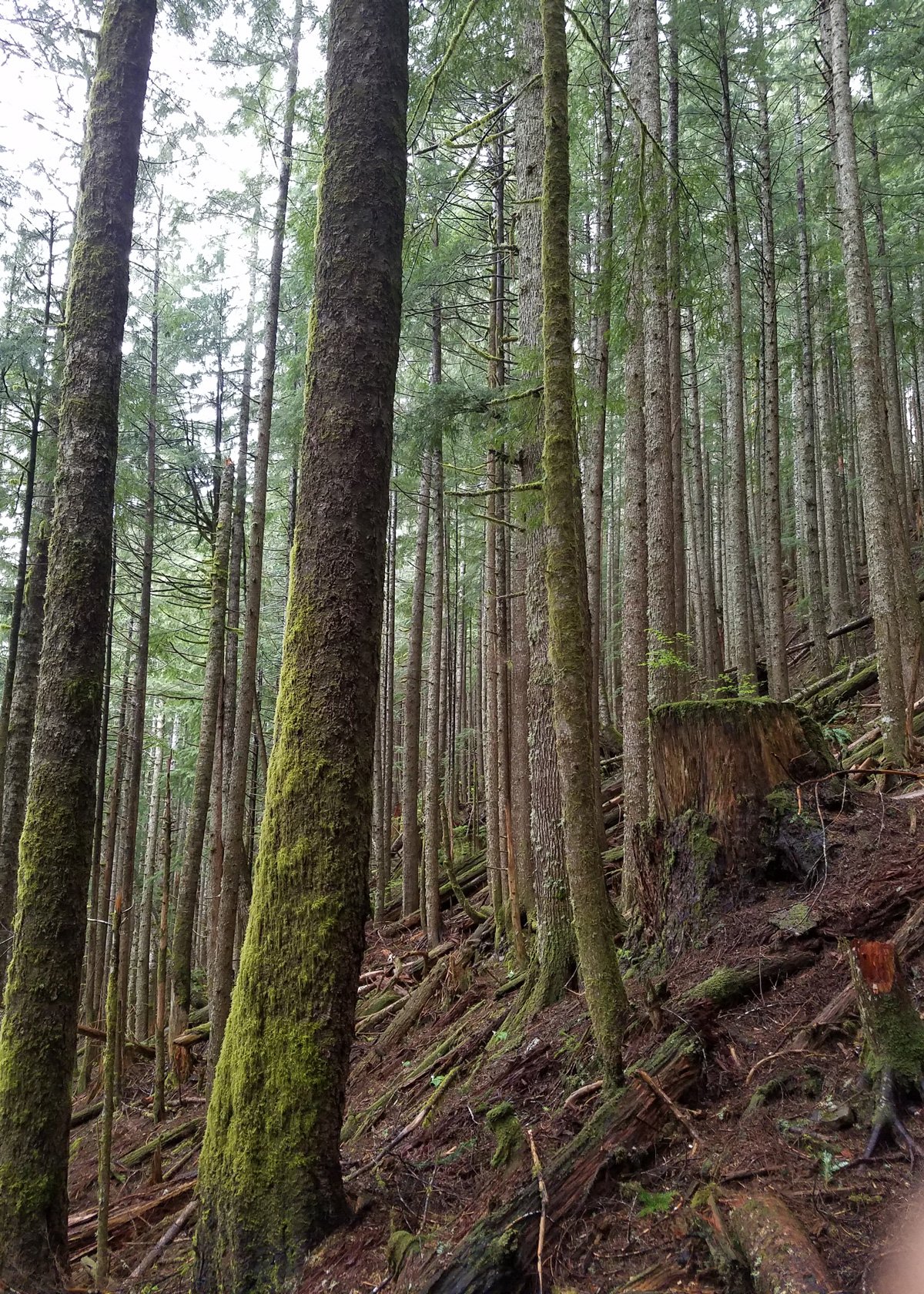
State scientists used field observations and computer modeling to identify the lands that were most likely to host mature, structurally complex forests. These are older stands, ranging from about 80 to 150 years old, that don’t qualify as old-growth forests but host a diversity of tree sizes and types as well as a dense, healthy understory. “Walking in a structurally complex forest, you just get that warm, fuzzy, green, mossy feeling,” said Daniel Donato, a forest ecologist with the Washington Department of Natural Resources.
Structurally complex forests host at-risk species like spotted owls, marbled murrelets, salmon and salamanders. They’re more resistant to fire, drought and disease and are one of the most important stores of carbon in western Washington, Donato said.
Using the map produced by Donato and his colleagues, Upthegrove and other Department of Natural Resources officials chose stands for potential conservation, most of them located on the Olympic Peninsula and in western Washington. Initial reports called the decisions final, but Upthegrove clarified that the new map was just a starting point, calling it a “preliminary illustration.”
“This is a scale of action and change toward prioritizing ecological values on state lands that we haven’t seen in decades.”
“We’re going to be cleaning the data and refining the maps based on more specific criteria, including trying to get more contiguous parcels,” he said. “That work is underway.”
Washington Conservation Action, an advocacy group, applauded Upthegrove’s announcement. “Conserving 77,000 acres is huge,” said forest program director Rachel Baker. “This is a scale of action and change toward prioritizing ecological values on state lands that we haven’t seen in decades.”
Other environmental activists were disappointed with the locations proposed for conservation, as well as with the fact that 19 of the 23 timber sales paused in January will now move forward. “We didn’t see any of the most at-risk areas prioritized,” said Joshua Wright, programs director at the Legacy Forest Defense Coalition. He’d like to see more protection in areas with few older forests, such as southwestern Washington.
Meanwhile, forestry advocates and some school-district officials argued that the proposed protections would harm local economies, particularly rural ones.

“Taking 77,000 acres off of harvestable acres would be a significant hit to the trust, to our industry, to rural communities and to the beneficiaries in terms of revenue,” said Heath Heikkila, director of government affairs for the American Forest Resources Council. The organization estimated that the plan would deprive trust beneficiaries of $300 million, a claim the Department of Natural Resources rejected.
The department said that 29,000 acres of structurally complex forest will remain available for harvest and that trust beneficiaries will not lose any revenue for at least five years, giving the department time to pursue other moneymaking strategies and purchase replacement forests.
Upthegrove emphasized that timber revenues generate only 1.5% of the total state school construction budget. The way schools rely on timber funds is “archaic,” he said, adding that the state needs to manage its forests for the environment as well as revenue.
“This is a different world than it was 100-and-some years ago, when this construct was created,” he said. With more pressures on the state’s forests, including climate change and habitat fragmentation, he hopes to change how the state runs its forests and its funds.
“We are going to ask the Legislature to fully fund our schools,” he said. “We can do things better. We shouldn’t be pitting children against trees.”
“We shouldn’t be pitting children against trees.”
Upthegrove’s proposal cites carbon credits from improved land management as a replacement revenue source. But the state cannot currently sell carbon credits, though legislation making that possible will likely be brought up in January. Still, without site-specific assessments and management plans in place, the potential for selling credits from state forests is uncertain, said Indroneil Ganguly, a professor of environmental and forest science at the University of Washington.
The Department of Natural Resources will now refine the maps in consultation with tribes, advocacy groups and the broader public. No firm timeline has been set, but Upthegrove said he is hoping for new maps in weeks, not months.
Baker of Conservation Action welcomed that news. “There’s a lot of opportunity to iterate and improve these maps,” she said. “This was a great, huge, bold announcement. Now, we have work to do to make sure we’re conserving the best forests.”
This story is part of High Country News’ Conservation Beyond Boundaries project, which is supported by the BAND Foundation.