

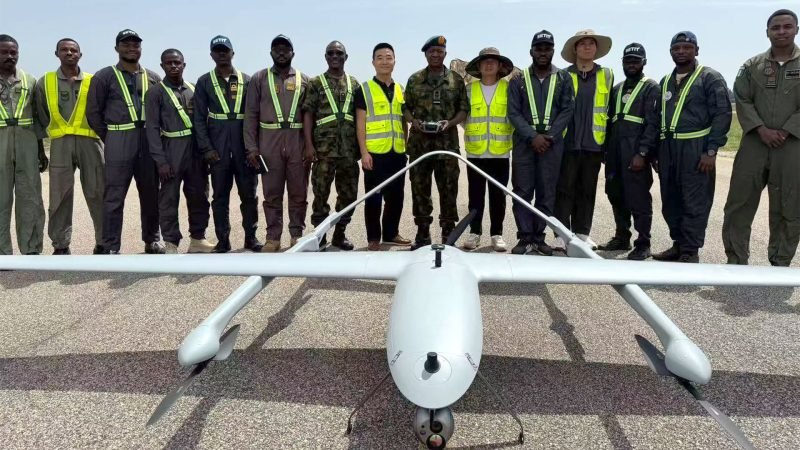
The Nigerian Air Force has expanded its unmanned aerial capabilities with the recent acquisition of Sky Whale Max hybrid vertical take-off and landing drones from Chinese manufacturer Shenzhen Yangda Security Company Limited, a move that includes hands-on training for personnel and delivery of complete systems tailored to operational needs. Conducted over multiple visits in August 2025, this initiative marks another chapter in Nigeria’s adoption of cost-effective Chinese platforms to address persistent security challenges, from Boko Haram insurgency in the northeast to banditry and oil theft in the south. While the exact number of units remains undisclosed, the focus on training suggests an emphasis on building proficiency for surveillance and logistics roles, potentially integrating these drones into broader counterterrorism efforts.
Shenzhen Yangda, established in 2014 and specialising in drone gimbals, multirotor systems, and fixed-wing vertical take-off and landing designs, positions the Sky Whale Max as a heavy-lift solution for demanding missions. The drone’s hybrid propulsion—combining battery power for quiet vertical phases with a gasoline generator for extended cruise—enables it to carry up to 15 kilograms of payload over 10 hours of flight, covering distances exceeding 100 kilometres as demonstrated during Nigerian trials. Measuring 4.9 meters in wingspan with a tandem-wing configuration for enhanced lift and stability, the airframe weighs 25 kilograms empty and reaches a maximum takeoff weight of 65 kilograms. Its 60-cubic-centimetre electronic fuel-injected engine drives electric motors, achieving speeds of 120 kilometres per hour while maintaining low acoustic signatures below 60 decibels at 100 meters altitude. Operators benefit from a dedicated gimbal bay for cameras or sensors, allowing simultaneous heavy cargo transport and real-time video feeds via encrypted links to ground stations.



In practice, the Sky Whale Max suits Nigeria’s vast terrain, where traditional fixed-wing drones require runways and pure electric models falter on endurance. For the Air Force, this translates to applications in border monitoring along the 4,047-kilometre frontier with Niger, Chad, Cameroon, and Benin, where jihadist crossovers demand persistent overwatch. The drone’s quick-assembly modular design—wings attach in under 20 minutes—facilitates deployments from forward bases like Maiduguri or Port Harcourt, while its differential GPS and inertial navigation ensure precision in GPS-denied environments common during electronic warfare disruptions. Payload options include high-definition electro-optical turrets with 30x zoom for day-night target identification, infrared scanners for heat signatures in dense foliage, or even lightweight resupply drops for remote outposts, reducing reliance on vulnerable convoys.
The training program, led by Yangda representatives including sales manager Lyn Qian, spanned four days across two visits, covering assembly, mission planning, flight execution, data retrieval, and basic maintenance. Participants practised real-world scenarios, culminating in a 100-kilometre test flight with live camera transmission, which elicited strong reactions from trainees for its seamless integration and reliability. Qian emphasised the package as an “integrated solution” addressing efficiency bottlenecks, such as delayed intelligence in anti-insurgency ops, where drones can relay feeds to command centres in under 10 seconds latency. This hands-on approach aligns with Nigeria’s strategy to indigenize skills, minimising long-term dependencies on foreign technicians and cutting sustainment costs estimated at $50,000 annually per unit.
Nigeria’s embrace of the Sky Whale Max builds on a decade-long trend of incorporating Chinese unmanned systems into its arsenal. The Air Force already fields platforms like the CH-4 medium-altitude long-endurance drone for armed reconnaissance, the Wing Loong II for precision strikes with laser-guided munitions, and the CH-3B for tactical support, all operated from bases in Kainji and Gombe. These assets have proven instrumental in Operation Hadin Kai against Boko Haram, where drones provide 24-hour coverage over Lake Chad’s marshlands, spotting militant camps and directing airstrikes from Alpha Jets or Super Tucanos. The Sky Whale’s hybrid design complements this fleet by filling gaps in short-takeoff scenarios, such as urban patrols in Abuja or delta surveillance against pipeline vandals.
This acquisition reflects broader dynamics in African defence markets, where China has emerged as the dominant unmanned aerial vehicle supplier. Over the past decade, firms like the China Aerospace Science and Technology Corporation have exported 282 combat drones to 17 countries, outpacing the United States’ 12 sales, as tracked by the Stockholm International Peace Research Institute. Affordability drives this surge; systems like the Wing Loong I cost under $2 million, enabling cash-strapped militaries to amass fleets that would otherwise require 10 to 15 times the investment in Western equivalents. For Nigeria, these platforms democratize air power, allowing a force of 15,000 personnel to project influence over 923,768 square kilometres without proportional manned aircraft investments.
As the Nigerian Air Force establishes new drone wings, the Sky Whale Max’s role in training underscores a pivot toward hybrid operations, blending unmanned persistence with piloted strikes. With two systems delivered and more potentially in the pipeline, this step not only enhances tactical flexibility but also deepens Sino-Nigerian ties, fostering technology transfers that could spawn local assembly lines. In a region rife with jihadist expansions and resource conflicts, such tools equip Abuja to maintain sovereignty, one autonomous flight at a time.


