According to the US Census Bureau and the Bureau of Economic Analysis, Nigerian goods destined for the U.S. market dropped by 41%.
Figures from the bureau showed that in July, Nigeria’s earnings decreased from $639 million in June 2025 to $379 million.
Revenue from both countries’ bilateral trade was affected from both angles as the U.S. also made less from its exports to Africa’s largest market.

Trade figures between Nigeria and America
In the same period under review, US exports to Nigeria decreased from $919 million in June to $584 million. In spite of the dip, the United States still recorded a trade surplus of $206 million in July, as opposed to $280 million in June.
According to the Foreign Trade in Goods Statistics released by the National Bureau of Statistics, the value of Nigeria’s total imports stood at ₦16.59 billion in Q4, 2024.
Of this, the United States had a 6.36% share of the total imports, making it Nigeria’s 4th most valuable import market.
A year prior, in Q4 of 2023, Nigeria’s top 5 trade partners were Singapore, ₦5,092.36 billion (or 36.09%); China, ₦2,060.59 billion (14.61%), Belgium, with ₦1,140.97 billion (8.09%), India, with ₦908.59 billion (6.44%); and the USA, contributing goods valued at ₦512.99 billion (or 3.64%).
These figures underscore the significant impact of the U.S. market on Nigeria.
The United States imported $3.14 billion worth of goods from Nigeria and exported $3.92 billion worth of goods to Nigeria between January and July 2025, resulting in a $781 million surplus for the US so far this year.
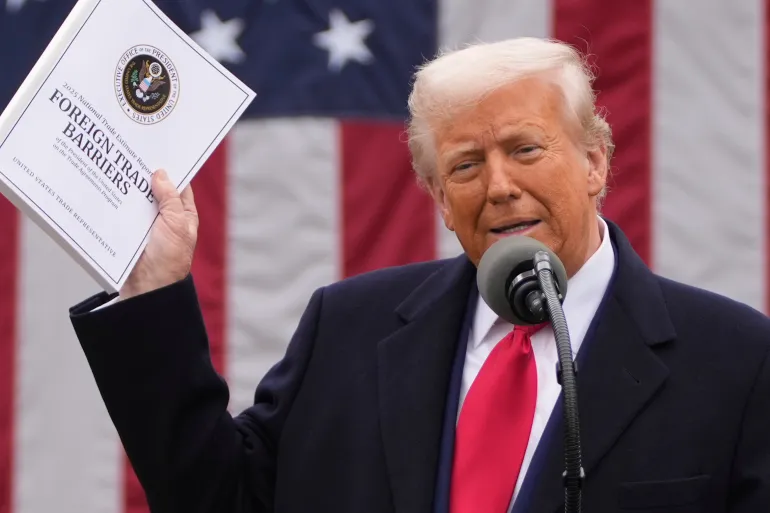
Bilateral trade between the two nations has experienced a decline subsequent to the imposition of tariffs by the current U.S. administration under President Donald Trump.
In April, Nigeria stood as one of the African countries affected by the policy, with a 14% tariff imposed on its goods.
Given this figure, trade between the two countries may be at even more risk as Trump’s latest adjustments in August peg Nigeria’s new tariff at 15%.
In April, Trump threatened to impose broad “reciprocal” taxes on global trading partners. The sanctions were delayed for 90 days to allow countries to renegotiate trade conditions, with the final deadline set for August 1.
As seen in the Punch, Dr. Aliyu Ilias, the CEO of CSA Advisory and a development economist, advised Nigeria to see the current trade crisis as a chance for adaptation.
“I think it’s a good time that this is happening to Nigeria. Trump’s tariff is not only for Nigeria. The advantage is that we are now exporting more overall, which is positive for us,” he stated.
“We also have to start being on our own. We can trade with other partners and see, because other partners are also looking for partners. The tariff that is affecting us is also affecting others, so it may be a good opportunity,” he added.
The decision follows President Donald Trump’s removal of the de minimis exception, which had permitted tiny shipments for $800 or less to enter the US duty-free, and his revocation of duty-free entry for overseas deliveries.