

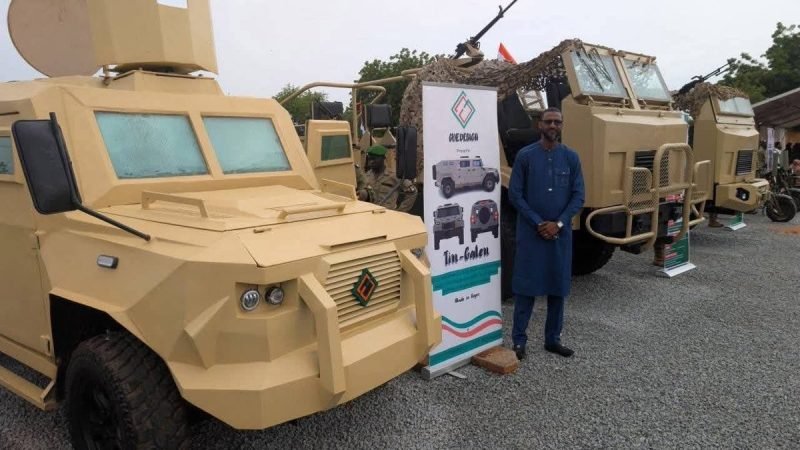
Niger has taken a bold step toward military independence with the unveiling of the Tin-Galen armored personnel carrier, a vehicle entirely conceived, designed, and built within the country by local talent. Developed by Guedesign Automotive, a Nigerien firm focused on defense solutions, the Tin-Galen made its debut in August 2025 during a ceremony in Niamey attended by the Chief of Staff of the Nigerien Armed Forces and other senior officials.
This event not only showcased the vehicle but also highlighted Niger’s determination to forge its own path in defence manufacturing, particularly in a region plagued by security threats and environmental hardships. As the nation’s first fully indigenous armoured vehicle, the Tin-Galen stands as a testament to engineering ingenuity tailored to the Sahel’s unforgiving landscape, where extreme temperatures, shifting sands, and rough terrain demand robust equipment.

Following the awards ceremony, the President of the Republic, Head of State, and Supreme Commander of the Armed Forces, accompanied by officials, visited an exhibition of combat equipment (armored vehicles, combat vehicles, Doki motorcycles), all manufactured in Niger, and booths displaying several products (Cambat drones, bulletproof vests, holsters, covers, etc.) produced by the Nigerien Armed Forces to make our Armed Forces more sovereign, in accordance with the vision of the Supreme Commander of the Armed Forces.
The ceremony took place in the presence of members of the CNSP, the President of the CCR, former Presidents of the Republic and Heads of State, members of the Government, Presidents of institutions, senior military and civilian officials, Diplomatic Corps accredited to Niger, and several guests.
The Tin-Galen draws its name from Tuareg linguistic traditions, blending elements that evoke strength, purposeful action, and relentless forward momentum. This choice reflects a deeper cultural resonance, aligning the vehicle with Niger’s evolving defence strategy that prioritises autonomy and national pride. In a part of the world where foreign powers have long influenced military procurements, this development signals a deliberate move away from reliance on imported hardware, which often comes with strings attached in terms of maintenance, parts availability, and geopolitical leverage. Niger’s leadership has emphasised self-sufficiency as a core pillar of its security doctrine, especially following recent shifts in international alliances that have prompted a reevaluation of external dependencies.
At its core, the Tin-Galen is engineered to meet the practical needs of Niger’s armed forces operating in the Sahel. It features B6-level ballistic protection, capable of resisting rounds from common threats like Kalashnikov assault rifles and sniper rifles. This armour rating ensures crew safety against small arms fire prevalent in insurgent ambushes and border skirmishes. The vehicle incorporates a reinforced chassis that enhances durability over uneven ground, while its off-road capabilities allow it to navigate the arid expanses and rocky outcrops typical of the region. Though specific technical specifications such as engine type or top speed have not been publicly detailed, the design prioritises mobility and resilience in high-heat environments, where temperatures can exceed 45 degrees Celsius, potentially degrading less-adapted machinery.


Guedesign Automotive, the company behind this achievement, assembled the Tin-Galen using local resources and expertise, drawing on Nigerien engineers who understand the operational realities on the ground. This homegrown approach reduces logistical vulnerabilities associated with foreign suppliers, such as delays in spare parts or escalating costs due to global supply chain disruptions. In the Sahel, where jihadist groups affiliated with al-Qaeda and the Islamic State exploit vast ungoverned spaces, having reliable transport for troops and equipment can make the difference in rapid response scenarios. The Tin-Galen’s configuration as an armoured personnel carrier suggests it can transport a squad of soldiers, potentially up to eight or ten, while offering mounting points for light weapons or communication gear to support patrol and reconnaissance missions.
This unveiling did not occur in isolation; it builds directly on earlier strides by Guedesign Automotive. Just three months prior, in May 2025, the company introduced the Tamgak Wangari, Niger’s inaugural domestically produced tactical vehicle. Presented at Military Base 101 in Niamey, the Tamgak Wangari is a military all-terrain buggy engineered for the Sahel’s challenges, including soft sand, intense heat, and a lack of paved roads. The ceremony drew the Chief of Staff and industry figures, underscoring its role as a symbol of innovation and national resolve. Named after elements signifying struggle and local ingenuity—Tamgak referencing the Air Mountains and Wangari denoting perseverance—the buggy embodies Niger’s push for technological sovereignty.
The Tamgak Wangari’s design emphasises agility and robustness, making it suitable for scouting, rapid insertions, or logistics support in remote areas. Built entirely by Nigerien engineers, it addresses the limitations of imported vehicles that often falter in the region’s extreme conditions. For instance, standard off-road platforms from abroad might overheat or bog down in loose sand, whereas the Tamgak Wangari incorporates adaptations like enhanced cooling systems and wide tires for better traction. Its unveiling marked a milestone, as it represented the first time Niger had produced a complete military vehicle from concept to assembly without external assistance.
Building on this foundation, Guedesign Automotive rolled out version 2.0 of the Tamgak Wangari alongside the Tin-Galen in August. Described as more powerful, robust, and sporty, this updated model boasts improved performance metrics, likely including a stronger engine, reinforced frame, and refined handling for demanding operations. The enhancements aim to boost speed and endurance, crucial for evading threats or covering long distances in patrols. Social media reactions from Nigerien users expressed enthusiasm, viewing these vehicles as steps toward reducing foreign influence and fostering local industry. One post highlighted the buggy’s role in symbolising resilience after Niger decided to expel French forces, framing it as a rejection of neo-colonial dependencies.
Niger’s venture into indigenous defence production comes at a pivotal moment for the Sahel. The region faces persistent instability from armed groups that conduct hit-and-run attacks, exploit ethnic tensions, and disrupt trade routes. Niger, with its vast territory spanning over 1.2 million square kilometres, struggles to secure borders shared with Mali, Burkina Faso, Nigeria, and Libya, all hotspots for militancy. Traditional reliance on foreign aid for military hardware—such as armoured vehicles from China or the United States—has exposed vulnerabilities, including high maintenance costs and political conditionalities. By producing vehicles like the Tin-Galen and Tamgak Wangari domestically, Niger aims to cut these ties, potentially saving resources and building a skilled workforce in engineering and manufacturing.
Guedesign Automotive’s efforts align with broader African trends toward localisation in defence sectors. Countries like South Africa have long produced advanced systems, but nations in West Africa, including Nigeria and Senegal, are increasingly investing in homegrown solutions. Nigeria, for example, has its own armoured vehicles. In Niger’s case, the focus on Sahel-specific adaptations sets it apart; the Tin-Galen’s armour and chassis are optimised for local threats like roadside bombs and small arms ambushes, while the Tamgak Wangari’s buggy format excels in mobility over dunes and dry riverbeds.


