

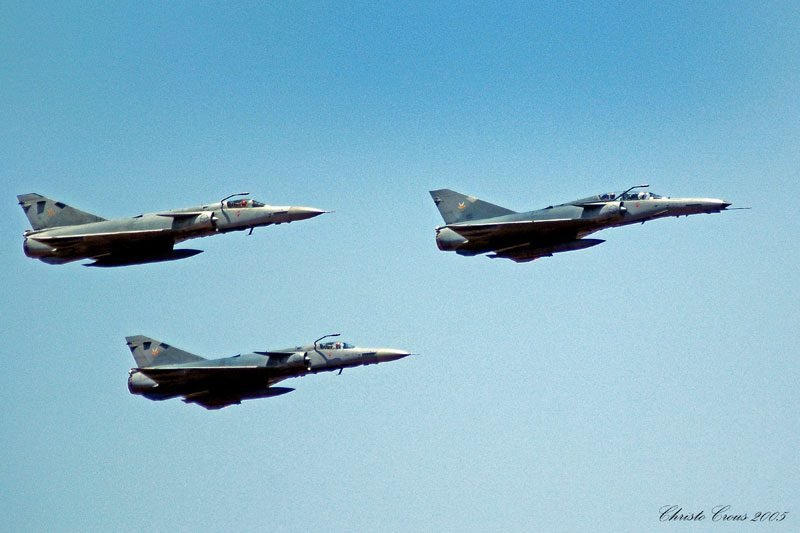
On August 19, 2025, Draken International, a prominent player in adversary air training services, filed a civil complaint in Florida’s Middle District Court against South Africa’s state-owned defence firm Denel.
The lawsuit centres on a $35.2 million contract for 12 Cheetah fighter jets that Denel largely failed to fulfil, despite multiple extensions and amendments. Draken seeks a $7.1 million refund, additional damages, and interest, painting a picture of prolonged delays, incomplete deliveries, and breached promises that have left the American company out of pocket and short on assets. This case not only spotlights the perils of international arms procurement but also highlights the lingering effects of corruption and mismanagement within Denel, as documented in South Africa’s Zondo Commission inquiries.
Draken International, often dubbed the world’s largest private air force, specialises in providing tactical aviation services to military clients, including the United States Air Force, Navy, and Marine Corps. Based in Lakeland, Florida, and owned by the private equity giant Blackstone, the company operates a diverse fleet of aircraft used for adversary training, where pilots simulate enemy threats to hone combat skills. Their services extend to close air support, joint terminal attack controller training, and advanced tactical exercises, filling a critical gap in military preparedness amid budget constraints on full-scale government fleets. Draken’s interest in the Cheetah jets stemmed from their compatibility with existing assets, such as the 22 modernised Mirage F1Ms acquired from Spain, which enhance realistic training scenarios against fourth-generation fighters.
The Cheetah itself boasts a storied history rooted in South Africa’s apartheid-era arms development. Developed in the 1980s by Atlas Aircraft Corporation, later absorbed into Denel, the Cheetah emerged as a heavily upgraded variant of the French Dassault Mirage III. Facing international sanctions that limited access to new aircraft, South African engineers incorporated Israeli Kfir influences, including a new nose design for improved avionics, canard foreplanes for better manoeuvrability, and the Snecma Atar 9K-50 engine capable of propelling the jet to Mach 2.2 speeds. The single-seat Cheetah C variant measures 15.55 meters in length with an 8.22-meter wingspan, offering a combat radius exceeding 1,300 kilometres and a service ceiling of 17,000 meters. Armament options include air-to-air missiles like the V3C Darter, air-to-ground ordnance, and a 30mm DEFA cannon, making it a versatile multirole fighter. The dual-seat Cheetah D served primarily for training, with similar specs but adapted for instructor-pilot configurations.
South Africa retired its Cheetah fleet in 2008 after acquiring Saab Gripen jets, leaving the aircraft in storage at facilities like Air Force Base Makhado. Denel, as the design authority, positioned itself as the go-to source for refurbishments and sales. A notable prior transaction involved exporting 12 Cheetahs to Ecuador in 2011, where they bolstered the Ecuadorian Air Force’s capabilities until phased out in 2021 due to maintenance challenges. That deal, valued at around $78 million including spares and training, demonstrated Denel’s potential in the secondary market for legacy aircraft, but it also foreshadowed issues with post-sale support that would later plague other customers.
The Draken-Denel contract originated on October 31, 2017, with an initial $29.2 million agreement for nine single-seat Cheetah C jets (serials 344, 345, 353, 361, 363, 369, 370, 375, 376) and three dual-seat Cheetah D models (845, 858, 859). The package included return-to-service work, flight acceptance tests in South Africa, and delivery to the United States, with a 24-month phased schedule. Draken paid a $500,000 good-faith deposit in December 2017 and a $9 million advance in March 2018, signalling confidence in Denel’s ability to deliver airworthy aircraft fitted with specific ejection seats and other components.
However, progress stalled almost immediately. By September 2020, Denel had delivered only two jets under Project Dragon—a single-seater and a dual-seater in October 2019—both arriving late and deficient. Key issues included missing ejection seats, incomplete avionics upgrades, and failure to meet airworthiness standards. Draken alleged that these shortcomings necessitated amendments to the contract. The first, on January 30, 2018, allowed Draken to source parts from third parties and deduct costs from the purchase price, as Denel could not supply them. A second amendment on October 6, 2020, raised the total price to $35.2 million and adjusted the delivery timeline, by which point Draken had paid $12.8 million without receiving a single fully compliant aircraft.
One more jet followed in mid-2021, but it too fell short of requirements, leading to deferred deliveries and fruitless negotiations. Draken described Denel’s responses as stalling tactics with pretextual obstacles, exacerbating damages from lost training opportunities. The company emphasised granting ample extensions before resorting to litigation, highlighting frustrations with Denel’s performance amid broader operational turmoil.
Denel is the design authority of the Cheetah fighter that was locally developed as a variant of the Mirage III in the 1980s. The aircraft were retired from active duty in 2008 following South Africa’s acquisition of its new fleet of Saab Gripen fighter jets. Denel previously delivered 12 Cheetahs to the Ecuadorian Air Force, in 2011.
Denel said that the Cheetahs, which can fly at Mach 2.2 and operate at ranges of more than 1,300km, were the first South African–designed fighters added to Draken’s inventory. Another aspect of Denel’s contract with Draken was that the aircraft must be delivered in airworthy condition and be fitted with specific ejection seats.
“Among other deficiencies, Denel failed to deliver the aircraft complete with ejection seats”
On 30 January 2018, they amended the initial agreement to allow Draken to order certain parts from third parties other than Denel and discount the cost against the purchase price.
“This amendment was necessary given Denel’s failure to provide several of the additional parts encompassed by the agreement,” Draken said.
On 6 October 2020, the parties amended the agreement again to adjust the phased delivery schedule for the remaining aircraft.
“As part of the amendment, the parties agreed to amend the total purchase price for the twelve aircraft to $35,238,028 (R625 million),” Draken stated.
“By the time the parties executed the second amended agreement, Draken had paid a total of $12,783,333 (R227 million) without receiving a single aircraft in Airworthy condition.” After this second amendment to the original agreement, Denel delivered one additional aircraft, which Draken said also failed to meet several performance and condition requirements.
“Given the extensive issues with Denel’s performance, the parties agreed to defer further deliveries pending discussions of a potential resolution,” Draken said.
“Over the course of such discussions, Denel has repeatedly stalled and raised pretextual hurdles to advancing the discussions.” Draken said this continued delay has only aggravated the significant damages already caused by Denel’s failure to perform under the agreement.
Denel’s woes trace back to the state capture era under former President Jacob Zuma, as exhaustively detailed in the Zondo Commission’s reports. Established in 1992 as a consolidation of South Africa’s defence manufacturing assets, Denel once thrived with innovations like the Rooivalk attack helicopter—a tandem-seat, twin-engine platform with anti-tank missiles and a 20mm cannon, deployed in UN peacekeeping missions in the Democratic Republic of Congo—and the G6 self-propelled howitzer, a 155mm artillery system on a wheeled chassis that saw action in the Gulf War with UAE forces. Revenue peaked at R8.2 billion in 2015-16, but plummeted to R2.4 billion by 2019-20 amid corruption scandals.
The Zondo Commission, chaired by Chief Justice Raymond Zondo, uncovered how Gupta-linked appointees hollowed out Denel through irregular contracts and board manipulations. For instance, in 2015, then-Public Enterprises Minister Lynne Brown appointed Daniel Mantsha as board chair, who allegedly facilitated deals favouring Gupta associates, resulting in R3.2 billion in irregular expenditure. This era saw a mass exodus of skilled engineers to the UAE, accompanied by accusations of intellectual property theft, further crippling production lines. By 2019-20, Denel reported a R1.96 billion loss, with liabilities exceeding assets by R2.3 billion, rendering it technically insolvent.
Real-world repercussions included salary delays in 2022, prompting trade union Solidarity to secure a court order auctioning Denel assets for R90 million in back pay. Employees faced withheld tax certificates despite deductions, eroding trust and accelerating the brain drain. The COVID-19 pandemic compounded delays on the Cheetah project, as did U.S. reductions in outsourced adversary training demand. Yet, Denel’s internal chaos, as per Zondo findings, remained the core issue, with the commission recommending prosecutions and reforms to prevent future capture.
Efforts to revive Denel have included a R9 billion bailout approved by late Minister Pravin Gordhan, spread over five years. In February 2024, board chair Gloria Serobe reported a R463 million net loss for 2023, 37% worse than forecasted, and the Auditor-General issued a disclaimer on financials. By February 2025, updated statements were still absent from parliamentary oversight. Denel has vowed to oppose the lawsuit, asserting commitment to obligations while declining to comment on the merits. Recent activities, such as a 2025 MoU with Brazil’s Embraer for KC-390 cooperation and participation in Abu Dhabi’s IDEX exhibition, suggest attempts at recovery, but financial opacity persists.
The Draken lawsuit also resonates on social media, with recent X posts amplifying the story. One user noted Denel’s R124 million exposure, linking it to broader economic woes in South Africa. Another highlighted the failure to deliver nine jets, framing it as a symptom of post-state capture decay. Defence analyst Darren Olivier tweeted about the $7 million claim, emphasising Denel’s delivery shortfalls. These discussions underscore public scrutiny of state-owned enterprises.
Looking ahead, the case could strain South Africa’s defence exports, which have already been diminished from Denel’s heyday, when it supplied G5 howitzers to Iraq in the 1980s or Umkhonto missiles to Algeria in the 2000s. Recovery hinges on transparency and reforms, as Zondo recommended. For Draken, pursuing litigation in U.S. courts leverages jurisdiction over international contracts, potentially setting precedents for enforcing deals with troubled suppliers.


