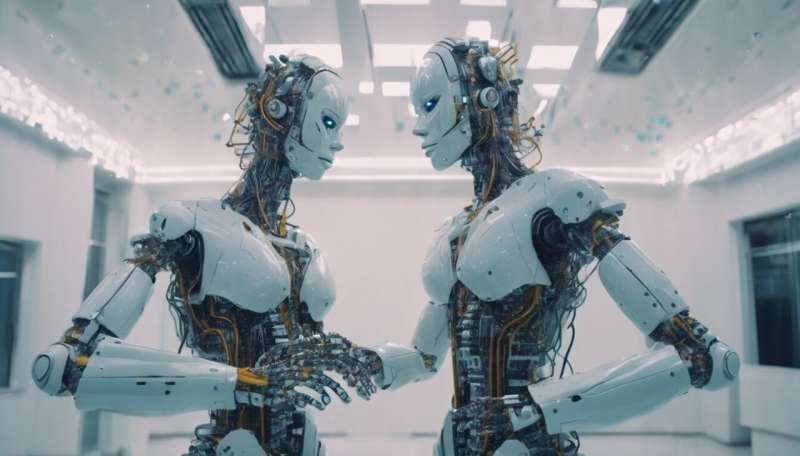
How will AI affect American workers? There are two major narratives floating around. The “techno-optimist” view is that AI will free humans from boring tasks and create new jobs, while the “techno-pessimist” view is that AI will lead to widespread unemployment.


As a sociologist who studies job insecurity, I’m among the pessimists. And that’s not just because of AI itself. It’s about something deeper—what scholars call “American exceptionalism.” While people commonly use this phrase to refer to anything that makes the U.S. unique, I use it narrowly to refer to the country’s approach to work and social welfare, which is quite different from the systems in other rich countries.
I suspect AI will “turbocharge” American exceptionalism in ways that make workers more afraid of losing their jobs. When fused with organizations’ adoption of new types of AI, workers’ fears may soon become reality, if they haven’t already.
An ‘exceptional’ system for American workers
Let’s start with what makes the U.S. different, especially from other rich countries.
The U.S. has relatively low levels of unionization, an “at-will” employment system, a modest welfare state, and a two-party system that lacks a social democratic tradition. Many wealthy countries boast higher unionization rates, stricter protections against being fired, and—particularly in Europe—more robust welfare states.
In other words, even before AI came into the picture, American workers were facing a system stacked against them.
This tendency grew more pronounced starting in the late 1970s, with Democrats and Republicans alike pursuing reforms such as stripping regulations and rolling back the welfare state. Between 1983 and 2022, unionization rates fell by more than 50%; they remain low today. In the 1990s, President Bill Clinton pledged to “end welfare as we know it” and followed with a law slashing support programs. Meanwhile, U.S. workers’ inflation-adjusted wages have stagnated and income inequality has risen since the 1970s.
The current Trump administration has taken these “exceptional” traits even further. From firing the head of the National Labor Relations Board to his executive order undermining federal employee unions, Trump has usurped the power of regulatory agencies and workers themselves. And more cuts to the welfare state are coming now that Trump’s domestic policy bill has been signed into law, including reductions in food aid and health insurance.
One telling example is the Trump administration’s mass firing of federal workers. While they are making their way through the courts, these efforts are notable for targeting government positions that have long been thought to be the most secure jobs.
As a sociologist, I think it’s fair to say that the U.S. is even more “exceptional” than it was just a year ago. This trend lays the foundation for U.S. workers to fear losing their jobs, for employers to cut workers loose, and for people to struggle making ends meet.
American exceptionalism, meet AI
To understand what’s happening, it helps to look at the different kinds of artificial intelligence, which generally refers to machines such as computers that can perform tasks comparably to humans.
One type is predictive AI, which is what powers your streaming and social media recommendations. The second type is generative AI, which is used to create seemingly novel content. ChatGPT and other large language models fall in this category. The third type, agentic AI, cannot only predict and plan outcomes but also can act autonomously to achieve those outcomes. Self-driving cars are perhaps the most well-known example.
Companies are increasingly using generative AI to boost productivity. According to Stanford University’s 2025 AI index report, generative AI has already surpassed human performance on a range of tasks, including visual reasoning and answering competition-level math and Ph.D.-level science questions. The U.S. Bureau of Labor Statistics has warned that generative AI will affect jobs across a range of industries.
I think agentic AI will have dramatic implications for the workforce. Companies are already beginning to use it for customer service in industries from finance to travel. As if on cue, OpenAI recently released ChatGPT agent, which it says can handle “complex tasks from start to finish.”
When you combine technological advancements—such as the current transition to generative AI and the likely broader agentic AI transition—with turbocharged American exceptionalism, you get a formula for job insecurity and displacement.
How AI might affect the future of job security
Interestingly, despite having fewer protections from firing and a more threadbare unemployment system, American workers are no more afraid of losing their jobs than workers in other rich countries, research shows. These perceptions are generally constant over time, but they spike as a result of certain economic reforms and during recessions.
Among the findings in my own research on free-market-driven economic reforms in Europe, people were most worried about losing their jobs in countries that had ratcheted up such policies within the past five years. That trend has important implications for the United States.
Recent polling shows that about a third of U.S. workers believe AI will hurt their jobs or job opportunities. Business leaders say they expect job losses in the service industries, supply chain management and human resources over the next three years.
There’s no shortage of predictions about AI-driven job gains and losses, but solid data is hard to come by—and don’t even bother asking most companies about AI-related layoffs.
On one hand, business leaders surveyed by McKinsey in 2024 reported high demand for new jobs such as “AI compliance specialist” and “AI ethics specialist,” which are the kinds of new roles that techno-optimists say will be created by AI.
On the other hand, it’s no small irony that AI was reportedly used to facilitate the mass firing of federal workers and may soon replace some Department of Education workers’ jobs.
America’s fusion of limited labor protections and aggressive AI adoption could create the perfect storm for widespread job insecurity. While unions have organized for AI-related job protections, and states are attempting to regulate AI, the U.S.”s path realistically depends less on workers’ and local politicians’ actions than what companies do. And I think companies’ increasing integration of AI will likely hurt American workers more than it helps.
If nothing changes, job insecurity may become the new normal.
The Conversation
This article is republished from The Conversation under a Creative Commons license. Read the original article.
Citation:
The US really is unlike other rich countries when it comes to job insecurity. AI could make it even more ‘exceptional’ (2025, August 26)
retrieved 26 August 2025
from https://techxplore.com/news/2025-08-rich-countries-job-insecurity-ai.html
This document is subject to copyright. Apart from any fair dealing for the purpose of private study or research, no
part may be reproduced without the written permission. The content is provided for information purposes only.