

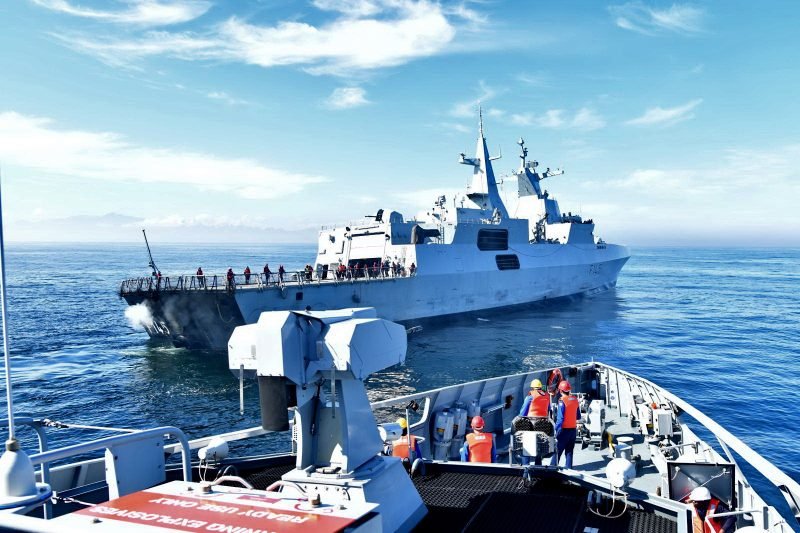
The South African Navy has wrapped up its annual force preparation exercise, Red Lion 2025, following an intensive three-week programme that ran from 4 to 22 August.
Conducted across multiple sites nationwide, the operation put naval crews, vessels, and support units through a rigorous series of drills designed to sharpen their abilities in diverse scenarios, from maritime combat to disaster response. With a focus on returning to fundamental skills, the exercise brought together military personnel and civilian agencies, demonstrating the Navy’s capacity to respond effectively to threats both at sea and on land. As the activities drew to a close, officials expressed confidence in the outcomes, noting improvements in coordination, readiness, and procedural effectiveness that will bolster future operations.
The exercise unfolded in key naval hubs, reflecting the South African Navy’s widespread presence. Simon’s Town in the Western Cape served as the primary focal point, often regarded as the informal heart of the maritime branch, hosting the main naval base, dockyard, and home port for the fleet. Additional sites in the province included Westlake at Silvermine, Goodwood, Gordon’s Bay, and Saldanha. Beyond the Western Cape, operations extended to the Eastern Cape with involvement at the naval base in Gqeberha and a station in East London; Gauteng, where the Navy’s headquarters unit operates in Pretoria’s central business district; and KwaZulu-Natal, centred on Naval Base Durban. This broad geographic spread ensured that units from various provinces could participate, fostering a unified approach to training.
Under the guiding theme of “back to basics,” Red Lion 2025 emphasised practical simulations that mirrored real-world challenges, such as civil unrest and natural disasters affecting public safety and security. Naval elements collaborated closely with civilian partners to navigate these scenarios, testing their joint response mechanisms. The overarching goal, as outlined by Chief Petty Officer Nkululeko Zulu in reports from the Western Cape segment, was to scrutinise and refine existing doctrines and standard operating procedures. This process aimed to boost interoperability among Navy components and hone skills for missions ashore and afloat, ensuring seamless integration in high-stakes environments.
Preparation kicked off with an orientation phase that equipped commanding officers and teams with essential tools. This included simulated media interactions to handle public communications during crises, alongside briefings on search and rescue protocols, vessel-to-shore radio links, security measures around naval installations, and aviation safety standards. These foundational sessions set the stage for the more demanding evolutions that followed, allowing participants to approach the drills with a clear understanding of protocols and risks.
Rear Admiral Handsome Matsane, the Flag Officer Fleet, described the exercise as a clear display of the Navy’s prowess in merging all its assets with exacting accuracy, while incorporating input from external stakeholders. He pointed out that the fleet sought to prove its adaptability in intricate situations, drawing on shared resources to meet emerging demands. According to Zulu’s accounts, the broader aim involved evaluating and elevating the fleet’s overall preparedness, encompassing staff training, machinery reliability, and tactical alignment to ready forces for potential combat or deployment at sea.
A standout feature came two weeks into the exercise, when interoperability drills off Durban highlighted cross-agency cooperation. In a coordinated maritime rescue simulation, the Navy teamed up with the National Sea Rescue Institute, South African Police Service, Customs Marine Unit, and the South African Air Force. The latter contributed A109 and BK117 helicopters, adding an aerial dimension to the operation. This joint effort underscored the value of unified action in emergency settings, where rapid and synchronised responses can make all the difference.
The sea phase, commencing on 11 August, saw Vice Admiral Monde Lobese’s Navy deploy three vessels into False Bay: the Valour Class frigate SAS Amatola (F145) and the newly commissioned multi-mission inshore patrol vessel SAS Adam Kok III (P1573), the third in its class. These ships departed from Simon’s Town harbour to engage in hands-on training. Able Seaman Sisanda Xaba detailed the initial at-sea sessions as particularly beneficial, featuring a mock fast inshore assault by a harbour patrol boat approaching from both port and starboard sides of the frigate and patrol vessel. Further activities encompassed live gunnery practice, towing manoeuvres, maintaining flying stations, deploying boarding craft, weapons handling drills, and exercises involving navigational publications.
For a brief period, the South African platforms were accompanied by the French Navy’s offshore patrol vessel Auguste Techer (P781), which joined them in what appeared to be a passage exercise. Ship tracking data from around 9 August captured the MMIPVs SAS King Shaka Zulu and SAS Adam Kok III, along with SAS Amatola, sailing in formation near False Bay alongside the French ship. The Auguste Techer, spotted in Cape Town harbour on 11 August, represents the third unit in the Félix Éboué class, displacing 1,300 tonnes when fully loaded and measuring 80 metres in length. Crewed by 30 sailors, it can house an additional 29 passengers and assist combat divers. Equipped with two 8-metre inflatable boats and a Survey Copter Aliaca unmanned aerial vehicle, the drone offers up to three hours of flight time over a 50-kilometre radius, launched via catapult and recovered by net.
This vessel succeeds the retired P400 class patrol ships, forming part of France’s extensive overseas military posture. That includes 20 naval assets, 40 aircraft, and 7,000 personnel stationed in French Polynesia, New Caledonia, and La Réunion. Their roles extend to upholding sovereignty, delivering aid in disasters, and enforcing international maritime law, including the United Nations Convention on the Law of the Sea, which safeguards navigation freedoms worldwide. The French Consulate General in Cape Town explained that the Auguste Techer focuses on sovereignty patrols, monitoring, and safeguarding interests across seven million square kilometres of France’s exclusive economic zone near its overseas territories. It also addresses pollution incidents and counters illegal maritime operations.
During its South African stopover, the French crew explored local sites, including the South African Naval Museum. Visitors included Colonel Frédéric Ducotey, head of joint staff for the Armed Forces in La Réunion Island, and Lieutenant Commander Robin Martins, the Auguste Techer’s commanding officer. This interaction added an international flavour to Red Lion, potentially opening avenues for future collaborative training.
Prior to heading offshore, Western Cape units tackled a slate of shore-based simulations. These covered responses to bomb threats with building evacuations, shipboard fires, and enhanced perimeter security around Simon’s Town facilities and the Armscor dockyard. Naval police, explosive ordnance disposal teams, and safety personnel played key roles, securing zones, probing incidents, and neutralising mock hazards. Such drills reinforced the Navy’s ability to protect its infrastructure and personnel amid potential disruptions.


