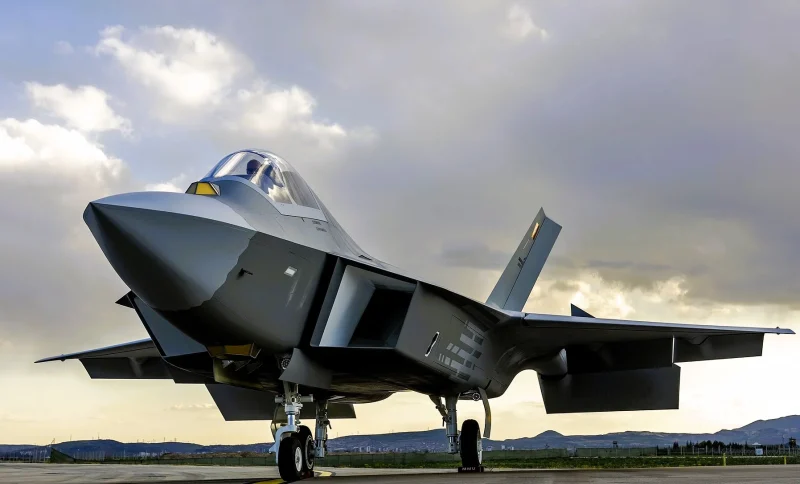
Turkey has given the go-ahead for Egypt to join its ambitious fifth-generation KAAN fighter jet programme, marking a potential shift in Middle Eastern defence collaborations that could reshape air power dynamics in the region.
This approval paves the way for Cairo to participate as a co-producer and manufacturer in the development led by Turkish Aerospace Industries. While Turkish authorities have yet to confirm the development, the move stems from extended negotiations and senior-level military dialogues that have built momentum over recent months. A memorandum of understanding between the two countries is anticipated by the end of 2025, formalising arrangements for technical exchanges and joint production efforts. Egyptian Air Force specialists have already examined the KAAN prototype, which is undergoing initial trials with an eye toward operational deployment around 2030.
General Hassan Rashid, a former chief of staff in the Egyptian Air Force, described the prospective joint manufacturing as a positive development, noting it would deliver substantial advantages to Egypt’s armed forces by broadening access to cutting-edge technology and reducing vulnerabilities tied to over-reliance on specific suppliers. The KAAN, alternatively referred to as the Turkish Fighter or National Combat Aircraft, emerges as a twin-engine, all-weather platform optimised for air superiority roles, intended to succeed Turkey’s ageing F-16 inventory. Its design draws parallels with global peers like the American F-35 Lightning II, Russia’s Su-57 Felon, and China’s J-20 Mighty Dragon, incorporating stealth elements such as radar-absorbent coatings and angular surfaces to minimise detection by enemy sensors. The aircraft’s internal bays house weapons to preserve its low-observable profile during engagements, with plans for conformal fuel tanks to boost endurance without compromising stealth. A digital core facilitates sensor integration, enabling real-time data sharing and coordinated strikes across allied units in multi-domain scenarios.
This initiative gained urgency for Turkey after the United States halted F-35 deliveries in response to Ankara’s acquisition of Russian S-400 air defence systems, prompting a pivot toward self-reliant development. For Egypt, involvement extends beyond the fighter itself, with reports indicating interest in complementary Turkish systems including drones, TRLG-230 missiles, compact precision-guided munitions, and L-UMTAS anti-tank weapons. Rashid emphasised the necessity of diversifying procurement sources, stating that Egypt cannot afford to depend solely on one or two nations for its armaments, a policy driven by past experiences with supply disruptions and geopolitical pressures.
Ali Bakir, a professor at Qatar University and visiting fellow at the Atlantic Council, observed that partnering on the KAAN could help narrow the technological disparity with Israel, which maintains a clear edge through its exclusive regional access to the F-35. Israel’s status as the only Middle Eastern operator of this stealth jet stems from stringent US export controls that have barred deliveries to allies like the United Arab Emirates and Saudi Arabia. Even if such restrictions ease, Bakir noted, the variants provided would likely feature downgraded capabilities compared to those supplied to Israel. Gulf states, including Saudi Arabia and the UAE, reportedly see the KAAN as a promising option, with entry into service possibly as early as 2028, offering a viable alternative free from similar limitations.
President Abdel Fattah el-Sissi first signalled Egypt’s enthusiasm during his inaugural visit to Ankara in September 2024, a trip that revitalised bilateral relations after years of strain. The emerging alliance reflects a regional trend toward diminishing dependence on Western arms providers, amid concerns over conditional sales and political leverage. Egypt’s air force, one of the largest in the area, currently fields approximately 210 F-16s, 78 Mirage 5s, 19 Mirage 2000s, alongside newer MiG-29M and Rafale models. Many older aircraft, particularly the Mirages and MiGs, approach retirement, necessitating upgrades to sustain combat readiness against evolving threats.
Cairo’s modernisation drive has involved 54 Rafale acquisitions from France since 2015, with ongoing deliveries, as well as negotiations with South Korea for FA-50 light attack jets to refresh training capabilities. Efforts to procure Russian Su-30s faced US opposition, with threats of sanctions under the Countering America’s Adversaries Through Sanctions Act, which could have jeopardised Egypt’s access to American military aid and equipment. Washington countered by proposing F-15s, though the deal remains pending amid ongoing talks. Parallel explorations with China for J-31 fighters aim to introduce stealth and advanced features to offset Israel’s F-35 advantage, with joint exercises and official dialogues fuelling speculation of impending agreements. Although China has denied recent J-10 deliveries, the conversations persist, driven by Egypt’s need for affordable, capable alternatives amid restricted access to top-tier Western jets.
Beyond immediate fleet renewal, Egypt’s role in the KAAN initiative carries profound effects for African defence landscapes. As the first African participant in producing a fifth-generation fighter, Egypt could emerge as a continental manufacturing centre, exporting components or assembled aircraft to neighbours and amplifying its influence within the African Union and Arab League. The arrangement promises technology transfers, local assembly rights, and joint production, aligning with Cairo’s aspirations to cultivate a self-sustaining defence sector. This evolution might inspire similar ventures across Africa, where nations seek to localise production and lessen import dependencies, fostering economic growth through skilled jobs and supply chains.