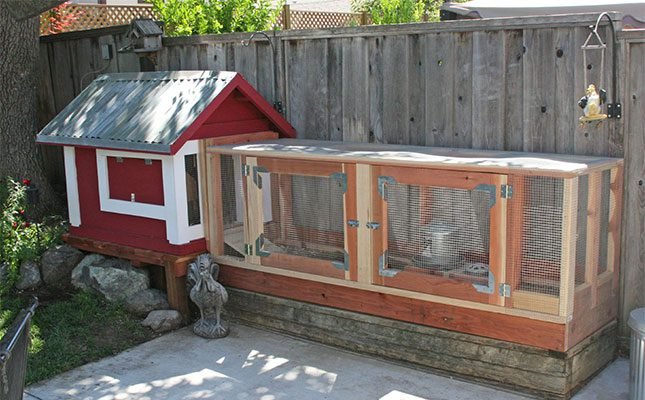
Choosing the right site and materials to set up a chicken house or coop on your smallholding or in your backyard is essential to ensure the health and safety of your chickens.


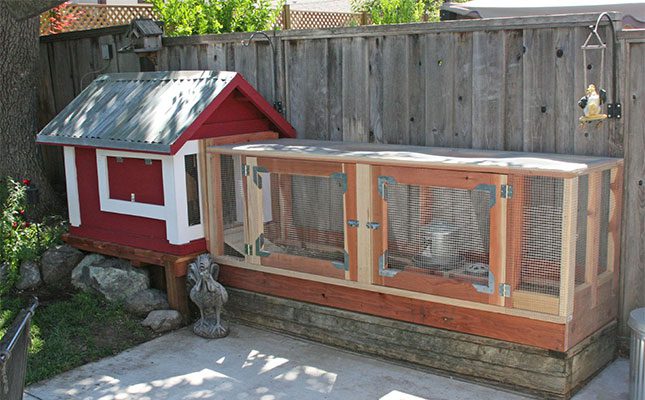
Photo: Allan Hack | Flickr
A well-designed chicken house provides a clean, dry, secure, and comfortable environment for chickens. This promotes their health and maximises egg production or meat yield while keeping operational costs low.
When setting up a chicken house or coop, there are a number of factors that must first be considered. These factors are paramount for the health, well-being, and survival of your chickens. However, the criteria for this will change depending on the type of house you are erecting. Remember that a good poultry house must offer the birds protection from predators and poor weather, and prevent injury.
The following criteria are specifically with relation to basic coops, and not intensive housing systems used by commercial farmers in which the environment is largely controlled with artificial lighting, heating and cooling, amongst others.
Site selection
Select a site with good natural drainage. Excess moisture promotes the growth of bacteria, parasites, and fungal diseases. In this regard, avoid low-lying areas where water can accumulate, leading to muddy conditions, increased humidity inside the coop, and a higher risk of disease. Keep in mind that poor drainage can also damage the foundation of your chicken house.
Choose a site that receives some sunlight throughout the day, especially in the morning. However, it should also offer some natural shade, particularly during the hottest parts of the day in summer. This is important because sunlight helps to dry out the coop, reducing moisture and killing some bacteria.
Choose a site that is reasonably close to a water source and, preferably, an electricity source.
If possible, also choose a site that can influence predator risk. For example, avoid areas with dense vegetation or structures that could provide cover for predators near the chicken house. Consider the visibility of the coop from your house or other secure areas.
If you plan on expanding your operation in future, choose a site with enough room to build a larger coop or extend the existing one and the run.
Direction and elevation
When choosing a direction in which to construct your chicken house, align the house to face north and south to allow for even sunlight exposure and temperature regulation. As the sun rises from the east, if the house is aligned north/south, the internal environment warms evenly. This helps chickens avoid crowding for warmth, which creates a more comfortable environment.
Elevation is also important, according to the Old Farmer’s Almanac.
“Raised coops are more secure than coops built right on the ground (unless you set your coop on concrete) because that will prevent predators from digging underneath to try to get into the coop, and keep a wooden floor from rotting.
“A raised coop will provide your chickens shelter from the summer sun and from the rain and snow in the winter. Raising the coop up at least [20cm to 30cm] on wooden legs or cement blocks is high enough that the chickens can easily fit underneath. If you free-range your chickens, they can hide from hawks and other aerial predators underneath a raised coop.”
House size
Another factor to consider is house size, which will largely depend on the scale of your operation. Start small and expand as needed. The general rule of thumb is that each chicken needs around 8m² to 12m² of space to prevent overcrowding and ensure uniform growth.
Overcrowding increases competition for food and water, weakens birds and increases the risk of disease transmission. Lower stocking densities promote better health and reduce stress.
Spacing between houses
Also consider spacing between houses if you are erecting more than one chicken house. Maintain at least 20m between poultry houses to improve air circulation and prevent stale air to circulate between houses and reduce disease spread.
Trees or hedges should not be planted too close to chicken houses, as they block airflow, leading to poor ventilation and an increased heat build-up inside the chicken house.
If obstructions are unavoidable, make openings in the wall larger to compensate for the decrease in ventilation.
Construction materials
The type of construction materials to use is another factor to consider. Building materials must be easy-to-clean and maintain. Regular cleaning prevents disease build-up.
Wood is a common material used to build a ‘backyard’ chicken house. Pine, spruce and fir are often used, but may require treatment for longevity. Woods like cedar and redwood are more expensive, but are also more insect-resistant. Plywood is often used for walls and roofing sheathing. While wood is generally inexpensive (or more affordable compared with other materials), it is susceptible to rot and pests, as well as water damage.
Coops and chicken houses can also be made of corrugated steel and galvanised aluminium, according to Easy Coops.
“These coops are a lasting solution and protect against predators and other threats. However, because they are heavy, they are not suitable for chicken tractors and other movable coops.”
These metals are durable, weather-resistant, easy to clean and doesn’t rot or attract pests. However, the metals can be expensive, and can get very hot or cold depending on the climate. They may also require specialised tools for cutting and assembly.
Plastic can also be used, but this is not ideal, says Easy Coops. It is, however, lightweight and easy to clean and work with.
“Even if you are a beginner chicken grower with meagre skills, these attributes give you ample freedom to design your dream chicken coop.”
Plastic is low maintenance and rot-resistant, but it can also be expensive and is not as structurally strong as wood or metal. It may also degrade over time due to sun exposure.
You can also use concrete, which is extremely durable and predator-proof, and easy to clean.
But it is more expensive and labour-intensive to install, and can be very cold if not properly insulated. It is also a permanent structure that cannot be moved.
When choosing what materials to use, keep in mind your budget, the climate, the durability of the coop, how much maintenance will be required, how easy it is to construct, and ventilation.
Typical materials used in chicken coops and houses
Recommended materials to use for building a chicken coop or house:
- Framing: typically wood (2x4s are common)
- Walls and roofing: wood (plywood, OSB, shiplap), metal sheeting, and plastic panels
Flooring: concrete, wood (sealed or raised), and hardware cloth (for droppings to fall through – requires careful design) - Protection from predators (run): hardware cloth (stronger and smaller mesh than chicken wire), and welded wire mesh.
- Ventilation: hardware cloth-covered openings, and vents made from wood or PVC.
- Bedding (inside coop): pine shavings, straw, hemp, and sand (not structural, but important for the floor)