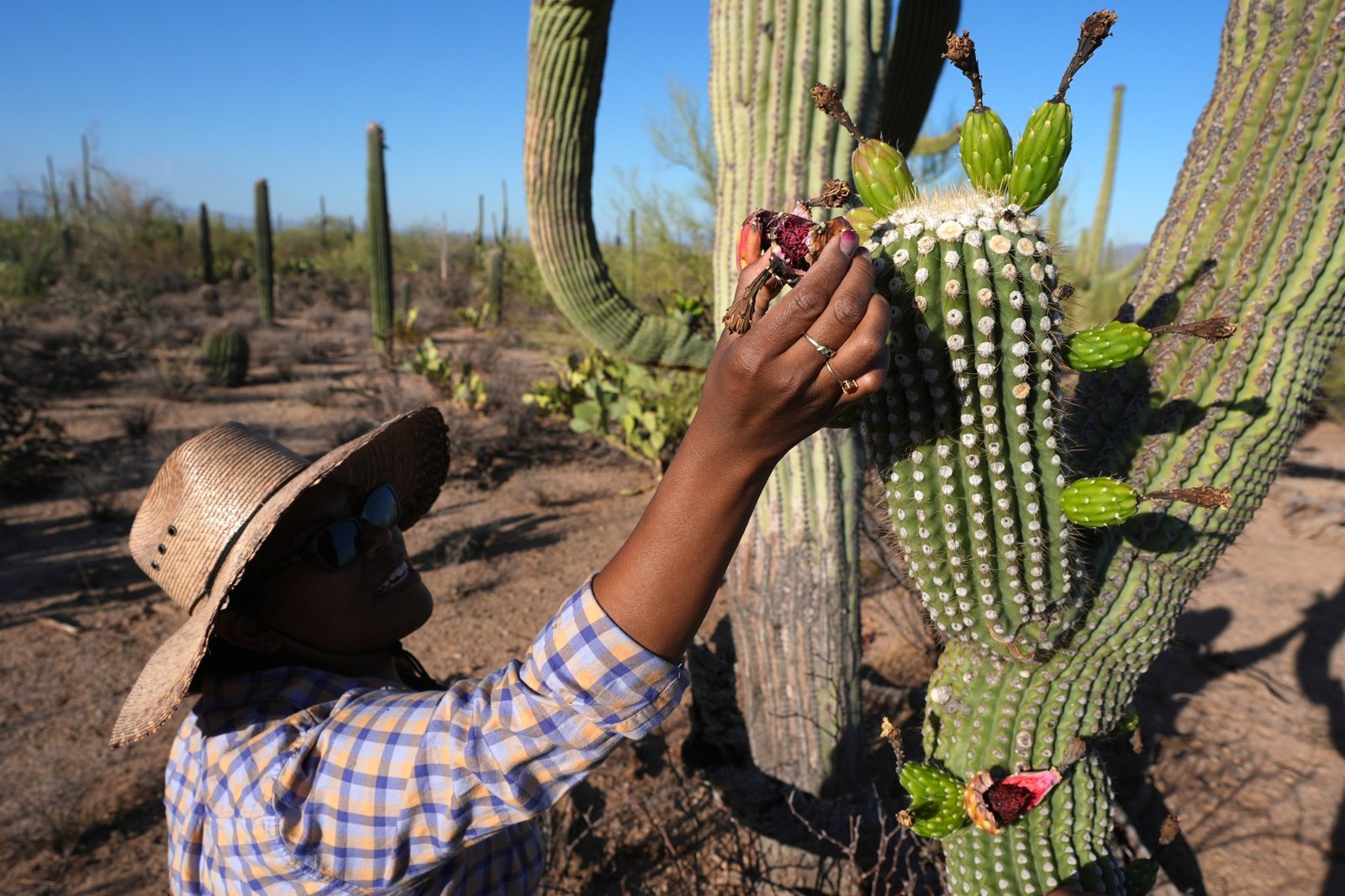

When Tanisha Tucker Lohse sees the first saguaro flowers bloom in the spring, she dreams of bahidaj, the blood-red fruit the cactus produces. She envisions the ancient tradition of harvesting bahidaj, her people tending to boiling vats of fruit pulp in the middle of the Sonoran Desert to make sweet and nutritious syrups and jellies — even wine.
Lohse has participated in the Tohono O’odham Nation’s bahidaj harvest nearly every year since she was 8. Each June, she heads into the Arizona desert for days on end, armed with 20-foot-long poles to pluck the fruit off the tips of saguaro stems. Then she boils it all down into syrup. She organizes the harvest camps where the ritual takes place, teaching friends and family the centuries-old practices that her ancestors passed on to her.
All this — the fruits, the O’odham customs, the continued presence of saguaros here over millions of years — starts, of course, with the cactus flower. The blossoms add a touch of softness to the gritty, thorny desert landscape, a place that can otherwise seem hostile. “I love looking at the flowers,” Lohse said. “They’re a reminder of the beauty that grows in such a harsh environment.”

Visitors from all around the world visit the Sonoran Desert to see the towering saguaros. At the right time of year, the flowers also have their admirers. But they’ve seldom received much research attention. Scientists have been monitoring saguaros consistently since 1942, but not their flowers; floral surveys in the 20th century were typically one-off undertakings, some of which didn’t even last a full flowering season.
Now, the research is slowly catching up. Several ongoing flower-monitoring efforts are demystifying the factors that influence when and how much the cactuses bloom. New findings reveal how saguaros bend to the changing whims of the climate, as told through their finicky flowers.

SAGUAROS SYMBOLIZE the Sonoran Desert, appearing in classic Western movies and even children’s cartoons. A cactus can grow up to 78 feet high and live over 200 years. Saguaros take their time to mature, with their first flowers usually blooming when the plant is around 35 years old.
For a plant with such a long lifespan, their flowers are fleeting by contrast, unfurling in the night and shuttering by the next evening. But they make the most of their stage time by putting on a show: Pearly petals with sun-yellow hearts bedeck the saguaro’s stem and limbs, giving the cactus the lively flair of a 1920s flapper.
By observing the quantity and timing of the blooming, researchers are beginning to understand the connection between the saguaro’s health and climate fluctuations. In the winter of 2011, the area surrounding Tucson experienced a string of below-freezing days that proved fatal for many cactuses. Flower numbers fell by tenfold the following spring.
“They’re a reminder of the beauty that grows in such a harsh environment.”
Then, in 2021, the Sonoran Desert erupted in flowers; scientists surmised that a few wet years had set the stage for a superbloom, although the flowering could have been a Hail Mary survival response to the stress of the decades-long drought. Extreme heat and drought may also trigger anomalous behavior, coaxing flowers to bloom on the plants’ torsos and hips instead of on top of their heads.
Altogether, the variations in annual flowering patterns hint at a compelling trend. “Most of them are affected by weather events, when it’s either freezing or too hot,” said Bill Peachey, an independent biologist who has been surveying saguaro flowers on his own since 1997. “That exactly matches the symptoms of climate change.” An unpredictable flowering schedule can throw off the delicate balance of the surrounding ecosystem, especially for pollinators that count on a regular flowering season that happens from mid-April to early June.
In the desert, “there are a lot more pollinators than we think,” said Mark Johnson, a research biologist with the U.S. Army Corps of Engineers. By sequencing bits and pieces of the wildlife DNA found in the environment, his team found that saguaro flowers sustain over a hundred species of insects, birds, reptiles and mammals, including several migratory creatures.

Previous studies have documented nectar-sipping lesser long-nosed bats timing their migration for the height of the floral festival so they can nurse their young here. Birds and bats are also drawn to the blooms to feed on the bees and butterflies the flowers attract.


In recent years, scientists have observed more saguaros flowering off-schedule. Once again, shifting weather patterns might be to blame. Saguaros bloom earlier as temperatures rise, one study found. Peachey and other scientists have also observed some saguaros flowering into the fall, for reasons not yet understood.
There’s a good chance that the late bloomers might not produce new cactuses, Peachey said, since their seeds would miss the summer’s monsoon rains required for germination. This, in turn, could throw off the sequence of pollination, fruiting and seed dispersal that ultimately leads to the next generation of saguaros.
Today, technological innovations are enabling scientists to collect more detailed records on saguaro flowers. Scientists led by Saguaro National Park researchers photographed flowering cactuses using 30-foot-long selfie sticks.
Over time, the scientists noticed that buds sprout in a merry-go-round fashion on the top of the cactus. “If we hadn’t seen it in the photographs, we probably wouldn’t have noticed it,” said Don Swann, a retired national park service biologist working on the “Flower Power” project. Starting on the eastern side of the plant, the buds pop up in a counterclockwise direction, a pattern Swann and his team believe allows them to duck the morning heat as the summer progresses.
Swann is still working at park during his retirement, since he just can’t resist piecing together the saguaro’s many mysteries. “People come from all over the world to Tucson to see this plant that they’ve heard about,” he said. “They have lots of questions, and we want to be the place where they can get those questions answered.”
“People come from all over the world to Tucson to see this plant that they’ve heard about.”
ACROSS THE SONORAN DESERT, saguaros are everywhere, studding canyons, hills and plains all the way to the horizon. This seeming abundance is a false impression, though: Fewer young saguaros are reaching adulthood, mainly due to a prolonged drought that’s been simmering since the 1990s. As summer temperatures climb to record-breaking levels, residents have noted many saguaros individuals wilting, losing their arms or toppling over in the intolerable heat.
The saguaro’s survival strategy involves playing the numbers game: A single plant sprouts thousands of flowers to generate millions of seeds over its lifetime — just to produce a seedling or two. It’s the plant’s solution to the dispiritingly low reproduction odds made worse by climate change.
It’s unclear exactly what role the fluctuating flowering patterns play in the saguaro’s precarious future. Fewer flowers naturally means fewer saguaros. But too many flowers aren’t necessarily a cause for celebration either. Scientists and flower aficionados still debate whether it’s a natural survival response to environmental shifts, or a distress signal from an entire ecosystem. Either way, the effects of a good or bad flowering year will take decades to play out, since saguaros are slow growers.
Still, Lohse of the Tohono O’odham Nation trusts that the saguaro will endure, as will her ancestors’ traditions that she’s determined to keep alive. “Saguaros are so resilient,” Lohse said. “I think all plant life is way more advanced than we give them credit for.”