

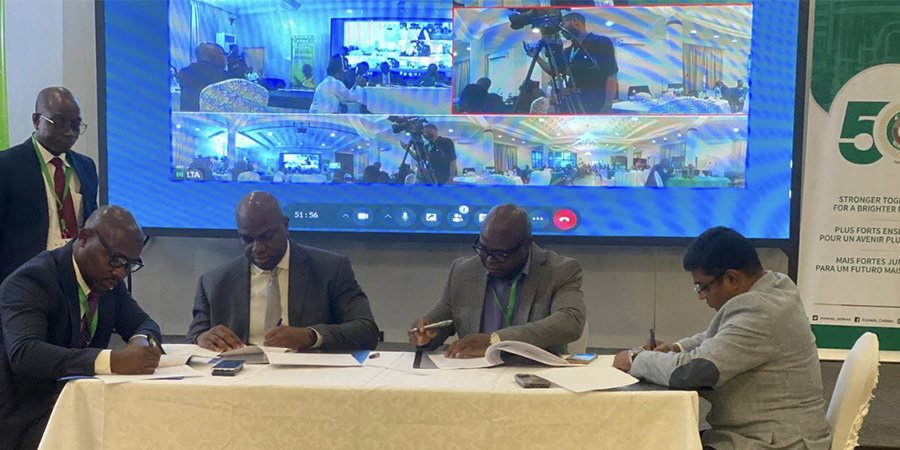
The Liberia Ministry of Posts and Telecommunications has unveiled two significant milestones set to enhance the nation’s role in regional connectivity across West Africa. The deals are widely seen as a significant step in the implementation of the Economic Community of West African States (ECOWAS) Free Roaming Regulation. The regulation, adopted to dismantle mobile communication barriers across the sub-region, drives regional trade, mobility, and social cohesion.
Read More: Liberia, ECOWAS, World Bank Launch Second Submarine Cable to Boost Connectivity
Liberia-Côte d’Ivoire Roaming Agreement
Firstly, Liberia has formalized a new roaming agreement with Côte d’Ivoire, paving the way for smoother cross-border communication and enabling travelers between the two nations to stay connected more easily.
Clarence K. Massaquoi, Chairman of the Liberia Telecommunications Authority (LTA), said:
“Our people share not only land but culture. The Dan, Krahn, and Grebo communities live on both sides of the Cavalla River. Families cross the river daily to farm, trade, and celebrate holidays together. Yet, they face high mobile charges due to international roaming. Today’s agreement seeks to remove that barrier.”
The Liberia-Côte d’Ivoire agreement aligns with ECOWAS’s broader vision of a “roam-like-at-home” policy, already being pursued in parts of the region. Mobile operators in Liberia and Côte d’Ivoire have already begun technical preparations to implement the new roaming framework. The agreement covers voice calls, text messaging, and data services, with tariffs harmonized to ensure affordability. Officials say the framework will take effect in the coming weeks.
Massaquoi added:
“This is about more than phone calls; it is about connecting our people, strengthening our economies, and building the foundation for a truly united West Africa.”
Related: West Africa’s Push for Borderless Roaming
Liberia-Sierra Leone Roaming Agreement
Secondly, an earlier telecommunications pact with Sierra Leone has now been fully activated, ensuring uninterrupted communication between neighboring countries.
Under the new arrangement, Liberians traveling to Sierra Leone will enjoy free incoming calls for up to 30 days. Outgoing calls, SMS, and mobile data will be billed at the same rates paid by Sierra Leonean residents. This means no more inflated charges and no need to buy a local SIM card for short visits.
Data services are also included in the plan, meaning travelers can browse, message, and use apps as if they were at home. After 30 days, regular roaming charges apply, ensuring the system is not abused for permanent roaming.
The agreement also introduces a revenue-sharing model whereby 40% of roaming revenue goes to the visitor’s home operator while 60% goes to the host country’s operator, a setup designed to benefit both consumers and telecom providers.
Massaquoi emphasized that high cross-border call costs have long held back trade, travel, and social ties. “When roaming fees are gone, farmers, traders, and families near borders can communicate freely without worrying about big bills,” he explained.
Speaking on behalf of ECOWAS Commission President, Dr. Omar Aliu Ture, Josephine Nkrumah, ECOWAS Resident Representative to Liberia, said:
“This year marks 50 years of ECOWAS, and today’s milestone shows how far we’ve come in building an ECOWAS of people, not just countries. Free roaming is more than technology; it’s about closing gaps, empowering citizens, and building social unity.”
She cited the European Union’s (EU) success as a model for what West Africa could achieve. “In Europe, free roaming led to a 1,700% increase in roaming use. That growth means more than just calls; it means building businesses, stronger social ties, and empowered citizens,” Nkrumah added.
The Ministry expressed appreciation to the Liberia Telecommunications Authority (LTA), the West African Telecommunications Regulators Association (WATRA), and the Autorité de Régulation des Télécommunications de Côte d’Ivoire (ARTCI) for their pivotal contributions. Together, these advancements mark a step toward a more integrated and connected West Africa.


