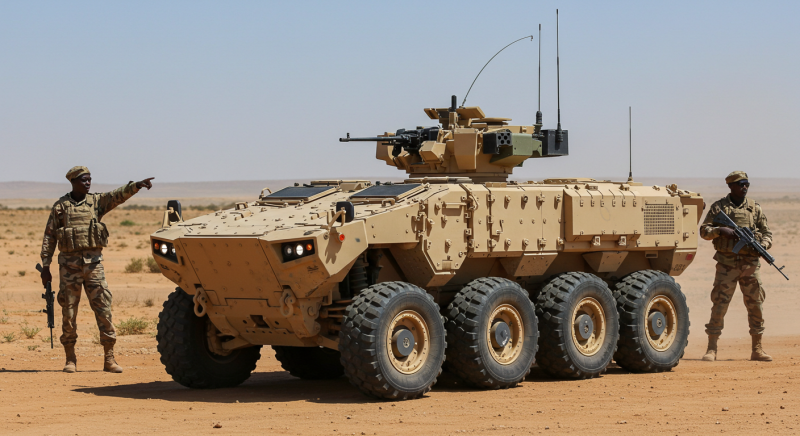
Across the vast and varied landscapes of Africa, where conflicts often unfold in remote deserts, dense jungles, and urban sprawls, military forces face persistent challenges from insurgent groups, border disputes, and resource-driven tensions. In this context, uncrewed ground vehicles, or UGVs, are emerging as a practical tool to reshape how African armies conduct operations. These machines, ranging from small throwable scouts to larger platforms capable of carrying weapons or supplies, allow troops to extend their reach without exposing personnel to unnecessary dangers. As African nations invest in modernising their defences amid rising security demands, UGVs offer a way to bridge gaps in manpower and technology, drawing on global advancements while adapting to local needs.
In an era of strategic competition, uncrewed ground vehicles are poised to play a pivotal role in enhancing the capabilities of African armed forces to outmatch peer adversaries and maintain a tactical and strategic advantage. These systems deliver increased situational awareness, lethality, and tactical options for army formations in support of multi-domain operations. Operators remotely control UGVs that operate semi-autonomously, enabling real-time decision-making from safer positions. UGVs prove relevant to all phases of multi-domain operations, from the initial compete stage where they gather intelligence to outmanoeuvre opponents, through penetration efforts to breach enemy lines, disintegrate phases to disrupt command structures, exploit opportunities to press advantages, and recompete cycles to sustain long-term dominance.
The African market for UGVs reflects this growing interest, with the sector valued at 65.5 million US dollars in 2023 and projected to reach 107.1 million by 2030, expanding at a compound annual growth rate of 7.3 per cent. In terms of units, the market stood at 293 in 2023 and could climb to 663 by the end of the decade, with a volume growth rate of 12.4 per cent. This expansion stems from pressing concerns over border security, terrorism, and illicit crossings, which have prompted higher defence spending across the continent. UGVs, fitted with advanced sensors and surveillance gear, help mitigate risks to soldiers while boosting effectiveness on the battlefield. However, hurdles like high development costs and a lack of standardisation persist, as diverse vehicle types complicate integration. Opportunities arise from progress in artificial intelligence, allowing for smarter, more autonomous systems that handle complex tasks with greater precision in military, agricultural, and mining applications.
South Africa stands out as a hub for UGV development and testing, leveraging its established defence industry to pioneer homegrown solutions. As far back as 2014, local firms showcased new unmanned platforms at the Africa Aerospace and Defence exhibition, designed for roles in reconnaissance and demining. By 2016, companies like B-Cat Military had refined the Pathfinder UGV, an amphibious vehicle capable of navigating water and rough terrain, ideal for border patrols along rivers or coastal areas. That same year, Denel Mechem worked on a specialised UGV for demining and air sampling, aiming for full operation by year’s end to clear explosive remnants in post-conflict zones. These efforts build on South Africa’s history of innovation under constraints, much like its early unmanned aerial vehicle programmes refined through combat experience.
International collaborations have further accelerated UGV adoption in South Africa. In 2019, Rheinmetall demonstrated its Mission Master UGV at the Ammunition Capability Demonstration at the Overberg Test Range, drawing observers from 53 countries. The vehicle, armed with a Fieldranger Multi weapon station and Thales 70mm rocket launchers, fired a salvo of 14 rockets—delivering 60 kilograms of explosives in just 1.6 seconds—in a ground-to-ground role adapted from air systems. Operated remotely via the Argus soldier system in a man-in-the-loop setup, it showcased stability and digitisation suitable for military standards. The Mission Master also features variants for rescue, equipped with stretchers, oxygen supplies, defibrillators, and climate-controlled storage, allowing autonomous casualty evacuation over long distances. Its modular design supports tasks like logistics, surveillance, fire suppression, and chemical detection, making it versatile for Africa’s demanding environments where terrain and weather can hinder traditional vehicles.
Further north, in the Sahel region plagued by jihadist insurgencies, UGVs have seen real-world deployment. Estonia’s defence forces, as part of the French-led Operation Barkhane, introduced the Milrem Robotics THeMIS UGV to Mali in April 2019. This marked one of the first tactical uses of a UGV in an active conflict zone on the continent. Over several months, the THeMIS supported Estonian platoons by patrolling streets in Gao, transporting half a tonne of ammunition and water to inaccessible areas, and aiding in observation and casualty evacuation. It covered 1,200 kilometres of lava rock terrain and logged over 330 hours in temperatures reaching 50 degrees Celsius, even surviving proximity to a vehicle-borne improvised explosive device with 200 kilograms of explosives. Feedback from operators, including Lieutenant Colonel Sten Allik, praised its endurance and how it prompted new ways of thinking about operations. The platform’s potential extends to mounting heavy machine guns or Javelin missiles for fire support, as well as intelligence, surveillance, reconnaissance, and electronic warfare roles. For African militaries facing similar threats in the Sahel—such as those in Burkina Faso, Niger, or Chad—this deployment illustrates how UGVs can speed up responses, reduce casualties, and maintain momentum in prolonged counter-insurgency campaigns.
Tunisia provides another example of UGV integration in counter-terrorism efforts. The country’s Anti-terrorism Battalion has employed the Throwbot 2, a compact, throwable robot designed for close-quarters reconnaissance. Weighing just over a kilogramme, it can be tossed into buildings or over walls to transmit audio and video feeds, allowing operators to assess threats without direct exposure. In Tunisia’s ongoing fight against Islamist militants affiliated with al-Qaeda or ISIS, who often hide in urban or mountainous hideouts, such devices enable safer clearances of potential ambush sites or bomb-laden structures. This aligns with broader trends where small, affordable UGVs complement larger systems, providing layered capabilities for forces with limited budgets.
Turkey’s influence in African defence markets, primarily through drones, is now extending to UGVs. In 2025, Turkish firm Havelsan partnered with Egypt’s Kader Factory for Developed Industries to produce unmanned ground vehicles locally. This collaboration builds on Turkey’s success with platforms like the Barkan UGV, which entered serial production for its own armed forces after operational trials. Designed for law enforcement and military support, the Barkan offers remote control and autonomous modes, suitable for challenging environments like those in North Africa. Egypt, with its focus on Sinai Peninsula security and border threats, stands to benefit from localised manufacturing, reducing dependency on imports while tailoring systems to regional needs. Turkey’s push for UGV exports mirrors its drone strategy, which has seen Bayraktar TB2 units adopted by nations like Ethiopia and Somalia for striking rebels and terrorists.
These developments come as African battlefields evolve, with asymmetric warfare demanding tools that handle vast distances, unpredictable weather, and hybrid threats blending conventional and guerrilla tactics. In places like the Democratic Republic of Congo’s eastern provinces or Mozambique’s Cabo Delgado, where militants exploit rugged terrain for hit-and-run attacks, UGVs can conduct persistent surveillance or deliver supplies to isolated outposts, freeing human soldiers for more complex roles. Their semi-autonomous features, guided by operators via secure links, ensure adaptability without full reliance on fragile communications networks common in remote areas.
Looking ahead, the integration of artificial intelligence promises even greater autonomy, with UGVs learning from environments to navigate obstacles or identify targets independently. Key players like QinetiQ, Elbit Systems, and Rheinmetall are already active in the African market, alongside local innovators. As defence budgets rise in countries such as Nigeria, Kenya, and Morocco, UGVs will likely become staples in multi-domain strategies, supporting phases from competition through to recompetition by providing persistent presence and force multiplication. While challenges like ethical concerns over armed autonomy and vulnerability to jamming remain, the trajectory points to a future where these vehicles not only protect lives but also tilt the balance in Africa’s enduring security struggles.