

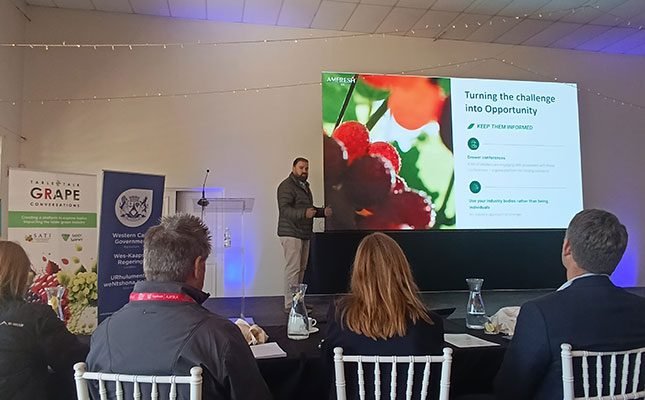
Navigating market risk and embracing innovation were central themes at the Table Talk: Grape Conversations event, held in Paarl in the Western Cape on Friday.


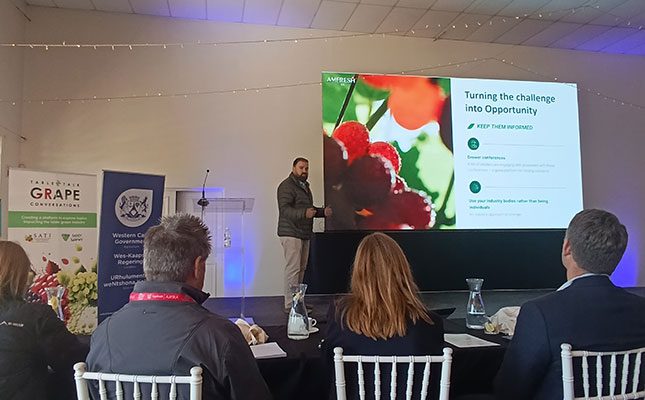
Photo: Glenneis Kriel
Speaking at the event, Charl du Bois, managing director of Capespan, stressed the importance of applying common sense and data-driven insights to build and sustain markets.
He urged the industry to draw lessons from other South African fruit industries, particularly pome and citrus, in terms of broad export strategies and targeting specific markets with specific varieties.
Du Bois highlighted the need to closely monitor what competitor countries were doing to prevent market oversupply.
He pointed to Peru as an example: around 63% of its table grape exports went to the US and 25% to the EU. In contrast, South Africa exported about 58% of its table grapes to the EU, 18% to the UK, and 10% to North America, which included the US and Canada.
“Peru used to mainly export Red Globe grapes but has since heavily invested in new varieties, such as Sweet Globe and Autumn Globe, which now dominate their offering,” he said.
Du Bois added that the South African industry should support government efforts to open new markets and negotiate favourable tariffs, phytosanitary protocols, and maximum residue limits.
“Asia presents major opportunities, but high tariffs and strict phytosanitary requirements must be addressed if we are to tap into this market effectively,” he said.
He also stressed the need to improve logistics, saying that effective logistics were “non-negotiable if South Africa wants to ensure good arrival conditions, extend shelf life, and remain internationally competitive”.
Du Bois concluded with a strong emphasis on research and development, as well as the importance of generic marketing to promote South African grapes.
“Our long-standing relationships with Europe and the UK remain crucial, but those markets are becoming saturated. Fruit without a retail destination has long been a red flag; going forward, it will be disastrous,” he explained.
Roland Fröhlich, head of agronomy at AMFresh in the UK, spoke about the growing pressure on retailers to source environmentally responsible produce. He said much of this pressure stemmed from the Pesticide Action Network (PAN), a coalition of more than 600 NGOs advocating for reduced pesticide use and greater transparency around its application.
“PAN has compiled a list of highly hazardous pesticides. Whether or not a product is legally compliant no longer matters; retailers cannot afford to be seen as doing the bare minimum regarding minimum residue limits,” he said.
He warned that bad publicity affected not just the retailer but also the country of origin and its producers. As a result, retailers were moving away from transactional supplier relationships towards strategic partnerships with transparent suppliers that aligned with their environmental, social, and governance targets.
“Open communication between these partners is essential; good and bad news must be shared,” Fröhlich added.
Louw Pienaar, senior analyst at the Bureau for Food and Agricultural Policy, addressed concerns about the 30% tariff imposed on South African agricultural exports to the US.
He said the impact on the broader sector was expected to be minimal, given the small volume of exports involved. For example, only about 2% of South Africa’s table grape exports were destined for the US.
However, Pienaar acknowledged that producers and regions heavily reliant on the US market would need to act quickly to mitigate the effects.
“This isn’t the first time the US has introduced high tariffs. However, the high tariffs are usually only temporary, followed by a longer period of reduced tariffs once the mistake and its negative impact on trade is realised. I expect the tariff to settle at between 10% and 15% before the end of the year,” he said.


