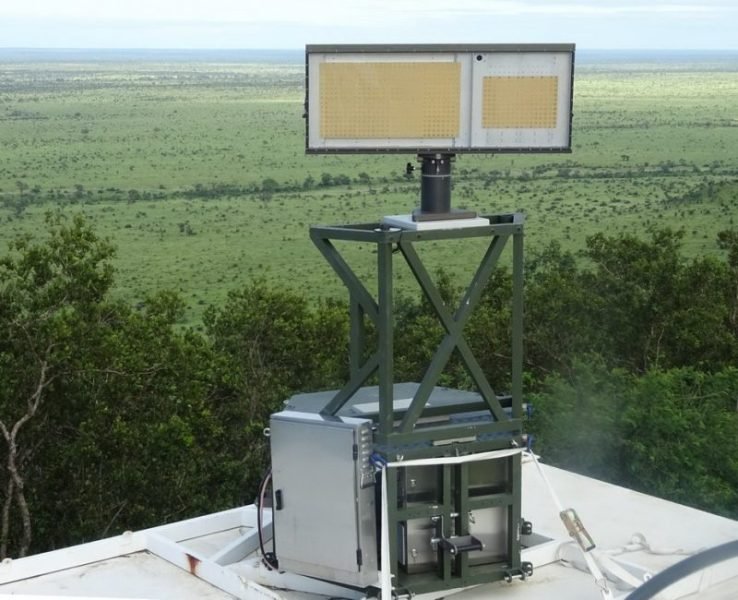
The Council for Scientific and Industrial Research (CSIR) in South Africa has introduced a new radar system designed for ground-based detection, marking an important advancement in surveillance technology.
This new development, known as the Ground-based Surveillance and Classification Radar (GSCR), is intended to integrate with the CSIR’s existing Meerkat wide area surveillance system. The Meerkat platform currently relies on a radar from Reutech Radar Systems, the RSR 904, but the CSIR’s newly developed GSCR offers a more cost-effective alternative.
This innovation reflects the CSIR’s ongoing efforts to enhance surveillance capabilities for a range of applications, from border security to wildlife conservation. The Meerkat system itself is a robust tool, combining radar with day and thermal cameras to enable 24-hour operation. It includes information analysis software capable of detecting, tracking, and classifying individuals entering specific areas. With the ability to monitor up to 200 square kilometres at a time, Meerkat is well-suited for overseeing large expanses, such as borders or nature reserves.
The introduction of the GSCR aims to build on this foundation, bringing additional functionality and efficiency to the platform. One of the standout features of the GSCR is its capacity to classify targets, distinguishing, for instance, between animals and humans. This ability sets it apart from the current setup, where Meerkat’s cameras play a key role in identifying and classifying targets alongside the RSR 904 radar. With the GSCR, there is potential for the radar to operate independently of these cameras, reducing reliance on additional equipment. The CSIR envisions the GSCR enabling unattended automated operation, a feature that could transform how the system is used in the field.
For example, a game ranger could receive a notification on their mobile phone if an intrusion is detected, allowing for rapid response without the need for constant human monitoring. The GSCR employs C-band electronically-steered antenna technology, which improves both its sensitivity and accuracy in classifying targets. This technological choice enhances the radar’s performance, making it a versatile tool for various operational needs. The system is available in three variants, with detection ranges of 4 km, 7 km, and 10 km, offering flexibility depending on the scale of the area to be monitored. Whether deployed for short-range tasks or broader surveillance, the GSCR can be tailored to meet specific requirements.
The development of this radar was supported by the Department of Science and Innovation (DSI), reflecting a commitment to advancing South Africa’s scientific and technological capabilities. The CSIR has identified several key users for the GSCR, including the Border Management Authority, which could employ it to strengthen national security. Another notable application is in counter-rhino poaching efforts, where the radar’s ability to differentiate between humans and animals could help protect endangered species by alerting authorities to unauthorised human presence in conservation areas.
Beyond these, the CSIR sees the GSCR contributing to a range of other purposes, such as general security and crime prevention. This new radar does not exist in isolation but forms part of a broader vision at the CSIR. The organisation views the GSCR, alongside its Tyto, Otus, and RINO cameras, as components of a larger family of surveillance systems. Together, these technologies could address diverse challenges, including wildlife protection, border safeguarding, countering crime on farms and in suburban areas, securing critical infrastructure, and even detecting aerial intrusions.
This integrated approach suggests a future where the CSIR’s tools work in concert to tackle both local and regional security issues. The CSIR’s expertise in radar technology is well-established, with a long history of development in this field. At present, the organisation is engaged in multiple radar projects that showcase its capabilities. One such initiative is a synthetic aperture radar (SAR) designed for unmanned aerial vehicles (UAVs). This system promises high-resolution imaging from the air, which could prove valuable for reconnaissance, environmental monitoring, or other applications. Additionally, the CSIR has delivered a radar-based drone detection system to Armasuisse, Switzerland’s Federal Office for Defence Procurement. Known as SAMURAI (Swiss African MUltistatic RAdar Initiative), this project highlights the CSIR’s ability to collaborate internationally and produce solutions that meet global demands.
Among its recent achievements, the CSIR’s most prominent radar project is the Quadome, developed in partnership with Hensoldt South Africa. Described as the largest local radar initiative in many years, the Quadome has already secured an export customer in the UK’s Royal Navy, demonstrating its appeal on the international stage. This success points to the CSIR’s capacity to create world-class technology that competes in the global defence market. The collaboration with Hensoldt South Africa extends beyond the Quadome. In March 2021, the CSIR and Hensoldt, a leading sensor designer, announced a joint venture to develop the next generation of tactical 3D surveillance radar systems for naval and land operations. The partnership aimed to roll out a series of software-configurable radar systems by 2023, designed to resist countermeasures while remaining competitively priced.
This collaboration reflects a shared ambition to push radar technology forward, ensuring it meets the evolving needs of modern defence and security forces. The introduction of the GSCR and the CSIR’s wider radar efforts carry important implications for South Africa. By developing cost-effective, locally produced technology, the CSIR is reducing dependence on foreign suppliers and strengthening national self-reliance in critical sectors. The GSCR’s potential for automated operation and its target classification capabilities make it a practical tool for diverse users, from security agencies to conservationists. Its adaptability also means it could be deployed in varied settings, such as rural farms, urban suburbs, or protected wildlife areas, addressing a broad spectrum of concerns. Looking beyond South Africa, the CSIR’s advancements position the country as a contributor to the global defence and surveillance industry.
The export success of the Quadome radar and the delivery of the SAMURAI system to Switzerland indicate that CSIR-developed technologies are gaining traction internationally. As the organisation continues to expand its portfolio, it is likely to attract further interest from both domestic and overseas markets.
In summary, the CSIR’s new Ground-based Surveillance and Classification Radar represents a practical and forward-thinking addition to its surveillance offerings. By enhancing the Meerkat system with a cost-effective, capable radar, the CSIR is improving how large areas can be monitored and protected. With its roots in a long-standing tradition of radar development and bolstered by partnerships like the one with Hensoldt, the GSCR is set to play a valuable role in South Africa’s security and conservation efforts.