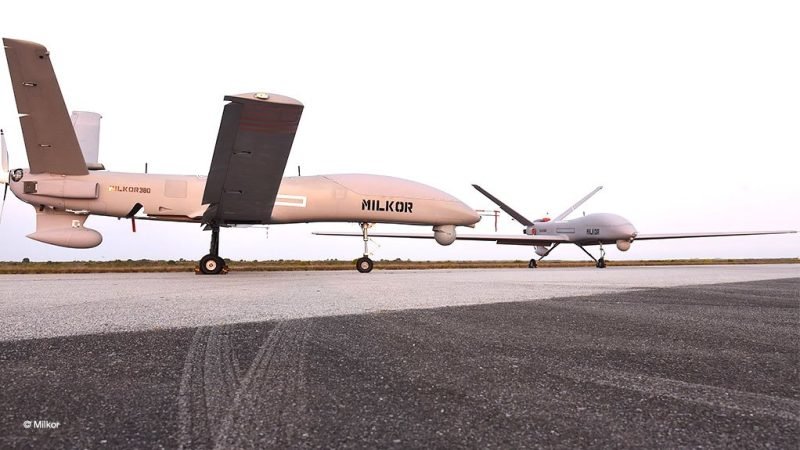
Milkor and Hanwha Systems have embarked on a partnership that promises to broaden the operational reach and sensing capabilities of the Milkor 380 medium‑altitude, long‑endurance unmanned aerial vehicle. The agreement, formalized by a Memorandum of Understanding at the 2025 Paris Air Show, entrusts Hanwha’s advanced Active Electronically Scanned Array synthetic‑aperture radar payload to the Milkor 380 platform, creating a turnkey surveillance and reconnaissance solution ready for export to markets across the Middle East, Africa and beyond. The MoU was signed by Julian Coetzee, CEO of Milkor UAE, and Hyuck Park, Senior Vice President of Hanwha Systems’ Defence Electronics Business Division.
Milkor UAE’s communications director, Daniel du Plessis, explained that as a proudly South African defence company, Milkor constantly seeks collaborations with world‑leading firms to ensure its capabilities remain market‑relevant and offer a complete solution to clients. By integrating Hanwha’s radar surveillance expertise, Milkor aims to generate economic benefits, create jobs and retain critical skills within South Africa’s defence industry, while also showcasing its capabilities on the global stage.
Hyuck Park described the collaboration as “an opportunity to combine Hanwha’s advanced technology with Milkor’s innovative platforms to deliver next‑generation defence capabilities to global customers.” He emphasized that integrating Hanwha’s AESA radar—a technology honed through airborne applications such as the KF‑21 Boramae fighter’s radar testing aboard a modified Boeing 737—will equip the Milkor 380 with high‑resolution imaging, ground‑ and maritime‑moving target indication and all‑weather reconnaissance capability, markedly improving its effectiveness in intelligence gathering and situational awareness.
The Milkor 380 itself boasts an 18.6‑meter wingspan, a maximum take‑off weight of 1,500 kilograms and endurance of 30 hours at 10,000 feet when flying at 60 knots, with a range exceeding 4,000 kilometres—attributes that lend themselves to missions such as border surveillance, maritime patrols and combat operations. Dual‑redundant line‑of‑sight communications sustain contact out to 250 kilometres, with seamless transition to satellite systems for beyond‑line‑of‑sight operations. Payload flexibility remains a hallmark: the aircraft can carry up to 220 kilograms of sensors, munitions, communications pods or electronic warfare systems, with each outer wing hardpoint rated at 80 kilograms, each inner wing station at 150 kilograms and an underbelly station cleared for 400 kilograms. Its nose bay can accommodate various electro‑optical, infrared and radar sensors.
Already, Milkor has partnered with Germany’s Hensoldt to integrate the ARGOS II HDT airborne observation system with laser‑designator capabilities for precision targeting. The platform has been displayed armed with Al Tariq X‑series precision‑guided munitions, Halcon Desert Sting DS‑16 guided bombs and FZ602 laser‑guided rocket pods, and a mock‑up of a Milkor‑developed missile has been shown under the aircraft, signalling Milkor’s exploration of in‑house missile solutions.
Production at Milkor’s Cape Town facility currently averages eight airframes per year, with plans to double output by 2026. Last year saw six Milkor 380s under construction, following Milkor’s announcement in 2022 that the South African Department of Defence would receive the first of its new medium‑altitude, long‑endurance unmanned systems for testing and possible operational deployment. Since 2024, Milkor has pursued regional export opportunities, including talks to supply a dozen Milkor 380s to the Democratic Republic of the Congo to support operations against the M23 rebels.
By marrying Hanwha’s radar payload with Milkor’s versatile aircraft, both companies aim to provide a comprehensive, ready‑to‑fly solution for modern intelligence, surveillance and reconnaissance demands, fulfilling a broad spectrum of defence needs from high‑resolution imaging to maritime monitoring.