
 Download this post…
Happy Birthday, America. Here is your present: Enslavement. (Gotcha!) AI.Gov will be exclusively run by Technocrats to achieve Technocrat ends. There will be no public input or involvement. For all you scoffers (politicians, academics, and citizens) who have been carping at me for the last 18 years, as I warned you what was coming, will you please get your head on straight? If these digital manics are not stopped, it is game over for freedom and liberty, for sanctity and humaneness. ⁃ Patrick Wood, Editor.
The veil of secrecy surrounding AI.gov was torn away when researchers at 404 Media discovered a publicly accessible GitHub repository containing the project’s complete blueprint. Before government officials could slam the digital door shut, the entire architecture of America’s technocratic future had been exposed to public scrutiny.
AI.gov isn’t simply another government website—it’s a unified platform designed to give federal agencies unprecedented power to monitor, analyze, and control every aspect of digital life within government operations, with the infrastructure already in place to extend far beyond. The platform consists of three primary components that together form what I call the “Trinity of Technocratic Control”:
1. The AI Chatbot Assistant
Positioned as a helpful tool for “streamlining research, problem-solving, and strategy guidance,” this chatbot is designed to replace human judgment with algorithmic determination. By removing the “messy unpredictability” of human decision-making, it creates a veneer of efficiency while eroding the democratic process.
2. The Unified API Framework
This system promises to connect all government systems to AI models from major providers including OpenAI, Google, Anthropic, Amazon, and Meta. The centralization creates a single point of control over how artificial intelligence interfaces with every branch of federal government—from defense to healthcare to law enforcement.
3. CONSOLE: The Panopticon Dashboard
The most chilling component, CONSOLE, provides real-time monitoring of AI usage across government agencies. It tracks which tools federal employees use, analyzes their performance, and enables managers to “optimize resource allocation.” In plain English: comprehensive workplace surveillance disguised as management analytics.
“CONSOLE will allow agencies to monitor AI usage at their agencies in real time to see how employees are using tools and which ones they prefer.”

Thomas Shedd. Photo-Illustration: Wired Staff; Sean Gallup/Getty Images
Every revolution has its architects, and the AI.gov initiative is no exception. Leading this charge is Thomas Shedd, a former Tesla software integration engineering manager appointed to head the General Services Administration’s Technology Transformation Services (TTS) in January 2025. Shedd’s appointment represents more than a personnel change—it signals a fundamental shift in how our government conceives of its relationship with citizens.
Described as an ally of Elon Musk, Shedd has outlined an “AI-first strategy” for government operations, with the explicit goal of transforming the GSA to operate “like a software startup”. This language isn’t accidental. It reveals the technocratic mindset that views governance as an engineering problem to be optimized rather than a democratic process requiring human deliberation and consent.
Under Shedd’s leadership, TTS has already undergone 50% workforce reductions. This isn’t mere cost-cutting—it’s the systematic replacement of human workers with algorithmic systems, creating the conditions for what technocrats euphemistically call “efficiency gains” but which more accurately represents the elimination of human agency from government operations.
To understand the true scope of AI.gov’s potential impact, we must examine the technical infrastructure being deployed. The platform is built primarily on FedRAMP-certified systems, with most AI models served through Amazon Bedrock. While this certification process ostensibly ensures security, it also creates a controlled environment where only approved AI systems can operate within government networks.
However, leaked documentation reveals concerning gaps. The inclusion of models from Cohere—a company without FedRAMP certification—suggests security protocols are being overridden to prioritize rapid deployment. This recklessness exposes sensitive government data to unprecedented risks, all in service of accelerating the technocratic agenda.
The scale of federal employees potentially subject to AI.gov’s monitoring capabilities is staggering:
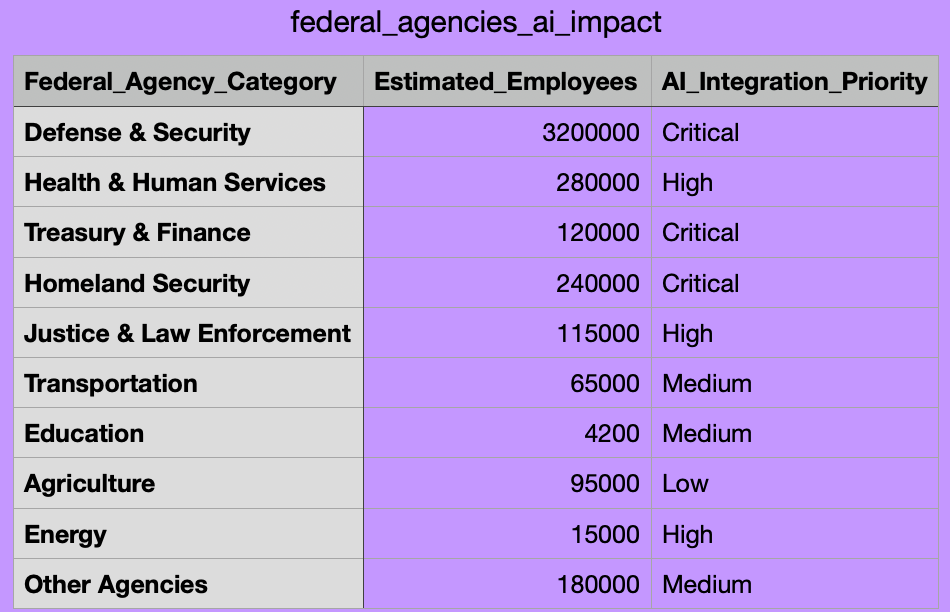
Federal agencies with over 4.3 million employees now face algorithmic surveillance under AI.gov
Technocracy is the science of social engineering, the scientific operation of the entire social mechanism to produce and distribute goods and services to the entire population of this continent. For the first time in human history it will be done as a scientific, technical engineering problem. There will be no place for Politics or Politicians, Finance or Financeers, Rackets or Racketeers.


Technocracy states that this method of operating the social mechanism of the North American Continent is now mandatory because we have passed from a state of actual scarcity into the present status of potential abundance in which we are now held to an artificial scarcity forced upon us in order to continue a Price System which can distribute goods only by means of a medium of exchange. Technocracy states that price and abundance are incompatible; the greater the abundance the smaller the price. In a real abundance there can be no price at all. Only by abandoning the interfering price control and substituting a scientific method of production and distribution can an abundance be achieved. Technocracy will distribute by means of a certificate of distribution available to every citizen from birth to death.
The Technate will encompass the entire American Continent from Panama to the North Pole because the natural resources and the natural boundaries of this area make it an independent, self-sustaining geographical unit. Technocracy’s blue -prints have been designed for this continent and for no other. It is an American Plan for the American continent, No imported political philosophies including Democracy are in any way applicable.
Technocracy views governance as an engineering problem requiring solutions from credentialed experts. It promises efficiency and “data-driven decisions” but eliminates citizen agency from the governing process. As Patrick Wood, author of Technocracy: The Hard Road to World Order, warns:
“Technocracy removes political structure and citizen involvement. It hands control to a scientific dictatorship.”
Cognitive Liberty Presents: Resist The Technocracy


Global AI Surveillance is moving mainstream
The AI.gov threat mirrors global trends:
56 countries now use AI surveillance, with government contracts surging to $95M in 2024
China’s social credit system and the EU’s proposed AI Act reveal a disturbing convergence between authoritarian and democratic states. Even the Department of Homeland Security now monitors “soft targets” like shopping malls using AI surveillance.
The Path Forward: Reclaiming Human Agency
We stand at a crossroads. The choice isn’t between efficiency and inefficiency—it’s between human agency and algorithmic control, the Constitutional Republic vs algocracy.
- Transparency: Every AI.gov algorithm must be open to public inspection.
- Human Review: All AI decisions require human oversight and appeal processes.
- Cognitive Liberty Zones: Federal employees deserve surveillance-free communication channels.