
Researchers at NYU Tandon School of Engineering have created VeriGen, the first specialized artificial intelligence model successfully trained to generate Verilog code, the programming language that describes how a chip’s circuitry functions.


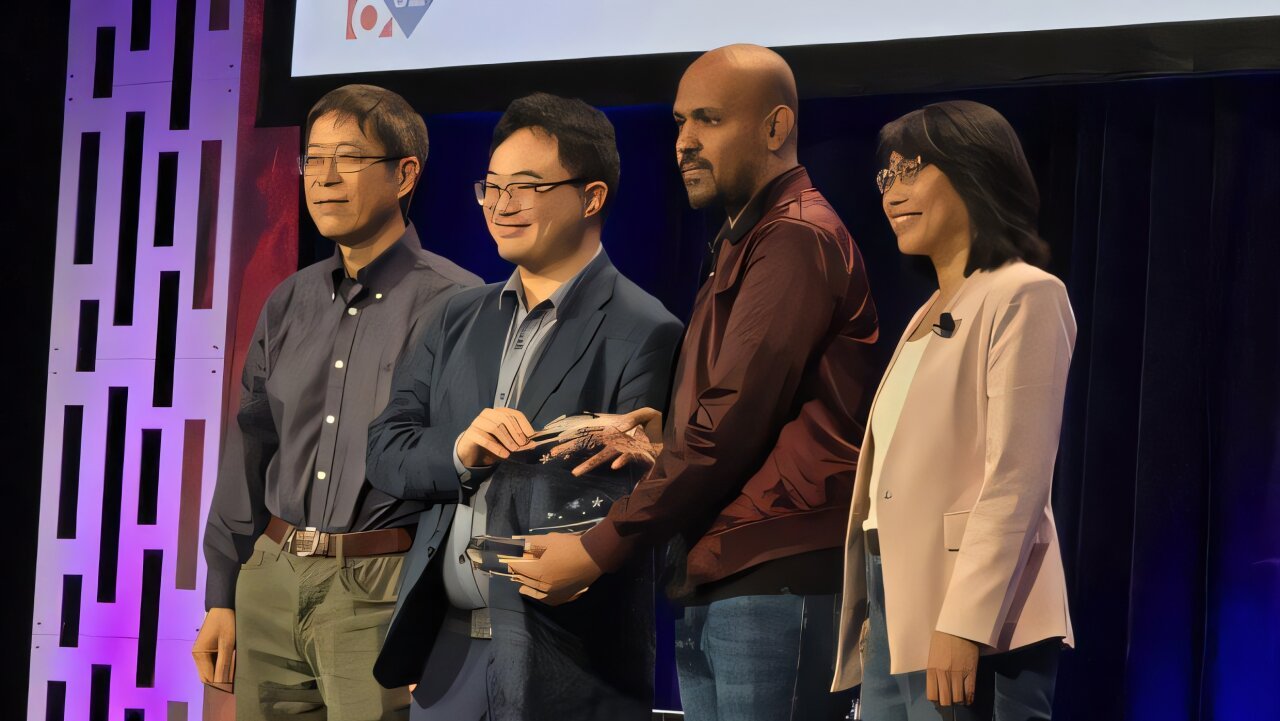
The research just earned the ACM Transactions on Design Automation of Electronic Systems 2024 Best Paper Award, affirming it as a major advance in automating the creation of hardware description languages that have traditionally required deep technical expertise.
“General purpose AI models are not very good at generating Verilog code, because there’s very little Verilog code on the Internet available for training,” said lead author Institute Professor Siddharth Garg, who sits in NYU Tandon’s Department of Electrical and Computer Engineering (ECE) and serves on the faculty of NYU WIRELESS and NYU Center for Cybersecurity (CCS). “These models tend to do well on programming languages that are well represented on GitHub, like C and Python, but tend to do a lot worse on poorly represented languages like Verilog.”
Along with Garg, a team of NYU Tandon Ph.D. students, postdoctoral researchers, and faculty members Ramesh Karri and Brendan Dolan-Gavitt tackled this challenge by creating and distributing the largest AI training dataset of Verilog code ever assembled. They scoured GitHub to gather approximately 50,000 Verilog files from public repositories, and supplemented this with content from 70 Verilog textbooks. This data collection process required careful filtering and de-duplication to create a high-quality training corpus.
For their most powerful model, the researchers then fine-tuned Salesforce’s open-source CodeGen-16B language model, which contains 16 billion parameters and was originally pre-trained on both natural language and programming code.
The computational demands were substantial. Training required three NVIDIA A100 GPUs working in parallel, with the model parameters alone consuming 30 GB of memory and the full training process requiring approximately 250 GB of GPU memory.
This fine-tuned model performed impressively in testing, outperforming commercial state-of-the-art models while being an order of magnitude smaller and fully open-source. In their evaluation, the fine-tuned CodeGen-16B achieved a 41.9% rate of functionally correct code versus 35.4% for the commercial code-davinci-002 model—with fine-tuning boosting accuracy from just 1.09% to 27%, demonstrating the significant advantage of domain-specific training.
“We’ve shown that by fine-tuning a model on that specific task you care about, you can get orders of magnitude reduction in the size of the model,” Garg noted, highlighting how their approach improved both accuracy and efficiency. The smaller size enables the model to run on standard laptops rather than requiring specialized hardware.
The team evaluated VeriGen’s capabilities across a range of increasingly complex hardware design tasks, from basic digital components to advanced finite state machines. While still not perfect—particularly on the most complex challenges—VeriGen demonstrated remarkable improvements over general-purpose models, especially in generating syntactically correct code.
The significance of this work has been recognized in the field, with subsequent research by NVIDIA in 2025 acknowledging VeriGen as one of the earliest and most important benchmarks for LLM-based Verilog generation, helping establish foundations for rapid advancements in AI-assisted hardware design.
The project’s open-source nature has already sparked significant interest in the field. While VeriGen was the team’s first model presented in the ACM paper, they’ve since developed an improved family of models called “CL Verilog” that perform even better.
These newer models have been provided to hardware companies including Qualcomm and NXP for evaluation of potential commercial applications. The work builds upon earlier NYU Tandon efforts including the 2020 DAVE (Deriving Automatically Verilog from English) project, advancing the field by creating a more comprehensive solution through large-scale fine-tuning of language models.
VeriGen complements other AI-assisted chip design initiatives from NYU Tandon aimed at democratizing hardware: their Chip Chat project created the first functional microchip designed through natural language conversations with GPT-4; Chips4All, supported by the National Science Foundation’s (NSF’s) Research Traineeship program, trains diverse STEM graduate students in chip design; and BASICS, funded through NSF’s Experiential Learning for Emerging and Novel Technologies initiative, teaches chip design to non-STEM professionals.
More information:
Shailja Thakur et al, VeriGen: A Large Language Model for Verilog Code Generation, ACM Transactions on Design Automation of Electronic Systems (2024). DOI: 10.1145/3643681
NYU Tandon School of Engineering
Citation:
Engineers create first AI model specialized for chip design language (2025, June 26)
retrieved 26 June 2025
from https://techxplore.com/news/2025-06-ai-specialized-chip-language.html
This document is subject to copyright. Apart from any fair dealing for the purpose of private study or research, no
part may be reproduced without the written permission. The content is provided for information purposes only.