PRAGUE—China describes its space activity—including the deployment of highly maneuverable satellites, satellites equipped with robotic arms, and moon missions—as nonmilitary. But officials from the United States and Taiwan, as well as independent space experts, worry that China is “rehearsing” how to use satellites as space weapons in the opening days of an invasion.
They also fear China is positioning itself to press other nations into accepting whatever space activities Beijing defines as “normal.”


Speaking at the 8th annual Space Security Conference here this week, Holmes Liao, a senior adviser to the Taiwan Space Agency, said China’s recent space activities are “not just logical demonstrations, but could be, maybe, rehearsals for future space design operations.”
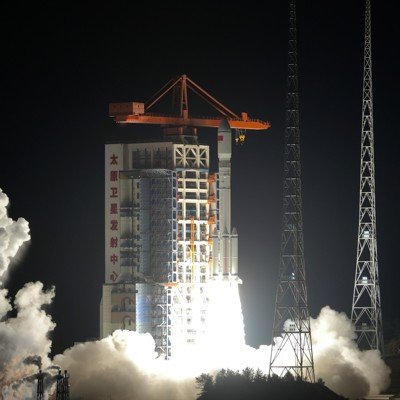
Those activities include the use of several satellites to perform complex maneuvers—what Gen. Michael Guetlein, vice chief the U.S. Space Force, described in March as “dogfighting” in space, a term Liao echoed on Monday. Liao also recounted a January 2024 incident in which China launched a rocket from the Xichang Satellite Launch Center in Sichuan province: “Because of the trajectory,” he said, “Taiwanese radar picked up the launch as an incoming missile.”
That incident reflects an increasingly common Chinese tactic: using military exercises, launches or air patrols to trigger alarms in Taiwan. Last week, at the GLOBSEC security forum—also in Prague—Taiwan’s foreign minister, Chen Ming-tong, said China’s “gray zone” operations are designed to strain Taiwan’s readiness and response capacity—sometimes by literally exhausting radar operators or pilots. The term refers to coercive actions that fall below the threshold of armed conflict.
Chen added that China is extending similar tactics to Taiwan’s partners, including Japan. The recent deployment of two aircraft carriers near Japan “serves the same purpose—to exhaust their capability to meet the challenge,” he said.
Like Liao, Chen used the word “rehearsal” to characterize the intent. “That activity looks and smells less like an exercise. It’s more like a rehearsal of a large-scale invasion,” he said.
China’s behavior in orbit mirrors its strategy at sea, said John Huth, director of the Defense Intelligence Agency’s Office of Space and Counterspace.
“I think the South China Sea is the perfect example of what the CCP does when they develop leverage,” Huth said. “There were simply atolls there that they added sand to. They created an airfield, they put leverage on it, and they now defend it with their coast guard vessels. They did that in an area with overlapping territorial claims from their neighbors.”
China’s ultimate goal could be extending that strategy into space where the territory could be the orbital trajectory of a satellite, a constellation of satellites, or even dominance of the moon, Huth said.
“If they are the first to land on the moon and deliver a cislunar base, that puts them in the driver’s seat.”
Chen said Taiwan, for its part, is adapting to reduce fatigue and resource strain.
“We don’t have enough ships to ship-by-ship and plane-by-plane [assets] to scramble and meet the challenge at sea. So we have to come up with some more innovative way to deal with that.”
That includes using artificial intelligence to analyze a broader range of satellite and other sensor data to determine whether Chinese maneuvers are routine or a precursor to attack.
Taiwan is applying the same AI-assisted analysis to counter Chinese gray-zone tactics in orbit, Liao said. The Taiwan Space Agency is building a space surveillance center where operators will use AI and space situational awareness data to better interpret satellite maneuvers and rocket launches.
Both missions require vast amounts of data, particularly radar. But while ground- and sea-based radar are common, space-based radar is much more rare.
Tony Frazier, CEO of space radar company LeoLabs, said demand for space-based radar to track objects in orbit is rising globally.
“We see demand in Asia. We signed [a memorandum of understanding] with Singapore,” Frazier said. “There are other activities progressing in our pipeline, and I see similar opportunities emerging in Europe and the Middle East,” in addition to ongoing work with the U.S. government.