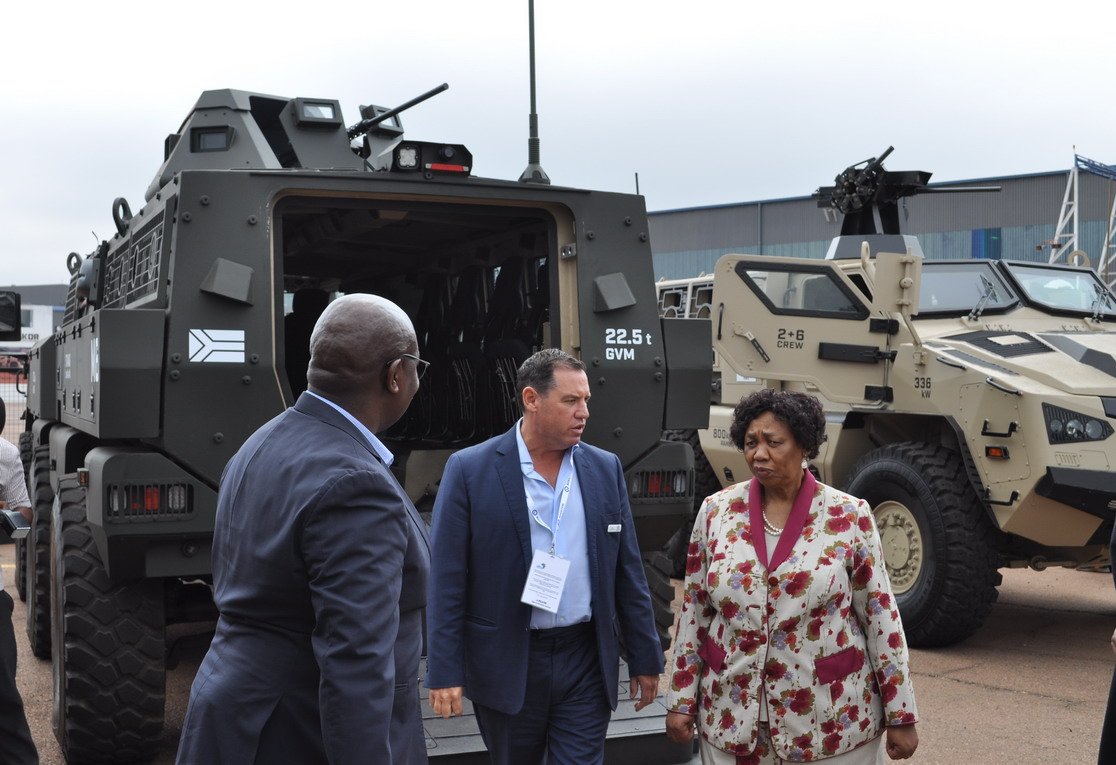

South Africa’s Minister of Defence and Military Veterans, Angie Motshekga, has expressed her strong admiration for the South African defence industry (SADI), calling it one of the country’s most valuable assets and a pillar of national capability.
Speaking following the conclusion of the South African National Defence Force’s (SANDF’s) commemoration of the International Day of United Nations Peacekeepers, Motshekga praised both the public and private sector elements of the SADI for their innovation, resilience, and international reputation, describing the industry as “world class” – while also acknowledging that financial constraints continue to hamper its full potential.


“I was in awe to see how strong the South African defence industry is…. even in terms of the private companies that are there,” she told journalists during the 29 May peacekeepers day in Bloemfontein. “We sell technology even to France; I saw it at the NCACC [National Conventional Arms Control Committee] meeting last night.”
Motshekga also emphasised the economic benefits that a strong and growing SADI could bring to the wider South African economy, telling reporters: “we have a very strong defence industry as a country, that we should be proud of and should support so that we get more young people that have skills, because it is high science.”
“They [the SADI] have a huge potential to contribute to our economic growth as long as we can invest, support them; they are going to be a big factor in our economy growing.”
The Minister cited South African participation in recent international defence exhibitions as evidence of the local industry’s capabilities and global competitiveness. “I went to Malaysia recently, where South African companies were exhibiting and supplying their highly sophisticated technology to world class companies,” she said. “While we have a very strong industry, we just need to find a way to make it stronger.”
Motshekga’s remarks are consistent with what appears to be a renewed impetus from the South African government to support the domestic arms industry, particularly as it holds potentially significant benefits for the wider economy. One example is the recent participation of high-ranking SANDF and government officials, including Deputy Minister of Defence Bantu Holomisa, in the Public-Private Partnerships for Defence and Security Conference in March of this year. The conference was aimed at enhancing coordination and cooperation between the public and private spheres in defence, with the ultimate goal of supporting the SADI’s sustainability and growth in order to meet the present and future needs of the SANDF, while also supporting broader economic growth.
Denel: Worth Saving
Motshekga chose to highlight Denel as key element in the SADI’s future, labelling it as “family silver” and describing it as “one of the most valuable assets we have as a country that also puts us at a very strong footing.”
“We are rebuilding Denel,” she said, pointing to the strategic value of the company despite its years-long crisis of financial mismanagement, skills flight, and operational decline. “I am aware that there was a big country that wanted to partner with us, and said we can sell you this and sell you that, we can assist you, and when they came here, they said but your facilities are superior to ours, I think it was China.”
The praise for Denel comes despite the company remaining in what could be described as a perpetual state of crisis. Once the crown jewel of South Africa’s defence manufacturing capability, Denel has suffered a severe erosion of capacity, losing contracts, engineers, and market share. Its recovery has been slow, hampered by underfunding, internal dysfunction, and limited political will. The company’s inability to deliver on the long-delayed Project Hoefyster is but one manifestation of its ongoing struggles.
Meanwhile, Armscor (the state arms procurement agency) has also struggled to meet its mandate and ensure operational efficiency. Neither entity has been able to adequately provide for the needs of the SANDF, whose own budget constraints have exacerbated the problem.
Private Sector Innovation Driving Growth
Most of the recent growth and innovation in the South African defence industry has come from the private sector, which has filled the void left by faltering state-owned entities. Despite numerous challenges, ranging from restricted access to capital, to regulatory delays, privately-owned defence firms have managed to increase exports and participate in international projects, often on highly competitive terms.
Indeed, it is estimated that approximately 80 percent of South African produced arms are destined for the export market, with some private companies reportedly exporting some 90 percent of their products. Interestingly, the National Conventional Arms Control Committee’s annual reports indicate that, over the past five years, the SADI has experienced significant uptick in its fortunes, with the value of exports increasing dramatically since 2022. This has been largely driven by an upsurge in global defence spending in the wake of the Russian invasion of Ukraine.
While the SADI has done relatively well over the past several years, Motshekga acknowledged that economic constraints remain a key and immediate challenge. “As long as we get money [to] support it, get it to work, we are in a very good position,” she said. “But as we always say, the resources are limited. Our stubborn economy, which is not growing, makes it difficult for Treasury to give us the basic money that we need.”
She warned that a failure to invest in the industry could undermine its sustainability: “We have to buy first as a country from them. If the local country does not buy, they are not going to sell. So, it is those things we have to get right.”