– Advertisement –
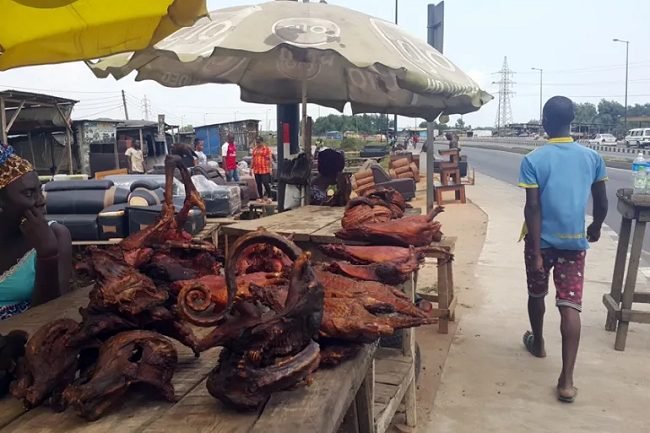
At Oluwo Market in Epe, a coastal town on the outskirts of Lagos, bushmeat sells fast. Antelopes, grasscutters, porcupines, monkeys, snakes. There’s a buyer for every animal.
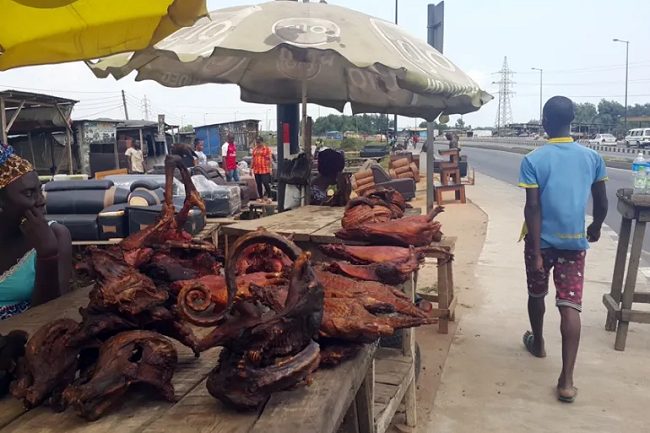
For Sunday Adeeko, a bushmeat retailer with over a decade in the trade, the business is simple: supply and demand. “There is no law that says we should not kill bushmeats,” he claimed, adding, “Only pangolins are not for sale. We are told not to kill them, but I don’t know of any other.”
This widespread and dangerously false perception goes to the heart of Nigeria’s biodiversity crisis. Across markets and forests, ignorance of wildlife laws and indifference to ecological consequences are driving endangered species toward extinction. Pangolins, elephants, gorillas, and lions are being hunted and traded in defiance of international treaties and national legislation.
Dr. Mark Ofua, a conservationist and veterinarian, disagrees with Adeeko on his claim that no law prevents the killings of protected animals as bushmeat. For contextual understanding, he explains the differences between legal and illegal bushmeat.
“There is what we call legal bushmeat, and there is illegal bushmeat. Legal bushmeat is the consumption of bushmeat that is not legislated by law. There is no law protecting these animals because they are not in danger of extinction. In the International Union for Conservation of Nature IUCN classification, they are referred to as least concerned. These animals reproduce very fast, and they are everywhere. These include animals such as the Giant Rats and porcupines. The reproductive rate of these animals is very high, so there is no danger of losing them.
“On the other hand, illegal bushmeat is the consumption or trade in bushmeats that is protected by law, consumption of wild animals that is protected by law, so when you engage in this, you are a criminal. Certain animals are protected by law, either because of their importance to us or because they are on the brink of extinction, and we are about to lose them.
“These animals usually have very slow reproduction rates. For example, the elephant that carries a pregnancy for about 22 months, the pangolin that has a baby every 18 months animals reproduce very slowly, and our consumption and activities have pushed them to the brink of extinction; therefore, a law has now been promulgated to protect them so that we do not lose them and lose the beneficial roles they play to nature.
“If you consume such animals, if you kill, buy, trade, eat such animals, you are committing a crime because these animals are protected by law.”
He also added that he would attribute the claims that animals are not protected, made by people like Adeeko, including bushmeat sellers and hunters, to Ignorance.
“What they have majorly is ignorant, and as they say, ignorance of the law is not an excuse. So many animals are protected: pangolins, elephants, lions, gorillas, and chimpanzees are all protected species, and pythons, crocodiles, and monitor lizards are protected. Many animals are endangered and protected by law; however, the protection is insufficient, as they are also threatened.
“Additionally, some animals are prohibited due to the inherent danger of introducing them to cities for use as food or pets. Illegal bush meat consumption is a crime, and it’s a real thing. It is even a crime to keep those protected animals as pets at home, let alone consume them. They must be released back into their natural habitat in case anything contrary to this is found to violate the law.” Dr Ofua added.
The Situation: A Legal Framework Failing Wildlife
Nigeria is home to rich biodiversity, but the laws designed to safeguard it have not kept pace with reality. The Endangered Species (Control of International Trade and Traffic) (Amendment) Act of 2016 is rife with loopholes. It lacks meaningful penalties and fails to define clear agency roles for enforcement. As a result, wildlife offenders often walk free – or pay token fines that pale in comparison to the black-market value of the animals they exploit.
Even more troubling is the lack of public awareness. In many bushmeat markets, endangered species are openly sold, sometimes with law enforcement officials unaware of the illegality. The distinction between legal and illegal bushmeat has blurred, largely due to inconsistent messaging and poor community engagement.
The Problem: Extinction at the Edge of Awareness
Nigeria has already lost cheetahs and rhinos. Now fewer than 400 elephants and fewer than 50 lions remain. Pangolins – once widespread – are vanishing rapidly due to poaching and trafficking. These animals are not just biologically significant; they play critical roles in maintaining healthy ecosystems. Many, like elephants and pangolins, reproduce slowly, making population recovery nearly impossible without intervention.
Consuming or trading in species such as chimpanzees, crocodiles, pythons, and monitor lizards is illegal – but public ignorance enables continued violations. Protected species are not only killed for meat but sometimes kept illegally as pets, with little awareness that such actions constitute a crime.
The Solution: A Stronger, Smarter Wildlife Law
The proposed Endangered Species (Conservation and Protection) Bill 2024, which recently passed a third reading, offers a lifeline. It fixes the gaps in the current law, assigns clear responsibilities to agencies like Customs, Police, and NESREA, and establishes penalties proportionate to the ecological and economic damage caused by wildlife crimes.
It also provides for better judicial handling of conservation cases. Judges unfamiliar with environmental law will now have legislative guidance, ensuring wildlife criminals face real consequences – not token fines. A poacher who kills an elephant should not be punished with a ₦100 penalty when a single tusk may be worth millions.
According to Dr Ofua: “There are lots of loopholes in the old laws that these criminals have learnt to exploit; for instance, they have learned to walk their way around these laws and get off the hook. The old laws also did not clearly outline the roles of enforcement agencies, whose job is to catch criminals at our borders or in their hideouts, as is the case with other crimes. The new law will address all these loopholes.”
Broader Commitments and Needed Actions
Nigeria is a signatory to the Convention on International Trade in Endangered Species of Wild Fauna and Flora (CITES). But signing is not enough. Implementation must follow. That means not only passing the 2024 Bill, but investing in national awareness campaigns, empowering communities with knowledge, and ensuring law enforcement officers are trained to identify and act on wildlife crime.
The media, NGOs, and local institutions must also play a role. Citizens need to understand which animals are protected, why they matter, and how protecting them supports public health, food systems, and national heritage.
Conclusion: From Ignorance to Action
Nigeria’s wildlife is not an infinite resource. It is a legacy under siege. To save it, we must move beyond outdated policies, cultural inertia, and legal ambiguity. The new wildlife bill is not just a legal tool – it is a national imperative. It turns confusion into clarity, impunity into accountability, and decline into hope.
By acting now, by strengthening the law, educating the public, and enforcing protections – we protect not just animals but ourselves. Because every species we lose brings us closer to ecological collapse. And every step we take toward protection brings us closer to a sustainable future.
“Nigeria is blessed with a diversity of animals and plants. Some we have lost forever; the Cheetahs and Rhinos are functionally extinct from Nigeria, and many animals are functionally extinct from Nigeria. We need to work together and ensure we don’t lose any further. This can happen when we strengthen our laws, increase awareness about their importance, and work together to move from apathy to empathy for nature and wildlife,” Dr Ofua added.
By Ajibola Adedoye