When residents of Uis in western Namibia started noticing daily convoys of large trucks leaving what they thought was a small-scale artisanal mining site in January 2023, a group of community activists sprang into action.
They helped uncover an illegal Chinese lithium mining scheme involved in allegations of fraud, corruption, environmental crimes and labor abuses. Within months they had organized protests that have continued ever since.
Namibia’s Ministry of Mines and Energy launched a criminal investigation in December 2024 after a surprise inspection by mining commissioner Isabella Chirchir found that Xinfeng Investments had mixed thousands of metric tons of unprocessed lithium ore with legally mined ore at its facility in Uis.
“We were illegally mining at Ringman, about 10 kilometers from Xinfeng,” an employee told state-owned newspaper The New Era on the condition of anonymity. “The commissioner found employees transporting ore back to Xinfeng.”
Chirchir ordered the company to halt operations. It was the second time a Xinfeng mine was shut down. The first was in 2023 when its mine in Kohera violated the country’s ban on critical raw mineral exports.
During meetings with the ministry in December 2024, Xinfeng’s management admitted guilt, saying that its mining operations exceeded the approved scope of the license.
Namibia has significant lithium deposits, particularly in the Erongo region, and is emerging as a key part of the global market for the metal, which is crucial in producing batteries for electric vehicles and other applications.
Xinfeng Investments is a subsidiary of the Chinese firm Tangshan Xinfeng Lithium Industry, whose facility in China’s Hebei province can produce 20,000 metric tons of battery-grade lithium materials.
Locals have accused Xinfeng of exploiting their land, bribing traditional chiefs to evade proper permitting, mistreating local workers, damaging the area’s ecotourism industry and failing to deliver on promises to build processing facilities in Namibia.
Activists and media investigations have produced evidence that Xinfeng developed its industrial mine in Uis using 10 permits intended for local small-scale miners that were bought for $140 total. The permits also allowed Xinfeng to avoid an environmental impact assessment.
“We have two mines currently operating, making millions, yet those millions do not reflect in Uis,” activist Jimmy Areseb told New Era in January 2025. “How is it that the community remains poor, yet millions worth of ore are shipped out from Uis?”
In early January, community members spent a week camped out at the Dâure Daman Traditional Authority offices of traditional chiefs and councilors, whom they accused of accepting bribes from Xinfeng and granting it an exclusive prospecting license (EPL) to mine lithium without following proper procedures.
During a January 4 demonstration, they demanded that their chief be removed. Some protesters were removed by force, and Areseb was arrested.
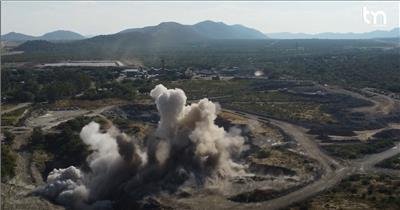
The Chinese-owned company has shown no respect for the community and its surrounding environment, he said, blaming frequent dynamite blasting for chasing away wildlife and harming tourism, the community’s traditional source of income.
“The places they are mining are sensitive breeding areas of wildlife from which the Tsiseb conservancy was earning an income for the community through trophy hunting,” he said. “When illegal lithium mining started, the animals moved from the area. When the trophy hunter with whom we had the contract came, there were no animals, and the community lost the contract.
“The other areas where mining is taking place are home to ancestral graves. Our elders who are still alive have been going to the relevant offices to lay their complaints that blasting is taking place in sacred areas, but it has been to no avail.”
Anmire Dâusas, a community member, said it is clear the company did not do an environmental impact assessment.
“If they had done the assessment, they would have known which areas are for tourism and where the graves are through their own study and consultation with the community members,” she told The Namibian newspaper. “But these were not done, and yet they were awarded environmental clearance certificates. This is why we say the awarding of the EPL has irregularities.”
Areseb said Xinfeng intentionally avoided negotiations that would have given the community a platform to request direct benefits such as investment in infrastructural development, sponsorships, and donations to farmers and small miners.
Uis locals and Namibian parliamentarians also have accused Xinfeng of housing workers in “apartheid conditions” and scaring away the wildlife that brings in tourism revenue.
Between January 2021 and December 2022, there were 102 cases of alleged human rights and environmental violations that implicated 39 Chinese mining companies involved in the extraction of minerals, according to a 2023 report released by the Business & Human Rights Resource Centre.
“Our data shows that human rights and environmental violations are common in the exploration, extraction and processing of transitional energy minerals,” the report stated.
Although mining is the single biggest contributor to the country’s gross domestic product, Namibians have grown increasingly irate as Chinese mining companies have removed tens of millions of dollars’ worth of natural resources with little benefit to the people. The Xinfeng saga is just another example of an ongoing debate across the continent.
“The government only receives the 2% in royalty payments,” Areseb told The Namibian in February 2025. “What is there for us? These are companies that bring their own employees, pay them salaries, provide housing for them and export the raw materials to add value in their country. Namibians don’t get jobs there.”