De facto reuse is defined as the unplanned or incidental presence of treated wastewater in a water supply source, and the use thereof as a drinking water supply source. This can negatively impact end-users, affecting health and causing aesthetic issues like unpleasant taste and odour from algal blooms.
The quality of drinking water sources is rapidly deteriorating on a global scale, largely due to overloaded wastewater treatment systems, industrial discharge and unsewered informal settlements. This situation is exacerbated during times of drought, when a large portion of river flow consists of wastewater (when the base flow is low). This issue is especially critical locally, as many water supply authorities and service providers rely on these polluted rivers and dams to provide drinking water for the communities and industries they serve.
Our drinking treatment plants were not designed to treat poor quality water, and are mostly equipped for conventional water treatment processes. Their process configurations should therefore include advanced treatment technologies to ensure removal of all unwanted pollutants from the incoming water.
While provision has been made to add new or modify existing treatment processes, but this is done on a project by project basis, and only at the larger water treatment plants, resulting in a high risk for pollutants (in particular micro-pollutants) to pass through the treatment plants and have a health impact on communities.
How prevalent is de facto water reuse in South Africa?

In a research project undertaken for the Water Research Commission by Chris Swartz Water Utilisation Engineers (CSWUE), ten of the largest rivers in the country were surveyed and sampled in an attempt to establish the extent of de facto reuse
In a research project undertaken for the Water Research Commission by Chris Swartz Water Utilisation Engineers (CSWUE), ten of the largest rivers in the country were surveyed and sampled in an attempt to establish the extent of de facto reuse. These rivers serve as important resources for drinking water abstraction, industrial use, and irrigation purposes. The findings of the research showed that they are severely impacted by wastewater pollution and this poses a health risk when the water from these rivers are used as sources for producing drinking water. Under low base-flow conditions, the impact of wastewater effluent contributions increases dramatically, therefore the wastewater percentage contribution is highly dependent on streamflow and stream size. De facto reuse is increasing on a widespread basis in South Africa. The impact thereof is dependent on the concentration, volume, and consistency of wastewater in raw water sources in South Africa.


Micro pollutants

Breede River was one of the rivers sampled for de facto reuse

It is the human health and environmental effects of exposure to the micro-pollutants in these waters that are of considerable concern. For this reason, these micro-pollutants are also referred to as chemicals (or contaminants) of emerging concern (CECs). The monitoring of CECs poses several challenges. Due to the sheer number of CECs and their transformation products, it would be impossible to monitor each of the chemicals individually and will be extremely time-consuming and expensive. Another challenge is that the relevance of these chemicals changes a lot over time due to changes in production, use and disposal and there is limited availability of new information about their occurrence, fate, and hazards. The necessary upgrading of the existing conventional water treatment plants to include advanced water treatment processes for removal of the CECs will, in addition, have a huge impact on the cost of drinking water production. Some of the main reasons for monetary estimates of the impacts of water pollution include raising awareness in order to convince politicians, community leaders and health administrators that a pollution problem of significant magnitude exists, and to encourage them to engage in preventative strategies, and analysing the cost-effectiveness of water pollution interventions or improved technological barriers to prevent disease outbreak when applying water reuse.
Solutions
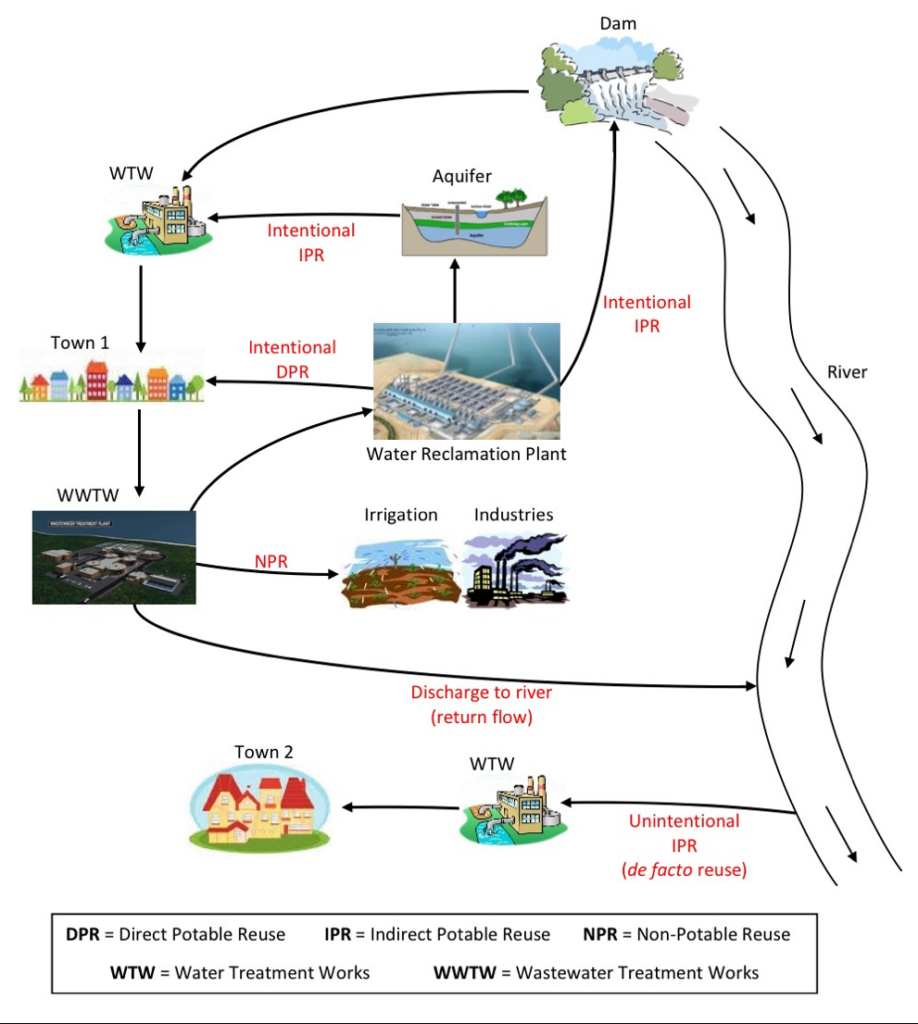
Different types of water reuse.
The Water Research Commission project evaluated the effectiveness of various unit treatment processes at selected South African water treatment plants in removing CECs. The results showed that conventional treatment processes such as coagulation, flocculation, sedimentation, and adsorption can remove moderate amounts of CECs (50 to 70%). However, the removal efficiency may vary depending on the physiochemical properties of the CECs as well as the quality of the water matrix. The addition of an advanced oxidation process (AOP), such as ozonation, or a membrane process such as Reverse Osmosis (RO) to the treatment configuration of the plant drastically increased the removal capability to a high degree of CEC removal (> 85%). Therefore, a multi-barrier treatment configuration will be the most effective approach for the removal of CECs from surface waters for drinking water production.

Chris Swartz,
Lead: Water Reuse Division Western Cape Chapter, WISA
One of the conclusions of the study was that there is a need to adopt the methodology that was developed in this study as part of the national water resource monitoring programs, such as the Integrated Waster Quality Management Strategy (IWQMS), to better understand the level and impact of wastewater on surface water resources. It is also clear that CECs should be incorporated in the Department of Water and Sanitation’s water quality databases and data dissemination platforms. Not only will this address various environmental and health challenges, but it will also assist in the evaluation of water and wastewater treatment operations and management. Expert insight by Chris Swartz, Lead: Water Reuse Division Western Cape Chapter, WISA