
Roketsan is Turkiye’s flag carrier in rocket and missile technologies. The company intends to expand its relations with African armed forces, having many products particularly well suited to their needs.
A number of African nations already use Roketsan products, including Niger, Mali, Ethiopia, Chad, and Djibouti. Many of these countries equip their unmanned aerial vehicles (UAVs) with Roketsan munitions.


“We have been proudly waving our flag in many parts of the world as one of the top 100 defence companies. Having strong relations both with our country and our defence industry, the African countries are of great importance for us as well,” Murat İkinci, Roketsan CEO, told defenceWeb.
“We at Roketsan intend to further develop relations with Africa and to increase our contribution to security in Africa by reinforcing the already strong political and cultural ties between Turkiye and Africa, expanding them to the defence industry. We are determined to offer optimum solutions to the security needs of African countries with our field-proven products that outweigh competitors in terms of their price-performance ratio,” he said.
One product Roketsan believes can reinforce African militaries with is the laser-guided CIRIT 70 mm 8 000 metre range rocket. Lightweight at just 15 kg, it can be used by helicopters, light attack aircraft and UAVs, and from ground or ship launchers. The related MAM-C omits the rocket motor, resulting in a 6.5 kg glide bomb with up to 8 000 metre range depending on release altitude.
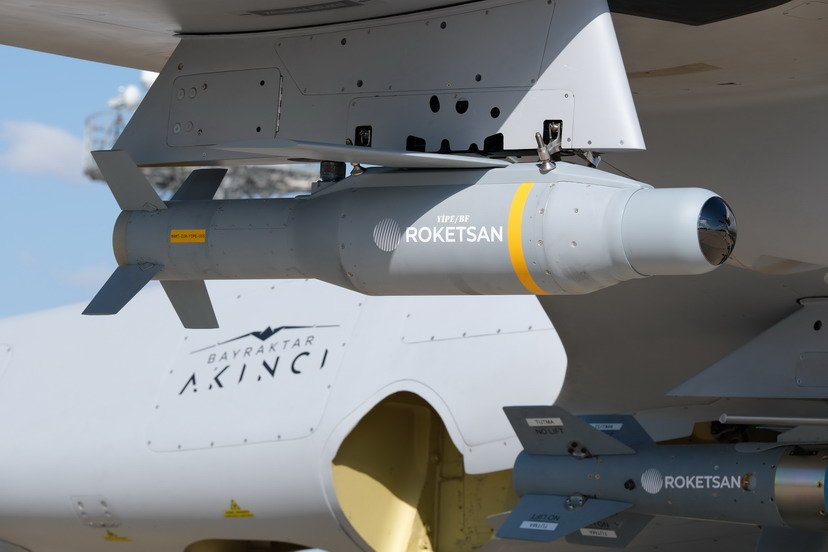
Also of interest will be the MAM-L and MAM-T glide bombs. The 23 kg MAM-L has a 25 km+ range depending on release altitude. It has an imaging infra-red (IIR) seeker and an RF datalink, and can have a tandem anti-tank, fragmentation or thermobaric warhead, and has been integrated with several UAVs. The 95 kg MAM-T is a winged glide bomb intended for use from heavier UAVs and manned aircraft with 50 km range depending on the release altitude. It has a blast/fragmentation warhead and GPS/INS complementing the IIR terminal guidance.
“The striking power of Turkish UAVs, which have become world-renowned and are included in the inventory of numerous countries, is enhanced by our Smart Micro Munition (SMM) family. We are further developing this product family, which has been a source of our export success and an indispensable component of Bayraktar TB2 UCAVs. Especially the IIR (Imaging Infra-Red) guidance capability of the MAM-L, which gives precision strike capability up to 25 kilometres, and has demonstrated superior performance in test firings,” Ikinci said.
“We believe that the Bayraktar TB2 UCAV and MAM-L duo, which have proven their success in the field, could be the most effective solution for the countries in Africa in their combat against terrorist threats. We are inviting our friends in Africa to become acquainted with this risk-free defence system that can neutralise both internal and external threats in the air.”
Another practical tool being promoted is the TEBER guidance kit for Mk 81 and Mk 82 bombs, which use an Inertial Navigation System, a Global Positioning System and a laser seeker.
Among Roketsan’s anti-tank missiles, the 2 500 metre range KARAOk uses an IIR seeker for fire-and-forget capability, has a tandem warhead and both direct and top attack modes. The 4 000 metre range OMTAS has an IIR seeker and RF data link for man-in-the-loop capability. The seeker has lock-on-after-launch and lock-on-before-launch modes. It has tandem HEAT, blast/fragmentation or thermobaric warheads.
The L-UMTAS long-range laser-guided anti-tank missile has a range of 8 000 metres, lock-on-before-launch and lock-on-after-launch capability, and tandem HEAT, blast/fragmentation or thermobaric warheads.
Also highlighted is the SUNGUR air defence missile system, of particular interest in that it is intended for use against UAVs and cruise missiles as well as aircraft. It comprises a 360° traverse gyro-stabilised turret that allows fire-on-the-move. Fire direction is by a FLIR STAR SAFIRE 380 HLD system with a laser designator, laser range finder and IFF. The turret mounts four fire-and-forget missiles with IIR seekers. It can engage targets from 500 to 8 000 metres and at altitudes up to 4 000 metres.
The KMC-U Tactical Missile Weapon System uses a stabilised turret with 360° traverse, which can launch the CIRIT and UMTAS. Further development will include the extended-range UMTAS-GM (16 km, dual IIR/SAL seeker) and the SUNGUR air defence missile, making it an extremely flexible fire support system.
The BURC Mobile Air Defence System developed specifically for use against UAVs and loitering munitions has four AESA radars that can detect drones at 4 kilometres, tactical UAVs, helicopters and small vehicles at 20 kilometres, and large vehicles at 24 kilometres. It mounts two four-round SUNGUR missile launcher pods and a three-barrel 20 mm cannon for close-in engagements.
Roketsan’s medium range HİSAR-O Air Defence Missile has an engagement envelope of 25 km in range and 10 000 metres altitude. It uses INS and an RF datalink for midcourse flight and an IIR seeker for terminal guidance.
The TRG-122 guided 122 mm rocket will be of immediate interest to the many African armies with 122 mm systems. The 76 kg rocket has a 13.5 kg blast/fragmentation warhead, and a range of 13-30 km. Guidance uses GPS and GLONASS aided INS giving better than 20 metres CEP (circular error probability), improving to better than 2 metres with terminal laser guidance that could be provided by a UAV marking the target. An air-launched version, IHA-122, with TV or laser guidance has been tested successfully from a UAV.
The RG-230 missile launched from a multiple rocket launcher gives a range of 20 to 70 km with a 42 kg blast/fragmentation warhead. The TRG variant uses GPS/GLONASS aided INS navigation for a 10 metre CEP, and the TRLG variant uses terminal laser guidance for a CEP better than 2 metres. An air-launched version, TRG-230-IHA, has a range up to 150 km.
Perhaps of interest mainly to larger African forces is the ÇAKIR cruise missile. This uses a turbojet to deliver a 70 kg blast/fragmentation warhead to 150 km. The use of radar absorbent materials in the airframe considerably reduces its signature, making it difficult to detect and engage.
Roketsan was established by the Turkish Defence Industry Executive Committee in 1988 as a missile technology centre and is majority owned by the Turkish Armed Forces Foundation. It has developed a wide range of innovative rockets, missiles and guided bombs for the Turkish armed forces and for export. It also manufactures subsystems for international missile projects and is active in space technology since the 2020 establishment of a satellite launch, space systems, and advanced technology research centre.
“Looking forward, Roketsan is developing technologies ‘from under the seas to the depths of space’ by working on air, land, sea, and space systems. As a company that has been operating for 36 years, with more than 5 000 highly-skilled personnel and modern facilities, we can provide reliable system solutions with proven performance for domestic and foreign users. We design, develop and manufactures rockets, missiles, guided munitions and weapon systems, integrate them into land, air and naval platforms, and can provide tailored systems determined by customer requirements. As a result, we hold an indispensable place in the inventories of many countries’ armed forces, particularly the Turkish Armed Forces,” Ikinci said.
“Ranking fourth among the companies investing in research and development nationwide in Türkiye as announced in 2024, our company ranked eleventh in the list of the fastest growing defence companies at a global scale according to the Stockholm International Peace Research Institute (SIPRI) and is included in the list of top 100 defence industry companies ranked by their size, again according to SIPRI, as the signs of our worldwide success. While taking our part among the biggest exporter companies of Türkiye in 2023, we have been sustaining our exports to friendly and allied nations at faster pace in 2024 too as a company that exports its products to many parts of the world from the Americas to Asia and Europe.
“Today, we continue to invest in our human resources and improve our production infrastructure through special programmes. With 36 years of experience and know-how, we continuously enhancing our expertise in land, sea, air and space systems, while developing cutting-edge technologies that places us among the leading companies in the world in our field,” Ikinci concluded.