
There were scenes of protest Wednesday outside the Royal Courts of Justice in London, on the first day of a pivotal court case to review existing oil and gas licences in the North Sea.
Environmentalist and presenter Chris Packham rallied protestors outside the courts.
“It’s a lot more difficult to look after these areas because essentially they’re out of sight and therefore out of mind, so we have to fight extra hard,” Packham told Energy Voice.
“When the licences were granted, there were a lot of things that weren’t taken into account that should have been taken into account. Firstly, proper assessments of the potential impact in those marine protected areas.”
Packham said that opposition to North Sea oil and gas licences from groups such as Natural England and the Joint Nature Conservation Committee (JNCC) was “summarily ignored”.
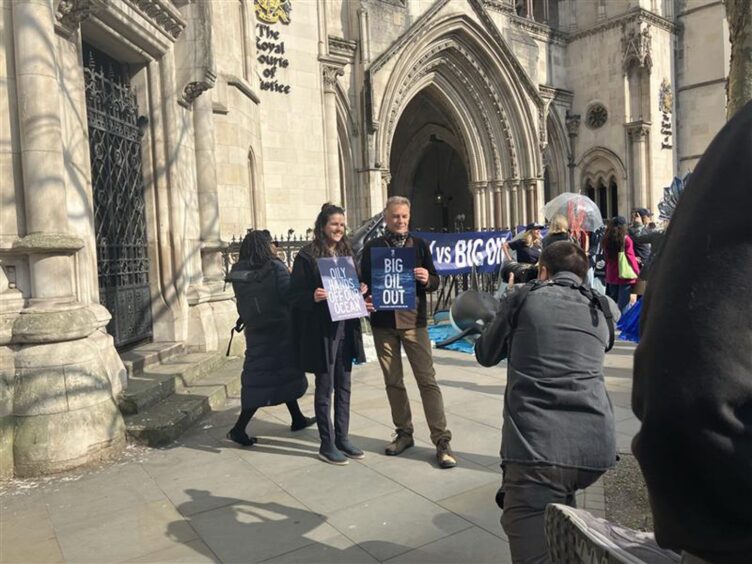 © Jessica Davies/DCT Media
Ocean conservation advocacy group Oceana claims that a raft of licences that were approved by the last Conservative government were issued environmental permits “unlawfully’”.
A lawyer representing the group said in court that the remedy being sought is “quashing” the up-to-31 oil and gas exploration licences that are subject to today’s court hearing.
The case involves the granting of both new and exclusive rights to “search for more petroleum in the green areas that overlap with special areas of conservation,” the court was told.
It centres on licences governing land in the North Sea, around Dogger Bank, the North Sea, West of Shetland and Morecambe Bay.
The lawyer representing the claimant, from law firm Leigh Day, said 28 licences are under challenge, including 24 initial term licences for exploration, involving “drilling and surveying”. A further four of the licences are second term licences, she said.
The case rests on two primary items of legislation, the Habitat Directive protecting marine life in those regions, and the precedent set last June by the Finch ruling against an oil field in Surrey.
A government consultation has ended on how the Finch ruling will apply to environmental assessments, according to Oceana director of policy Alec Taylor.
Red-throated divers, harbour and grey seals, guillemots, reefs and banks that are protected under those designations are all allegedly under threat in the North Sea.
The lawyer for the claimant said that regulations require the defendant to assess activities under the licence and not agree to anything that might “have an adverse effect”.
This is known as a “precautionary approach,” designed to prevent any adverse effects, for example, to the climate.
The claimant’s lawyer clams it “was not possible to rule out adverse effects” around North Sea oil and gas licences, according to the advice of the advisory committee.
This permitted “gaps in the material” to be filled around accidents, climate change and cumulative assessment.
“Climate change had not been factored in at all,” Oceana’s lawyer said of the licence approvals.
She added that there had been a “failure” to assess the effects of accidental events and that the “defendant acted unlawfully”.
In granting licences, the North Sea Transition Authority (NSTA) is required to seek approval from the energy secretary.
The NSTA’s principle objective is to maximise the economic recovery of UK petroleum, but it is also required to aid the government in reaching net zero.
The lawyer said that the defendant did not act in accordance with the necessary precautionary approach or the best scientific material.
“The defendant has misunderstood and failed to apply” the proper licensing process and rules, she added.
She said the advice from the JNCC, the government adviser on nature conservation, was “clear,” which raised concern around scientific doubt as to how climate mitigation efforts would be addressed.
The environmental assessments and licences were unlawful due to a “failure to properly assess the impacts of climate change,” she added.
This relates specifically to “scope one and scope three emissions,” which “flows from the supreme court’s decision in Finch,” according to the lawyer. She also cited an “unlawful approach to assessing” second term licences.