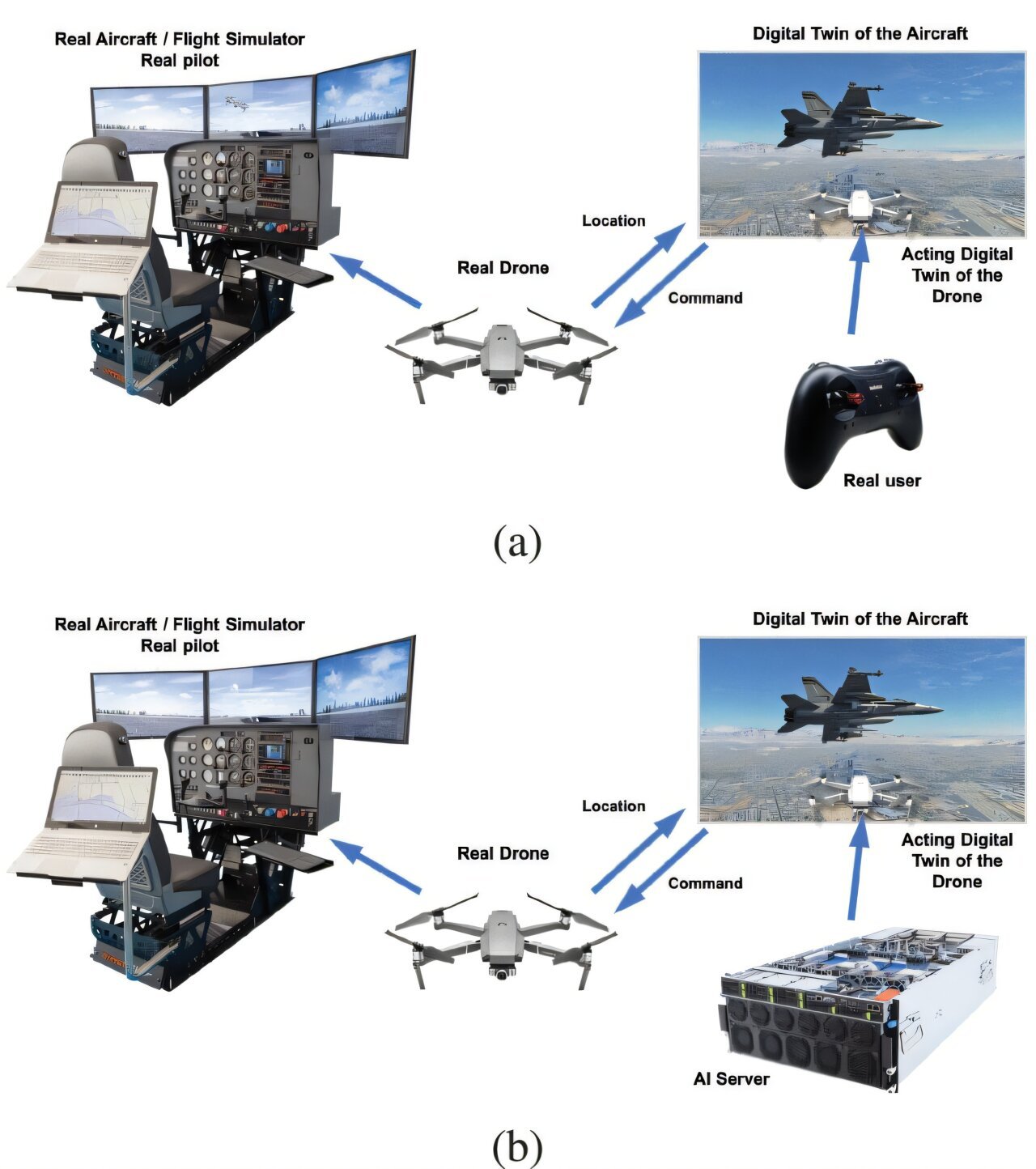

Scientists say they have developed a new AI-assisted model of a digital twin with the ability to adapt and control the physical machine in real time.


The discovery, reported in the journal IEEE Access, adds a new dimension to the digital copies of real-world machines, like robots, drones, or even autonomous cars, according to the authors.
Digital twins are exact replicas of things in the physical world. They are likened to video game versions of real machines with which they digitally twin, and are constantly updated with real-time data.
Engineers and scientists use digital twins to monitor and test machines without touching the physical system, rendering industries smarter and more efficient.
But most digital twins today are just observers. They can analyze and predict what might happen, but they cannot act autonomously.
That’s where the authors’ model comes in. The team introduces the concept of Intelligent Acting Digital Twins (IADT), but unlike traditional digital twins, their IADT doesn’t just watch.
“Imagine a drone chasing an enemy aircraft. A traditional digital twin would simulate different scenarios and suggest possible moves,” said Dr. Ahcene Bounceur, the lead author. “But with IADT, the digital twin can actually autonomously control the drone, learning from human pilots and eventually making its own decisions.”

Dr. Bounceur, an associate professor at the University of Sharjah’s College of Computing and Informatics in the United Arab Emirates (UAE), says IADT can have wide applications for the manufacturing industry and numerous other spheres with a direct bearing on human life.
“Bridging the gap between virtual and physical, and by learning from humans and acting independently, this (IADT) could be useful in many fields—health care, smart cities, self-driving cars and improving real-time responses even in the event of a disaster,” says Dr. Bounceur.
Dr. Bounceur is certain that the model will have “significant practical implications across multiple industries” and believes that its introduction would open the door “to real-world applications where digital twins can go beyond just monitoring and simulation—they can now act, adapt, and autonomously control real-world systems in real time.”
Moreover, he ascertains, the model can have practical applications across key sectors such as smart cities and infrastructure management, autonomous vehicles and robotics, health care and medical technology, defense, and aerospace, transforming how the world uses AI in digital twins.
The study’s co-author, Mostefa Kara of King Fahad University of Petroleum and Minerals in Saudi Arabia, adds, “A true digital twin should not just mirror the real world—it should interact with it, adapt to it, and even control it. That’s what we have achieved with IADT.
“The future isn’t just automation, it’s intelligence. We are building systems that don’t just follow commands, but understand their environment, make decisions, and act in real time.”
In their research, the authors declare their IADT to have “a groundbreaking capability” with Dr. Kara asserting that the model “integrates AI with digital twins and moves towards a world where machines don’t just assist humans, but they collaborate, adapt, and act on their own.”

“For too long, digital twins have been passive observers—monitoring and predicting but never acting. With IADT, we’ve changed that. Now, digital twins can think, learn, and take action in real time,” says Dr. Kara.
Of their IADT concept, the authors write that it “represents a significant advancement in leveraging digital twin technology,” adding, “IADT enables individuals to utilize a digital twin to control real-world systems, ultimately aiming for complete autonomy where the digital twin can autonomously manage the real system, eliminating the need for direct human intervention.
“We have delineated two distinct types of digital twins: one focused solely on a device’s behavior and another encompassing the behavior of the entire system.”
The authors claim to have validated their concept’s feasibility through practical implementations using the CupCarbon platform.
“These implementations demonstrate how the IADT integrates virtual and physical components to create a unified and effective framework, offering a significant advancement in the application of digital twin technology across various domains,” they note.
The research touts the model as a bold step towards fully autonomous systems: “By combining machine learning, AI, and digital twins, we move toward a future where machines can act and adapt without waiting for human input. This is essential for emergency response, automation, and high-risk industries where quick, intelligent actions are needed.”
In their conclusion, the authors reiterate that their “proposed architecture for ADT not only enables the integration of new features and behaviors into real systems but also offers a new design methodology for circuit designers venturing into digital twin applications.
“Through this work, we envision a future where digital twins play a pivotal role in achieving autonomy and optimization across various domains, revolutionizing the way we interact with and control real-world systems.”
More information:
Ahcene Bounceur et al, Intelligent Acting Digital Twins (IADT), IEEE Access (2025). DOI: 10.1109/ACCESS.2025.3532545
University of Sharjah
Citation:
Scientists develop AI-powered digital twin model that can control and adapt its physical doppelganger (2025, March 10)
retrieved 10 March 2025
from https://techxplore.com/news/2025-03-scientists-ai-powered-digital-twin.html
This document is subject to copyright. Apart from any fair dealing for the purpose of private study or research, no
part may be reproduced without the written permission. The content is provided for information purposes only.