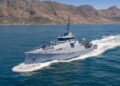

Taiwan’s Ministry of National Defense is seeking a contractor to build six more Min Jiang-class mine-laying vessels starting this year until 2027.
The ministry has opened another bidding process, aiming to secure a contract by April, following failed public tenders on December 18, 2024, and February 5, 2025.
A military source informed Taipei Times that the previous sessions did not move forward because they met less than the minimum number of three bids required to proceed with the contract awarding as per Article 48 of Taiwan’s Government Procurement Act.
Under that provision, a second tender process can be arranged shortly after the initial bidding and without the need for at least three bidders.
A budget of 1.8 billion New Taiwan Dollars ($54.8 million) was allocated for the latest contract to support Taipei’s efforts in boosting its armed forces’ asymmetric warfare capabilities in the event of a potential Chinese invasion.
Min Jiang-Class Minelayers
Taiwan’s current fleet of four Min Jiang-class minelayers are modified landing craft built domestically by Lung Teh Shipbuilding Co. for enhanced maritime defense.
They are operated by the 192nd Fleet’s mine operations squadron, with the first two commissioned and deployed from Zuoying naval base in 2022.
With a displacement of 376 tons, the minelayers are armed with a T-75 20-millimeter cannon and a couple of T-74 7.62-millimeter machine guns.
Each vessel measures about 40 meters (131 feet) and can carry up to 64 Wan Hsiang naval mines, with the ability to launch them manually or remotely.
“The minelayer ships were designed to face down an attack by amphibious vehicles trying to land in Taiwan,” a Taiwanese defense official was quoted as saying at the keel-laying ceremony for the lead vessel.
Asymmetric Warfare
Analysts such as Cato Institute senior fellow Eric Gomez have called for Taiwan to boost its asymmetric warfare capabilities, given the country’s size and distance from military allies like the US, in addition to the Trump administration’s ambiguity toward defending its East Asian ally against China.
Gomez urged US policymakers to press Taipei to “reorient its overall strategy to one of asymmetric defense to counter Chinese advantages” because if it cannot or is unable to do so, Washington’s intervention or assistance may not be enough.
Furthermore, RAND senior engineer and researcher Scott Savitz pointed out the crucial importance of naval mines and other sea-denial assets in defending the island country against adversaries.
“One way of obstructing a Chinese conquest of Taiwan involves literal obstruction — emplacing obstacles that would delay a Chinese invasion force, while rendering that force more vulnerable to other types of attack,” Savitz argued.