From the legendary Maasai warriors to the annual great migration of wildebeest and zebra, Kenya has no lack of cultural and natural wonders. One thing the country does lack, however, is the application of digital technologies. According to data from the Communications Authority of Kenya, just 58% of Kenyans were connected to the Internet in 2024.
Call from the silent world
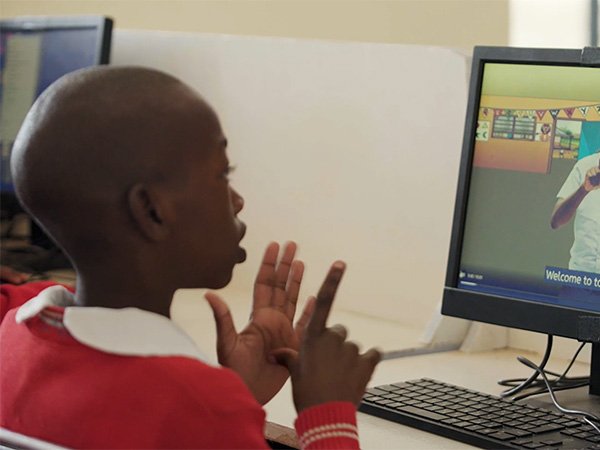
“Kuwa Nawe, Kua Nawe.” Thirteen-year-old student Melisa Ngami uses sign language to express this Swahili phrase, which means, “Be with you, grow with you”.
Melisa studies at Machakos School for the Deaf, which is located more than 60 kilometers from downtown Nairobi. Like all teenagers, the students at this school are curious about the world.
“My learners are visual learners. They can hear sometimes. They need to see something to relate with it. Because they use their eyes to learn, and learning has been quite hard,” explains Kenneth Bidan, Teacher, Machakos School for the Deaf.
Schools in Kenya are mainly limited to traditional teaching methods, where teachers write on a blackboard and students take notes. This is not sufficient for enabling curious students to learn new things. Moreover, the unbalanced distribution of educational resources in Kenya exacerbates learning challenges for deaf students.
Technology delivers an answer
Today, teachers and students at Machakos School for the Deaf are witnessing positive changes. This is thanks to Huawei’s TECH4ALL initiative, together with UNESCO and the Government of Kenya, including the Ministry of Education, Kenya Institute of Special Education, Ministry of IC&DE and ICT Authority. Including Machakos School for the Deaf, the project has so far connected 30 schools to the Internet through optical fiber networks, in turn transforming them into inclusive digital schools.
Machakos’ students can now unlock the potential of visual learning and access a wealth of online materials such as images and videos. More intuitive and easily digestible content allows the students enjoy a more relaxing and pleasant learning experience.
“On the Internet, I can learn sign language quickly, and also learn English and Math. I have become more confident,”signs Melisa Ngami, a student at Machakos School for Deaf.
Using the high-speed all-optical network, Kenya Institute of Special Education (KISE) provides live distance learning classes and high-quality online teaching materials for Machakos School for the Deaf, allowing students to interact with KISE’s education experts in real time.
“We offer online and offline training and courses for teachers and students with special educational needs,” says Dr. Zipporah Nudge a lecturer at the Department of Hearing and Communication Difficulties for KISE. “We have live streaming for students learning. We also have online classes for teachers.”
Dr. Nudge believes that the network can save time and resources, and ensure consistent course quality and educational resource distribution across the country.
“We ensure that whatever content is shared reaches the students, live from KISE. And the students will be getting the same materials as those that are in urban centers, even in the remotest parts of this country,” she adds.
Connecting Kenya with optical networks
Digital technologies are critical to the development of modern education. Lamine Mamadou Sow, Chief of Education, UNESCO Regional Office for East Africa, states that one of the United Nations Sustainable Development Goals is to provide quality and inclusive education as well as lifelong learning opportunities for all.
Connectivity, capabilities, and content are the three key dimensions for education development.
“We see ICT as an equalizer because ICT has the potential to reach out to disadvantaged children and people on low-incomes wherever they are in rural places. It’s a bridge,” explains Sow.“It’s something that can provide equity and inclusion in education so that all children can have equal access to learning opportunities and quality education resources. I am delighted to see that the DigiSchool project was successfully launched with the support of UNESCO, partners, and Huawei’s TECH4ALL initiative.”
Connectivity is the first step in transforming into digital schools. Huawei’s all-optical access and FTTR-B solutions enable all-optical Wi-Fi connections and high-speed networks for online courses and live classes, empowering students and teachers with digital capabilities. The 30 all-optical digital schools so far connected consist of 4 girls’ schools, 6 schools for deaf children, and 20 standard primary and secondary schools.
The project has benefited more than 12,000 teachers and students in remote areas of Kenya.
Huawei also supported M-PESA Foundation Academy, which serves talented but economically disadvantaged students with demonstrated leadership potential, and has a high-speed fibre network and campus-wide Wi-Fi provided by Safaricom. According to Paul Ngugi, Head of Technology and Learning Innovation at M-PESA Foundation Academy, the academy integrates digital technologies into teaching to cultivate talent for Kenya’s digital future.
“The high-speed all-optical network co-provided with Huawei turns our vision into reality and drives the development of digital education,”states Ngugi.
Kenya is transforming digitally at a rapid pace. The government has launched the Digital Superhighway Project, which involves constructing a high-speed fiber network spanning 100,000 km that will, among other outcomes, connect all schools in Kenya by 2030.
Thomas Bwaley, Director for Programmes & Standards for the ICT Authority, explains that, “Cooperating with partners such as Huawei, the Kenyan government provides high-speed Internet and Wi-Fi connectivity for educational institutions using all-optical access technologies. This can improve learning experiences and allow students in remote area to have the same opportunities as those in developed regions, bridging the education gap across the country.”
The Kenya Digital Superhighway Project will connect 100,000 institutions and markets across Kenya. The increasing number of fiber connections in the last mile will drive the digitalization of a diverse range of industries, including e-commerce and healthcare.
“Now we are building 25,000 public Wi-Fi hotspots and 1,450 digital hubs to bridge the digital divide and boost Kenya’s digital economy,” says Bwaley.