
• Business
  • Markets
  • Politics
  • Crypto
  • Finance
  • Intelligence
    • Policy Intelligence
    • Security Intelligence
    • Economic Intelligence
    • Fashion Intelligence
  • Energy
  • Technology
  • Taxes
  • Creator Economy
  • Wealth Management
  • LBNN Blueprints
  • Business
  • Markets
  • Politics
  • Crypto
  • Finance
  • Intelligence
    • Policy Intelligence
    • Security Intelligence
    • Economic Intelligence
    • Fashion Intelligence
  • Energy
  • Technology
  • Taxes
  • Creator Economy
  • Wealth Management
  • LBNN Blueprints

Humanoid robots can swiftly get up after they fall with new learning framework

Simon Osuji by Simon Osuji
February 24, 2025
in Artificial Intelligence
0
Humanoid robots can swiftly get up after they fall with new learning framework
0
SHARES
2
VIEWS
Share on FacebookShare on Twitter


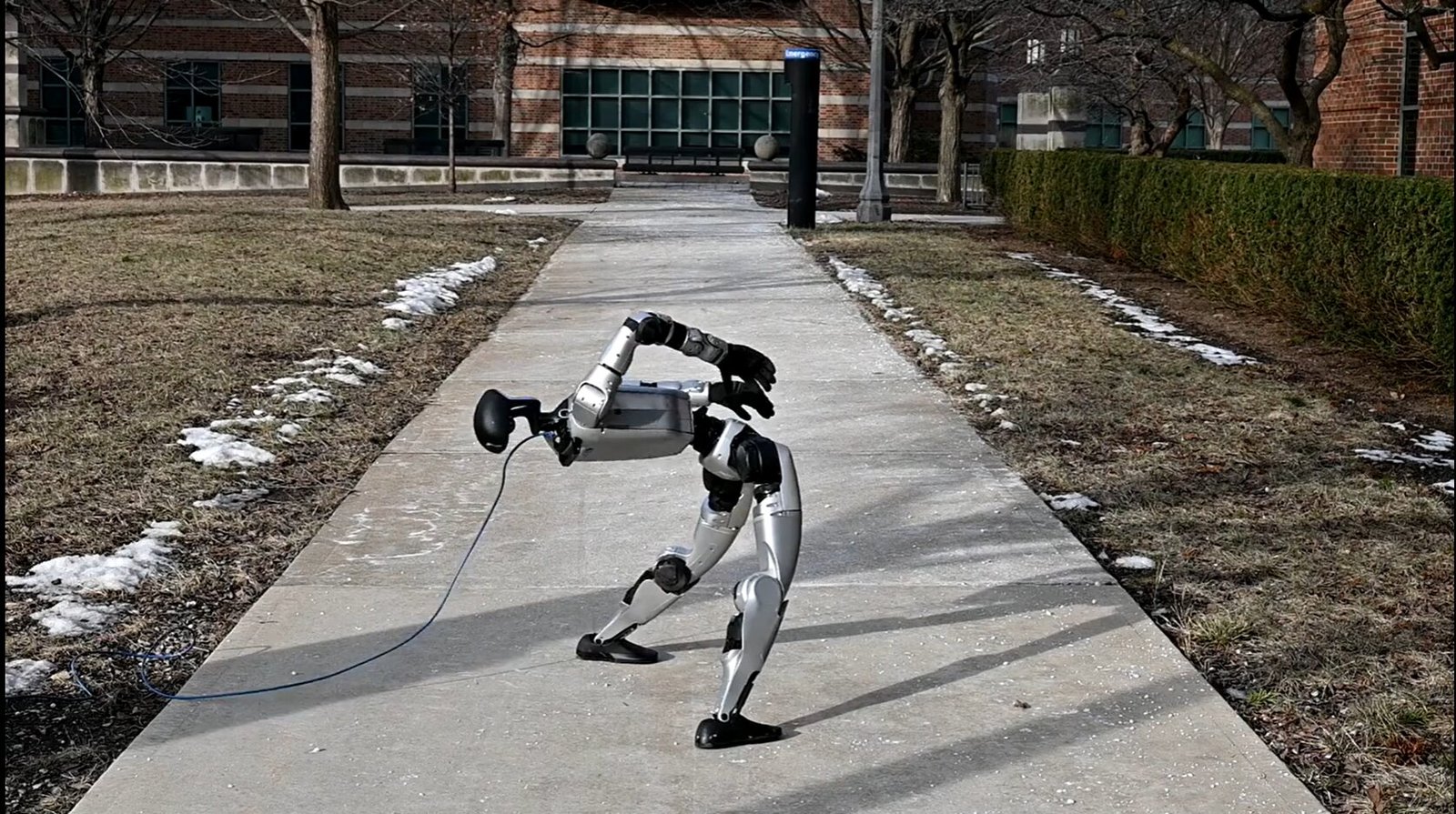
Humanoid robots can swiftly get up after they fall with new learning framework
Credit: Xialin He et al

Humanoid robots, which have a body structure that mirrors that of humans, could rapidly and effectively tackle a wide range of tasks in real-world settings. These robots and their underlying control algorithms have improved considerably in recent years. Many of them can now move faster, emulating various human-like movements.


Related posts

More Than 800 Google Workers Urge Company to Cancel Any Contracts With ICE and CBP

More Than 800 Google Workers Urge Company to Cancel Any Contracts With ICE and CBP

February 6, 2026
Scientists create smart synthetic skin that can hide images and change shape

Scientists create smart synthetic skin that can hide images and change shape

February 6, 2026

As these robots are designed to walk or run similarly to humans, thus balancing on two legs, they can sometimes collide with objects or trip on uneven terrain, falling to the ground. Yet, in contrast with humans, who can easily pick themselves up when they fall, humanoid robots can sometimes get stuck on the ground, requiring the support of human agents to get back on their feet.

Researchers at the University of Illinois Urbana-Champaign recently developed a new machine learning framework that could allow humanoid robots to automatically get back up and recover after falling to the ground. This framework, presented in a paper on the arXiv preprint server, could make these robots more autonomous, potentially contributing to their future large-scale deployment.


Credit: Xialin He et al

“Hand-designing controllers for getting up is difficult because of the varied configurations a humanoid can end up in after a fall and the challenging terrains humanoid robots are expected to operate on,” wrote Xialin He, Runpei Dong and their colleagues in their paper. “This paper develops a learning framework to produce controllers that enable humanoid robots to get up from varying configurations on varying terrains.”

A learning framework that allows humanoid robots to swiftly get up after they fall
Real-world results. We evaluate HumanUP (ours) in several real-world setups that span diverse surface properties, including both man-made and natural surfaces, and cover a wide range of roughness (rough concrete to slippery snow), bumpiness (flat concrete to tiles), ground compliance (completely firm concrete to being swampy muddy grass), and slope (flat to about 10 ∘ ). We compare HumanUP with G1’s built-in getting-up controller and our HumanUP w/o posture randomization (PR). HumanUP succeeds more consistently (78.3% vs. 41.7%) and can solve terrains that the G1’s controller can’t. Credit: arXiv (2025). DOI: 10.48550/arxiv.2502.12152

The new framework developed by this research team, dubbed HUMANUP, relies on a reinforcement learning (RL) approach. This approach is designed to improve the ability of humanoid robots to get up, irrespective of their position when they fall.

“Unlike previous successful applications of humanoid locomotion learning, the getting-up task involves complex contact patterns, which necessitates accurately modeling the collision geometry and sparser rewards,” wrote He, Dong and their colleagues. “We address these challenges through a two-phase approach that follows a curriculum.”

The HUMANUP RL framework spans across two different stages. During the first stage, the framework focuses on identifying good limb trajectories that would allow a robot to get up, which pose minimal constraints on how smooth the robot’s movements should be or the speed with which these movements should be executed.

A learning framework that allows humanoid robots to swiftly get up after they fall
Getting-up from prone pose result visualization of Tao et al. [65]. The motion generated by method [65] is highly unstable and unsafe, and it keeps jittering and jumping during the getting-up phase. Credit: arXiv (2025). DOI: 10.48550/arxiv.2502.12152

During the second phase, on the other hand, the framework refines the motions uncovered as part of the earlier phase, ultimately turning them into smooth and slow motions that can be performed by the robots. Notably, these refined motions should also be effective irrespective of the position of the robot and the terrain on which it fell.

The researchers tested their framework in both simulations and real-world environments, deploying it on the Unitree G1 humanoid robot, an advanced robotic system created by the Chinese company Unitree Robotics. Their findings were highly promising, as they found that their approach allowed the robot to autonomously recover after falling, irrespective of the position it was in and the terrain beneath it.


“We find these innovations enable a real-world G1 humanoid robot to get up from two main situations that we considered: a) lying face up and b) lying face down, both tested on flat, deformable, slippery surfaces and slopes (e.g., sloppy grass and snowfield),” wrote He, Dong and their colleagues. “To the best of our knowledge, this is the first successful demonstration of learned getting-up policies for human-sized humanoid robots in the real world.”

The new promising framework developed by He, Dong and their colleagues could soon be further improved and deployed on other humanoid robots, equipping them with the ability to automatically get themselves back up after falling. This could help to further advance the robots, which could facilitate their future widespread adoption.

More information:
Xialin He et al, Learning Getting-Up Policies for Real-World Humanoid Robots, arXiv (2025). DOI: 10.48550/arxiv.2502.12152

Journal information:
arXiv

© 2025 Science X Network

Citation:
Humanoid robots can swiftly get up after they fall with new learning framework (2025, February 24)
retrieved 24 February 2025
from https://techxplore.com/news/2025-02-humanoid-robots-swiftly-fall-framework.html

This document is subject to copyright. Apart from any fair dealing for the purpose of private study or research, no
part may be reproduced without the written permission. The content is provided for information purposes only.


Source link

Previous Post

Iraq to build largest industrial city

Next Post

How Much Would a 2020 Investment Be Worth Today?

Next Post
DeepSeek Sell-Off Led Retail Investors to Buy $920M in NVDA

How Much Would a 2020 Investment Be Worth Today?

Leave a Reply Cancel reply

Your email address will not be published. Required fields are marked *

RECOMMENDED NEWS

Music platform CEO says AI is not the enemy

Music platform CEO says AI is not the enemy

2 years ago
Elon Musk’s SpaceX took money directly from Chinese investors, company insider testifies

Elon Musk’s SpaceX took money directly from Chinese investors, company insider testifies

4 months ago
Islamic State Group Claim Bombing of Taliban Ministry

Islamic State Group Claim Bombing of Taliban Ministry

12 months ago
Estate Links Celebrates 30 years of Excellence Service

Dangote Cement Denies Running Sales Promo, Warns Public to be Careful of Social Media Fraudsters

2 years ago

POPULAR NEWS

  • Ghana to build three oil refineries, five petrochemical plants in energy sector overhaul

    Ghana to build three oil refineries, five petrochemical plants in energy sector overhaul

    0 shares
    Share 0 Tweet 0
  • The world’s top 10 most valuable car brands in 2025

    0 shares
    Share 0 Tweet 0
  • Top 10 African countries with the highest GDP per capita in 2025

    0 shares
    Share 0 Tweet 0
  • Global ranking of Top 5 smartphone brands in Q3, 2024

    0 shares
    Share 0 Tweet 0
  • When Will SHIB Reach $1? Here’s What ChatGPT Says

    0 shares
    Share 0 Tweet 0

Get strategic intelligence you won’t find anywhere else. Subscribe to the Limitless Beliefs Newsletter for monthly insights on overlooked business opportunities across Africa.

Subscription Form

© 2026 LBNN – All rights reserved.

Privacy Policy | About Us | Contact

Tiktok Youtube Telegram Instagram Linkedin X-twitter
No Result
View All Result
  • Home
  • Business
  • Politics
  • Markets
  • Crypto
  • Economics
    • Manufacturing
    • Real Estate
    • Infrastructure
  • Finance
  • Energy
  • Creator Economy
  • Wealth Management
  • Taxes
  • Telecoms
  • Military & Defense
  • Careers
  • Technology
  • Artificial Intelligence
  • Investigative journalism
  • Art & Culture
  • LBNN Blueprints
  • Quizzes
    • Enneagram quiz
  • Fashion Intelligence

© 2023 LBNN - All rights reserved.