Viewpoint
by Jon Abbott, Technologies Director & Industry Advisor at Vertiv
Telecommunications infrastructure has evolved in response to growing demand. But right now, that evolution is happening at a pace the industry hasn’t seen before. The surge in data traffic, the push for lower latency, and the rise of AI-driven applications are forcing operators to rethink how networks are built and managed. The challenge is no longer just about expanding capacity – it hinges on enabling networks to scale efficiently, adapt to new technologies, and support increasingly decentralised workloads.
The challenge: A network model under pressure
For years, network architecture has been built around major hubs. Data travelled through core sites in cities like Frankfurt, London, Amsterdam, and Paris, where it was processed and stored before being distributed. That model worked when demand was predictable and most applications could tolerate some latency. But today’s use cases – real-time financial trading, AI-powered automation, and low-latency content delivery – call for a different approach.
A growing reliance on AI is accelerating the need for a rethink. AI applications require immense computing power but transmitting massive datasets back and forth between core data centres isn’t practical. This is leading to a shift towards distributed processing, where workloads are handled closer to where they are generated.
Network sites are evolving into processing hubs
Telecom infrastructure has historically been designed for a single function; for example, cable landing stations bring subsea cables ashore, intermediate line amplifier sites extend signal transmission distances, and aggregation nodes consolidate fibre routes. But these sites are now being repurposed to support a broader range of functions, including local processing and caching.
At cable landing stations, compute power is increasingly being installed at the point where undersea cables come ashore, reducing the need to transfer data inland before it is processed. Intermediate line amplifier sites, which were originally designed to house relatively low-power equipment, are now seeing energy demands increase significantly as network operators retrofit them for edge computing.
These changes are essential to reducing strain on core infrastructure, improving efficiency and supporting applications that can’t tolerate delays. But they also introduce new technical challenges, particularly around space, power, and cooling.
Scaling up without disruption
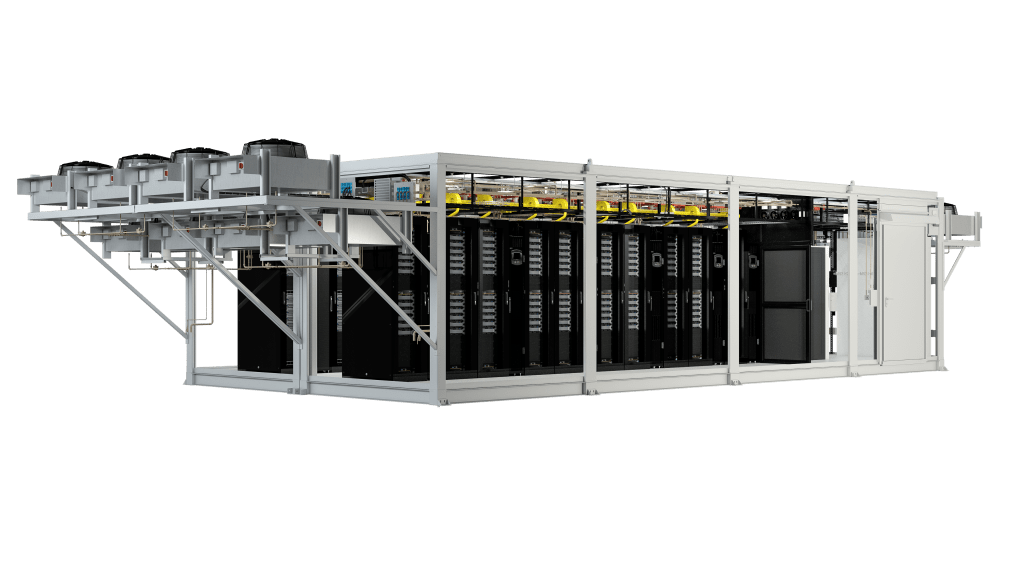
Many of these facilities were never designed to accommodate the kind of workloads now being placed on them. Expanding capacity in a way that doesn’t cause downtime or disrupt existing services is a key challenge. This is where modular infrastructure is proving to be a practical solution. Prefabricated, pre-integrated modules can be deployed rapidly, allowing organisations to add computing power without the need for large-scale construction projects.
One government department scaled up a new edge site in under two months using a modular approach with Vertiv solutions. The ability to deploy fully integrated infrastructure quickly ensured that additional capacity was brought online without disruption – something that is becoming increasingly important as AI workloads expand.

The Vertiv™ SmartMod™ platform
What’s next for network infrastructure?


As the boundaries between data centres and network infrastructure continue to blur, operators should prepare for a more distributed model of computing. In the coming years, there is likely to be a wider adoption of prefabricated modular deployments, more intelligent energy management to balance sustainability with performance and a shift towards facilities that can support AI-driven workloads as standard.
The industry is in the midst of a major transition. Networks are no longer just pipes that move data – they are becoming dynamic, high-performance computing environments. Organisations that adapt now will be best placed to meet the demands of the next decade.
You can find Vertiv at Booth 3 at Submarine Networks EMEA, Europe’s most important submarine cable event