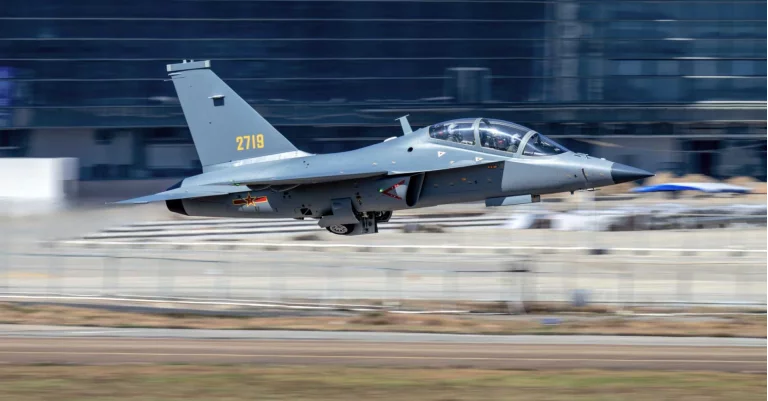
The Moroccan Air Force is exploring the option of replacing its aging Franco-German Assault Alpha jets with the Chinese L-15 light attack and trainer aircraft
According to local news media, Le Desk, the Royal Air Force indicated its preference for the L-15 Falcon, made by the Chinese aircraft manufacturer Hongdu Aviation Industry Corporation (HAIC) to replace its aging fleet of Alpha jets of Franco-German design.
Morocco’s choice is motivated by the seller performance of the aircraft. The Moroccan air force are said to be in advanced discussions with aircraft manufacturer Hongdu Aviation Industry Corporation (HAIC) for the acquisition of the Hongdu L-15 Falcon fighters.
Morocco acquired 24 Alpha Jets between 1979 and 1981 to enhance its air force’s training and light attack capabilities. These aircraft were assigned to a training squadron and a counterinsurgency unit in Meknes.
During the Western Sahara conflict, they were deployed in missions targeting Polisario Front positions. While the Alpha Jets fulfilled these roles, their subsonic performance, limited avionics, and lack of modern systems are now seen as inadequate. The Alpha Jet is equipped with two SNECMA Turbomeca Larzac turbofan engines and can carry up to 2,500 kilograms of armament across five hardpoints. Initially designed for subsonic training and close air support, its capabilities are now considered outdated in the context of current military needs.
The Alpha Jet, developed jointly by Dassault Aviation of France and Dornier Flugzeugwerke of Germany, has been in service since the late 1970s and has primarily been used for training and light attack roles. However, the Alpha Jet’s aging design no longer meets the requirements of modern military operations.
On the other hand, The Hongdu JL-10, also known as L-15 Falcon, has been exported to countries such as Zambia, which purchased six L-15Z units in 2014 for $100 million, and the United Arab Emirates, which ordered 12 units in 2022 with an option for 36 additional aircraft.
The L-15 Falcon, developed by Hongdu Aviation Industry Corporation (HAIC), offers several features not present in the Alpha Jet. First flown in 2006 and introduced in 2013, the aircraft was developed with technical assistance from the Yakovlev Design Bureau in Russia. Its propulsion system includes AI-222K-25F turbofan engines, which incorporate Ukrainian technology. The L-15B variant can reach speeds of up to Mach 1.4. The aircraft includes nine hardpoints capable of carrying a maximum payload of 3,500 kilograms, accommodating munitions such as SD-10 and PL-8 air-to-air missiles, as well as LS-6 satellite-guided bombs. It also incorporates fly-by-wire controls, a Passive Electronically Scanned Array (PESA) radar, and a glass cockpit, supporting its role in preparing pilots for advanced fighter aircraft. The L-15’s service life is estimated at 10,000 hours, and its design includes 25% composite materials to reduce weight and enhance durability.
The L-15 has multiple operational variants, including subsonic and carrier-compatible models. It has been exported to countries such as Zambia, which purchased six L-15Z units in 2014 for $100 million, and the United Arab Emirates, which ordered 12 units in 2022 with an option for 36 additional aircraft. Other countries, including Pakistan and Ukraine, have shown interest in the platform. In China, the L-15 is used by the People’s Liberation Army Air Force and Navy for training pilots for fourth- and fifth-generation fighter aircraft as Hongdu JL-10.
For quite a number of years, Morocco has been somewhat reliant on China for some of its defence needs. Morocco’s potential interest in the L-15 follows its acquisition of other Chinese defense systems, including the Sky Dragon 50 (FD-2000B) long-range air defense system, AR2 multiple rocket launchers, HQ-9 (FD2000B) long-range semi-active radar homing (SARH) surface-to-air missile, HJ-9A anti-tank missile systems, and Wing Loong 2 drones. This marks a shift from Morocco’s traditional reliance on Western suppliers. The L-15, if acquired, would be part of a broader defense modernization program aimed at updating and diversifying Morocco’s military equipment.