<

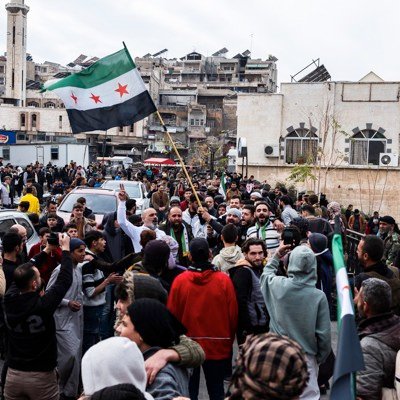
In a matter of days, opposition forces took the major city of Aleppo before advancing southward into other government-controlled areas of Hama, Homs and finally, on Dec 7, 2024, the capital, Damascus.
The offensive was all the more astonishing given that the 13-year civil war had largely been in a stalemate since a 2020 ceasefire brokered by Russia and Turkey.
Reports suggest President Bashar al-Assad has resigned and left the country. But what has he left behind and what happens next?
As an expert on Middle East security, I believe the opposition forces’ ability to maintain unity will be critical in the transition to a post-Assad Syria. Since the civil war started in 2011, the many opposition factions in Syria have been fractured by ideological differences and the interests of external backers—and that remains true despite their current victory.
Meanwhile, the rapid change of fortunes in Syria’s civil war poses serious questions for those countries that have backed one side or the other in the conflict. For Iran and Russia, the fall of their ally Assad will damage regional aspirations. For the backers of elements of the opposition—notably Turkey but also the United States, both of which maintain a military presence in Syria—there will be challenges, too.
Fears of a ‘catastrophic success’
Iran, the U.S., Russia, and Turkey have been crucial players throughout Syria’s civil war.
The recent opposition offensive came as Assad’s three key allies—Russia, Iran and Lebanon’s Hezbollah—were stretched thin. Russia’s focus on Ukraine and Iran’s setbacks from Israeli strikes have limited their ability to provide Assad robust support, while Hezbollah appeared hesitant to commit additional fighters, as it had done previously.
Then, on Dec. 2, as opposition forces were on the move, Russia began withdrawing naval assets from its strategic Mediterranean base at Tartus, Syria. This erosion of external backing substantially undermined Assad’s capacity to regroup and mount an effective counteroffensive.
The U.S. will no doubt welcome this diminished Russian and Iranian influence in Syria. But concern in Washington has already been aired over a scenario of “catastrophic success” in which Assad is replaced by an Islamist group that many in the West see as terrorists.
It was members of the Islamist group Hayat Tahrir al-Sham that spearheaded much of the opposition gains in Syria, fighting alongside the Turkish-backed Syrian National Army.
And while Hayat Tahrir al-Sham has not directly targeted the U.S. troops stationed in the northeast—which is under the control of Kurdish-led Syrian Democratic Forces—instability and the potential for clashes between opposition factions and U.S. allies could increase the risks for the 900 Syria-based American personnel.
The fact that different opposition groups have taken control of various once-government-held areas points to a crucial fact: Syria is de facto partitioned. The northwest is controlled by the Islamist Hayat Tahrir al-Sham and the Turkish-backed Syrian National Army. The northeast is under the Kurdish-led Syrian Democratic Forces, supported by the United States.
Despite a shared goal of ousting Assad and the joint offensive on Aleppo, conflicts between Hayat Tahrir al-Sham and the Syrian National Army are frequent. Hayat Tahrir al-Sham, led by Abu Mohammad al-Golani aims to assert control over opposition-held areas, including those currently managed by the Syrian National Army.
And the Syrian National Army and Hayat Tahrir al-Sham maintain complex, often conflicting relationships with the Syrian Democratic Forces, shaped by ideological, territorial and strategic differences. The Turkish-backed Syrian National Army frequently engages in direct clashes with the Syrian Defense Forces, which Turkey views as a terrorist organization and an offshoot of the Kurdistan Workers Party it has been fighting in southern Turkey for more than four decades.
The opposition’s internal fragmentation may weaken its ability to bring stability to Syria in the long run.
Adjustment problems
Assad’s fall will have major implications for those countries that have a stake in the region.
Iran’s grand strategy of preserving the “Shia Crescent”—connecting Tehran to Beirut through Baghdad and Damascus and in the process countering Sunni Islamist factions—has failed.
For Washington, Assad’s departure doesn’t necessarily fit any hoped-for outcome.
The U.S. has prioritized balancing, containing, and potentially diminishing Russian and Iranian influence in Syria. But until recently that did not mean the removal of Assad. The Biden administration had even hinted in early December that it would be prepared to lift sanctions on Syria if Assad severed ties with Iran and Hezbollah.
There was also talk of Assad’s government allying with the U.S.-backed Syrian Democratic Forces. But as city after city fell to Hayat Tahrir al-Sham and the Turkish-backed Syrian National Army, it became increasingly unlikely that the Kurdish group would align with the weakening Assad forces—especially as Kurdish forces themselves made significant territorial gains.
Syrian Democratic Forces will need to adapt in response to the fall of Assad. This will be doubly true if, as many anticipate and President-elect Donald Trump has hinted at, the U.S. withdraws from Syria. Currently, the 900 U.S. troops are in eastern Syria, alongside a military base in Al-Tanf, located near the Iraqi and Jordanian borders.
Should American forces withdraw, the Syrian Democratic Forces and the autonomous region it administers—known as the Autonomous Administration of North and East Syria—would need to negotiate their autonomy with both different factions of the opposition and Syrian neighbor Turkey.
A Kurdish and Islamist alliance?
The precarious role of Syrian Democratic Forces in the transition to the post-Assad era could make for a significant foreign policy headache for the U.S.
Given Turkey’s history of military incursions and campaigns against the Syrian Democratic Forces in northern cities like Afrin and Kobani, the Kurdish group may need to align with some factions of the opposition, likely Hayat Tahrir al-Sham, should the U.S. eventually withdraw.
Of late, Hayat Tahrir al-Sham has largely avoided antagonizing the Syrian Democratic Forces. Indeed, Hayat Tahrir al-Sham’s efforts to rebrand and moderate itself are notable, especially given its origins as a Salafist group with ties to al-Qaida.
By adopting a range of policies like issuing an amnesty for Syrian army personnel, facilitating evacuation agreements and using the language of building an ethnically and religiously diverse governance structure, the Islamist group has attempted to soften its hard-line image and gain favor – or at least neutrality – from international stakeholders, like the U.S.
Yet skepticism about Hayat Tahrir al-Sham’s ultimate objectives persists.
Strategic calculations for Turkey
Turkey’s position on Syria now is equally complex. Turkey is home to 3.6 million Syrian refugees—the largest refugee-hosting country globally. A prolonged economic downturn and rising anti-refugee sentiment had pressured Turkey President Recep Tayyip Erdoğan to signal a willingness to engage with Assad prior to the opposition offensive.
Turkey’s hope was that normalized relations with Syria would help facilitate refugee return and address concerns about a potential Kurdish state in northeastern Syria.
But Assad dismissed such overtures, and he intensified airstrikes on Idlib—triggering new waves of displacement near the Turkish border.
Turkey’s Syria policy is also closely linked to its renewed peace process with the Kurdistan Workers’ Party. These talks reportedly include discussions about the potential release of imprisoned Kurdistan Workers’ Party leader Abdullah Öcalan – whose influence runs deep in Kurdish-led regions in northern Syria.
The chance for a new Syria
The apparent end of the Assad family’s rule after half a century of brutal oppression signifies a pivotal moment for Syria – offering an opportunity to rebuild the nation on foundations of inclusivity, pluralism and stability.
Achieving this vision depends on the opposition factions’ ability to navigate the immense challenges of transition. This includes fostering unity among diverse groups, addressing grievances from years of conflict and establishing governance structures that reflect Syria’s ethnic, religious and political diversity. That will be no easy task.
This article is republished from The Conversation under a Creative Commons license. Read the original article.

]]>
Source link