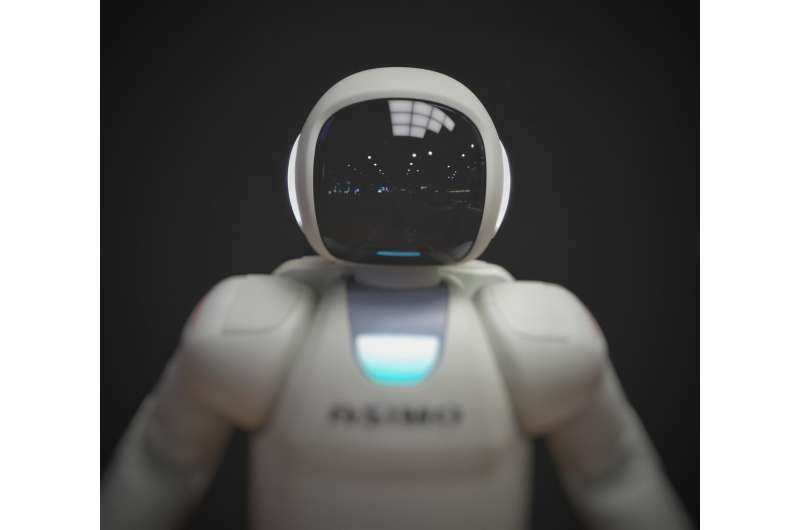
In a review paper published recently in Science Robotics a cognitive roboticist, cognitive psychologist and a psychiatrist discuss the concept of “sense of self” in humans, and they explore how robots can be used to better understand the phenomenon.


The experience of being, or having, a self—contained within our bodies and able to act in the world—comes naturally to all of us as human beings, along with a feeling of being the same self from day-to-day and of seeing others as also being selves. Robots could be used either as embodied models of the self (and its sub-components) or as testing platforms for psychological experiments. The authors suggest the possibility of generating in robots some of the processes which contribute to the “sense of self” in humans.
The authors are Agnieszka Wykowska, head of Social Cognition in Human-Robot Interaction unit at the Istituto Italiano di Tecnologia (IIT-Italian Institute of Technology) in Italy, Tony Prescott, Professor of Cognitive Robotics at University of Sheffield in UK and Kai Vogeley, Professor at the Department of Psychiatry and Psychotherapy at University of Cologne in Germany.
The inquiry originates from the idea that the sense of self in humans is intrinsically tied to having a body, feeling it, and experiencing actions and interactions. A key idea emerging from current research studies in human cognition is that the human sense of self is not just one thing but is made up of many ongoing processes, such as the sense of “owning” a body and the sense of having “agency,” that is the feeling of control over one’s actions.
Today, roboticists are aiming to construct robots that could reliably distinguish their own bodies (the self-other distinction) and detect the consequences of their own actions (agency). From this perspective, robots can serve as embodied models of the human cognitive processes underlying the sense of self. However, robots can also be used experimental probes for exploring the sense of self, as they possess bodies and can interact with both humans and their environment.
The three authors explore using robots in these two specific ways.
The first is programming robots to simulate processes within the human mind and brain that relate to the experience of self, as understood through psychology and neuroscience. Current research studies suggest that in humans a sense of self develops as the brain’s best explanation of its sensory experience, and its own role in generating those sensory signals. A robot, being a physically embodied actor, is a suitable platform to test those theories.
The second approach is using robots in psychological experiments where humans interact with them while the robots display social capacities, such as communication through language or joint attention. These experiments could allow for an analysis of whether people experience these robots as social others and whether the mental states they have about robots are similar to those they have when interacting with other people.
Some experiments conducted by Wykowska’s group at IIT have already shown that sometimes, humans develop sense of joint agency with robots, when they act together as a team and when the robot is perceived as an intentional agent.
The authors also draw a connection between the development of the sense of self in humans over the course of life and the possibility of transferring some of its features to robots. For instance, by age 4, children have a sense of themselves as existing through time, and of other people as also having selves.
These aspects of self are beginning to be investigated in robots by creating memory systems for robots that are similar to human autobiographical memory. However, this work is at an early stage; current robots do not have awareness of themselves as persisting from day to day, nor are they aware of others (humans or robots) as being selves.
The article also highlights future directions and open challenges in understanding the sense of self through robotics, especially when it is compromised in people due to specific conditions, such as schizophrenia or autism. By understanding such diversity, authors hope that scientists may be able to gain new insights into the building blocks of the experience of self.
More information:
Tony J. Prescott et al, Understanding the sense of self through robotics, Science Robotics (2024). DOI: 10.1126/scirobotics.adn2733
Italian Institute of Technology
Citation:
How robotics can be used to better understand the ‘sense of self’ in humans (2024, November 18)
retrieved 18 November 2024
from https://techxplore.com/news/2024-11-robotics-humans.html
This document is subject to copyright. Apart from any fair dealing for the purpose of private study or research, no
part may be reproduced without the written permission. The content is provided for information purposes only.