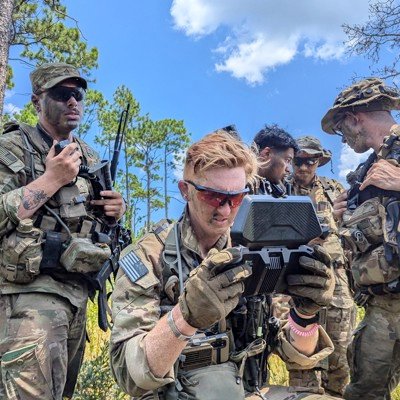
FORT JOHNSON, Louisiana—Staff Sgt. David Meyer peered intently into the screen of his hand-held drone controller, sweat slowly beading through his face paint in the 100-degree heat.
Somewhere below his quadcopter, an allied unit was under attack by Geronimo, the highly skilled force that plays the enemy in weeks-long wargames at the U.S. Army’s Joint Readiness Training Center here.

Meyer suspected the Geronimo troops of trying to trick his side into burning through its ammo. Then they’d melt back into the forest to strike again elsewhere. It’s the sort of game that comes naturally to Geronimo, whose home-team status gives them an unmatched knowledge of the training area’s 250,000 acres of pine forest.
This time, they may have underestimated their opponent.
Meyer was part of the new Lethal Unmanned Systems platoon, one of the Army’s first formations dedicated entirely to operating short-range reconnaissance drones. If Meyer’s drones could find Geronimo, they could bring the fire of an attached platoon of 81mm mortars and turn the opposition’s raid into a disaster.
All Meyer had to do was find them.
The LUS platoon
In mid-August, Defense One spent an afternoon with LUS soldiers as they fought Geronimo.
The soldiers are members of the 101st Airborne’s second brigade, which had traveled to JRTC to test the Army’s “transforming-in-contact” initiative. Announced earlier this year, the effort is sending new equipment to the 101st’s brigade, the 10th Mountain Division’s third brigade, the 25th Infantry Division’s second brigade. Soldiers are responsible for giving feedback and working out on new doctrine in conditions as close as possible to actual war.
The LUS platoon sits within the Multi-Purpose Company, or MPC, itself a new formation launched this April. The MPC’s four platoons—scout, mortar, anti-tank, and LUS—replace the old heavy weapons companies, which were downgraded to platoons in February.
Nine of the LUS platoon’s 21 soldiers fly drones, including Meyer and platoon leader 1st. Lt. Jahmir King. The rest are air defenders who use a mix of anti-aircraft weapons like Stinger missiles and counter-drone weapons, including the Bal Chatri drone detector, Dronebuster jamming rifle, and Modi electronic warfare system.
Just as in Ukraine, their drones are meant primarily to help spot enemy forces, and, if possible, coordinate indirect fire.
But unlike the Ukrainians, the LUS drone operators cannot directly stream their video to other soldiers. Instead, they must rely on an attached fire control officer to radio to the mortar section where they are seeing the rounds land. Similarly, LUS soldiers must upload data to battle-management systems to share it with commanders, in contrast to the banks of live drone video feeds that Ukrainian commanders use to survey the battlefield.
But the operators do have some ability to strike enemies themselves. Some of the drones can be rigged to drop munitions, and soldiers are trained to fly Switchblade loitering munitions systems. The unit was not practicing with the Switchblades at JRTC.
The unit can also use their drones for route reconnaissance, said MPC commander Captain Phil Tateyama. If the unit wants to quickly clear an area, a drone operator will fly a drone just ahead of the moving vehicle.
The platoon also carries a drone-borne electronic detection unit built on an ultracheap Raspberry Pi computer that can sniff for WiFi connections. To operate it, they’d temporarily brought along an Army cyber soldier.
The counter-drone unit, meanwhile, serves as a mobile defense force that can be split out as needed, with some members defending the command post and others assigned to the mortars, according to Tateyama and King.
Drones, lots of drones
The unit’s seven drone operators carry about five extra drones, but King said many more might be required in an actual war. In realistic training operations, such as the one they were on, he expected to have at least one drone down due to mechanical or other failures every other day.
Combat operations would likely increase that rate, he said.
“We’re going to start losing them, and then we’re out of a job,” said King.
The unit operates Parrot, Skydio, and Vesper drones, all small short-range systems with a flight time of under an hour. King said such systems could fly only one to three kilometers out before losing signal in the dense vegetation of Fort Johnson.
That meant the team had to be relatively close to the front line, placing them in easy range of Geronimo’s artillery and even their infantry.
Eventually, King and Tateyama said, they hope to equip the unit with medium-range drones like the C100. Smaller drones would then be assigned to the reconnaissance unit. Tateyama said those drones should most likely be operated by an experienced LUS member detailed to the recon unit.
King said they could move up to operating first-person-view drones — hobbyist racing drones that Ukraine uses for pinpoint strikes—although he added that the weeks of training necessary made it harder to employ such drones.
King said Skydio and Parrot drones performed well, with soldiers favoring the latter for its ability to identify the specific map coordinates of whatever object it looked at, which was useful for artillery coordination. A mechanical problem, however, meant that soldiers had not brought along the Parrot.
Drone soldiers
In contrast to previous Army drone operations, all of the LUS soldiers are infantrymen, rather than specialist operators.
“If you can drive semi-decent in [Grand Theft Auto],” then you can fly, said one soldier. To hone their skills, the unit practices drone operations on a special course back at Fort Campbell, their home base.
Soldiers also receive some training to recognize enemy vehicles, said King. Some features on the drone also help, such the Parrot’s ability to pinpoint the hottest parts of whatever it’s looking at. Using this feature, soldiers can easily identify exhaust pipes, thereby discovering vehicles.
Besides flying and processing drone footage, soldiers are also expected to keep the drones charged. Battery management in particular is a major concern in planning, said King.
“That’s what it’s about: how long can we stay on the objective.” One soldier said he kept extra batteries in the pouch typically used for dumping spent rifle magazines.
On top of all that, soldiers must also pull security. Ideally, King said he’d like to see three to four soldiers assigned to flying, data management, and security, for a maximum of 12 soldiers versus the seven they have now.
Hunting Geronimo
Back at the screen, Mayer soon ran into difficulty. In the sweltering heat of the Lousianna pine forest, the drone’s already limited batteries were eking out just 20 minutes of flight time—including only a few minutes over the objective.
To maximize coverage, the unit kept a fresh drone ready to go when one returned. But flight-safety rules forbid operating two drones at once.
As drone after drone buzzed into the sky, hope started to fade. For a brief moment, Meyer’s screen showed a Geronimo truck driving along the road—but then lost it.
Somewhere out there, Geronimo was still lurking, hidden beneath trees or simply beyond the range of the LUS platoon’s drone. They’d gotten away, if only for the moment.