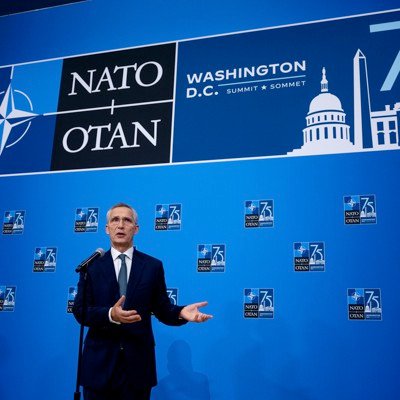
ASPEN, Colorado—Even as NATO pledged more support for Ukraine in its hot war against Russia last week, news broke of the Kremlin’s latest plot elsewhere in Europe—and alliance members wondered whether a key tool for detecting and thwarting such attacks would disappear under a Trump presidency.
Over the last several months, European and U.S. intelligence officials have highlighted efforts by the Russian government to sow mayhem across Europe. These include attempts to recruit ethnic Russians in Estonia to attack the property of government officials; disinformation campaigns to influence French elections and turn Moldovan citizens against their leaders; possibly arson and attempted attacks in Lithuania, England, and Poland; and a plot to assassinate the German head of arms manufacturer Rheinmetall, a key supplier of 155mm artillery rounds and other military equipment to Ukraine.


“These are part of a pattern, part of an ongoing Russian campaign. And the purpose of this campaign is, of course, to intimidate NATO allies from supporting Ukraine,” Jens Stoltenberg, the outgoing NATO Secretary General, said last Thursday. He added: “And what we have seen over the last month is that NATO allies have not been intimidated. NATO allies are actually stepping up their support, delivering more aid to Ukraine.”
The alliance has been watching out for such a pattern. Its 2022 Strategic Concept cites hybrid warfare by both Russia and China as a key concern and calls on members to “invest in our ability to prepare for, deter, and defend against the coercive use of political, economic, energy, information and other hybrid tactics by states and nonstate actors.”
Now, alliance members are trying to do just that.
“We’ve been working to turn it into real plans, real programs that demonstrate that NATO is capable and effective in dealing with exactly these kinds of challenges that’s going to be carried forward at this summit,” U.S. Secretary of State Anthony Blinken said last Wednesday
Blinken called the hybrid attacks a rising concern.
“Every ally is acutely focused on this fact that we’ve seen attacks in recent months, arson attacks, sabotage attacks, attempted assassinations, misinformation, disinformation, cyber threats. This is not these are not one-offs. This is part of a deliberate strategy by Russia, to try to undermine our security and undermine the cohesion of the Alliance. It’s not going to work because we see it and we’re acting on it,” he said.
Allies are working to forge “multilateral security alliances, [prepare] domestic resistance units, and [create] new cyber and intelligence capabilities within their national security bureaucracies,” three authors wrote in the spring 2022 issue of the Texas National Security Review.
Still, many hurdles make it difficult to detect and deter hybrid attacks—not least that such preparation can require blending of military and other state functions in a way that many democratic governments resist.
“This leaves states largely defenseless against Kremlin hybrid tactics that target civilian (non-military) institutions with the aim of disrupting social cohesion,” the authors wrote.
That idea was reinforced by Scott Jasper, a lecturer at the Naval Graduate school.
“Collaboration among federal, international, and private sector partners is required to disrupt this threat,” Jasper wrote in an email. “For instance, last week the U.S. Justice Department announced the search of nearly a thousand social media accounts used by Russian state-sponsored actors to create an AI-enhanced bot farm that spread disinformation in the United States and overseas.”
He pointed out that the FBI, along with the U.S. Cyber National Mission Force, Canada, and the Netherlands, had released a joint cybersecurity advisory on an AI-enabled bot maker called Meliorator that created authentic-looking social-media accounts to push disinformation.
“The tech company X Corp. (formerly Twitter) voluntarily suspended the bot accounts,” he wrote.
But increased collaboration between military, intelligence and civilian agencies remains weak. Speaking at the Aspen Security Forum on Wednesday, INTERPOL Secretary General Jürgen Stock described growing collaboration among non-state criminal organizations as a rising challenge and one for which governments were still not well-prepared to deal with due to challenges in collaboration. “We are still operating based on national jurisdiction, and more than ever, the threats for our communities are coming from outside of all jurisdictions. We know that there is a fragmented legal framework and in many of our member countries there is not the kind of law at all to deal with cyber criminality.”
As Russia’s history of supporting organized crime across Europe shows, organized criminal groups can provide a very convenient extension of state-run hybrid warfare operations.
While experts across NATO elsewhere call improving intelligence sharing within government entities and with allies critical to detecting and deterring hybrid-warfare attacks, the United States may be soon be moving in a different direction. A Politico report from earlier this month found that U.S. presidential candidate Donald Trump is considering curbing critical intelligence sharing with allies, which could hobble efforts to detect and deter hybrid warfare attacks.