Gentrification is a dirty word, and inner-city renewal is necessary in South Africa. Can these two competing realities coexist, or will the poor always lose when we modernise our cities?
By Duncan Nortier
Gentrification always comes at the cost of the poor, where wealthy people move in, poorer people are forced out. In a city like Johannesburg where overcrowdedness leads to slums, poorly maintained infrastructure, and high crime gentrifying an area seems like an impossibility as well as an oversimplification of the problem. Many of the efforts made by the City of Johannesburg have come up short. The Maboneng precinct was the poster child for inner city renewal but the reality is that Maboneng makes one block safe, and the surrounding areas stay the same, oftentimes made worse or unfairly overpoliced in an effort to make Maboneng safer.
The problems of Johannesburg are felt every so often with the announcement of a new tragedy, most recently the fire at 80 Albert Street. A historical building and heritage site that became a slum. The people living there had quite literally nowhere else to live, and the conditions were severe, the building unmaintained, and the law impotent to solve its problems. The building caught fire in the early hours of the morning and claimed the lives of 77 people. The unmaintained nature of the building, as well as the general lack of safety protocol greatly exacerbated the death toll. This is just one ‘hijacked’ building of many, each a death trap waiting to be sprung.
The problem is that if South Africa begins to tackle these issues, how do we treat the most vulnerable with dignity, how do we ensure the poor are not unfairly cast away from their homes, and how do we balance that with renewing the city centre? These issues are sensitive as removing people from their homes will always draw a parallel to the apartheid forced removals act.
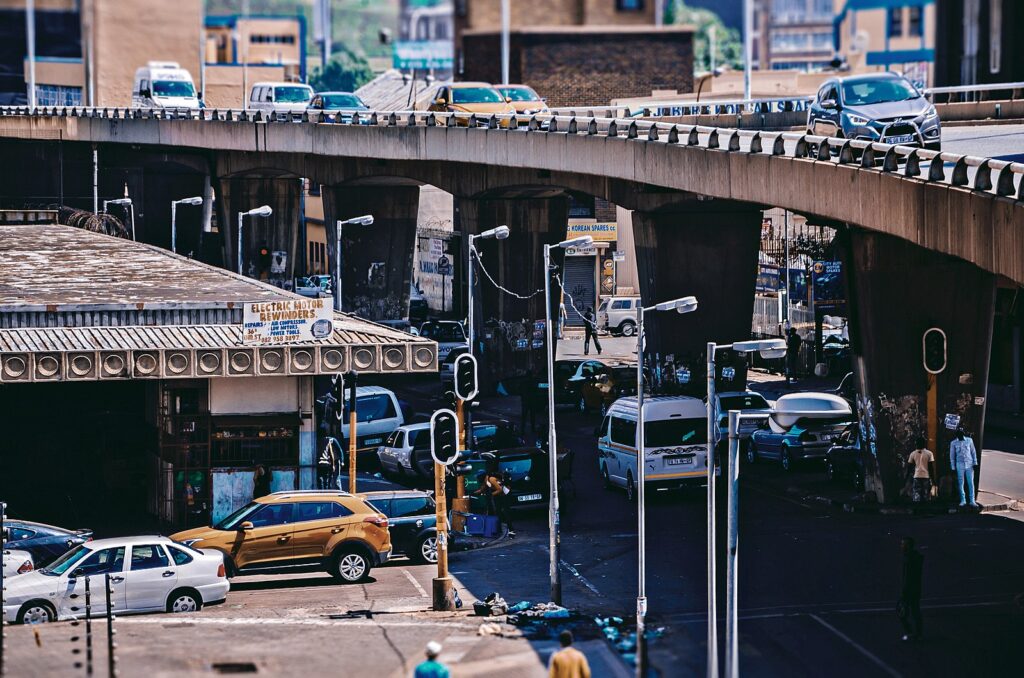
Maboneng Precinct: An example of how gentrification changes the image of a city, not the reality
Is there a balance?
Faranani Gethe, a chief building inspector for the City of Johannesburg and a current PhD student at the School of Construction Economics & Management at Wits University, believes that if we use policy correctly, we can begin to renew without gentrifying.

The main issue identified by Mr Gethe is that urban renewal always places budget and investment as a priority without any consideration for the social aspects of renewal. Without a strong guiding policy that can regulate projects, all renewal programs fall into the same ways of being, one that pushes poor people out while rich people come in.
“The core social elements of urban regeneration should always be safety, non-exclusion, and should realistically look at a blended income range,” says Faranani who adds that “the way that cities were designed in the past where the richer areas are separated, and the poorer areas are isolated and difficult to access should become a thing of the past.”
A mixed-income area is a frightfully new concept for South Africa as our areas have class and race histories attached to them, but in a city centre, this idea makes radical sense. People who work in the city should be able to live in the city, this is two-fold, not just a matter of income but safety too. “This does rely on getting our economy going and tackling our unemployment rates” Faranani adds.
The reality is that segregation still exists in South Africa, when apartheid ended and segregation became unlawful it didn’t remedy itself overnight, instead a true infrastructure gap became apparent and this is only worsened by additional social pressures like brain drain, white flight, and economic exclusion.
In his research, Faranani suggests four perspectives that should be looked at to create policy going forward.
- Triple bottom line theory: The theory expands conventional business success metrics to include an organisation’s contributions to social well-being, environmental health, and a just economy. Effectively humanising business practice.
- Planning gain theory: A practical example used by the United Kingdom that allows local authorities to get additional benefits prior to the private development of a property. This ensures the local government gets more out of a deal that usually only benefits the private sector.
- Equitable development theory: Equitable development requires both place-based and people-focused strategies. Place-based strategies might focus on areas like affordable housing or public transportation, while people-focused strategies might focus on areas like health or business development
- Social investment theory: Impact investing creates value by inducing firms to shift towards profitability, which a municipality can use to create self-sufficient projects without additional funding.
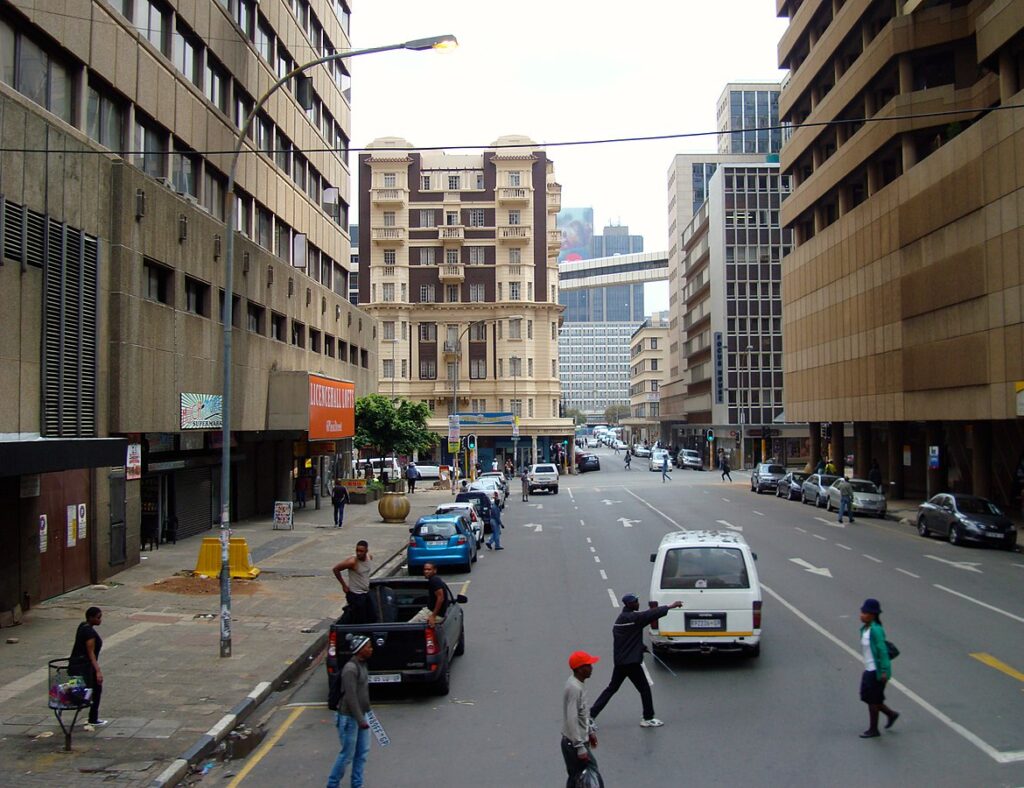
Inner-City Johannesburg, an area in need of renewal. Courtesy of Wiki Creative Commons
Notably these theories, while heavily focused on the social, do not arise in utopias but by uniting the social, economic, and environmental factors.
Faranani notes that robust policy is the weapon to arm municipalities in their mandates, and that policy can monitor and evaluate projects. This could create a stronger public sector rather than relying on the private sector alone, especially when profit can get in the way of the people.