PARIS, France – More than two-thirds of students regularly use financial products and services, but levels of financial literacy remain too low to ensure they can all avoid financial risks while benefiting from available opportunities, according to a new OECD report.
Governments should seek to boost young people’s financial literacy, enabling them to better understand key financial concepts, and the risks and rewards of financial products. Improving financial literacy will not only bring short-term improvements to students’ money management but will also help them take smarter financial decisions as they grow older.
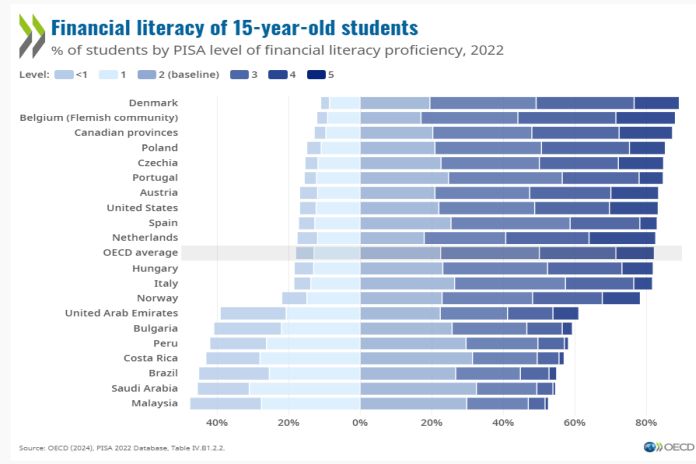
The PISA 2022 Volume IV financial literacy assessment, which measured the financial skills of 15-year-olds in 14 OECD and six partner countries and economies, shows that many students engage in basic financial activities from a young age. On average, more than eight in ten students have bought something online during the last 12 months and 66 percent of students made a payment using a mobile phone. However, many still lack the skills and knowledge needed to make sound financial decisions: nearly one out of five students on average in participating OECD countries and economies, did not achieve baseline proficiency levels in financial literacy.
The top performers – about 11 percent of OECD students assessed – are capable of solving non-routine financial problems and can describe the potential outcomes of financial decisions, showing an understanding of the wider financial landscape, such as income tax. Higher financial literacy is associated with more responsible financial behaviours, such as having a longer-term and more pro-active approach to money. Financially literate students are more likely to save, less likely to overspend and less likely to report buying something because their friends did.
These results, combined with the increased incidence, complexity and potential impacts of financial frauds and scams, highlight the need to better equip our young people with the knowledge and skills necessary to make safe and informed financial decisions.” OECD secretary-general Mathias Cormann said during the report launch. “We are keen to broaden the coverage of this assessment to help inform countries’ financial education policies and strategies with robust evidence, to ensure their education systems are as effective as they can be, including to prepare young people for their financial future.”
The PISA assessment shows that socio-economically advantaged students outperform their disadvantaged peers, with the socio-economic background accounting for 12 percent of the variation in performance. Not only did students from disadvantaged socio-economic backgrounds score lower in financial literacy, they also had fewer opportunities to learn about money.
Schools can also play an important role. The report shows that there is a positive correlation between financial literacy performance and students’ exposure to finance-related terms in schools. However, only two in three students have been exposed to school tasks exploring the difference between spending money on needs and wants. Opportunities to learn basic financial skills in school should be offered to all students, especially those who need them most, from the earliest possible age, as advocated by the OECD Recommendation on Financial Literacy.
The study also underlines that young people are very likely to use digital financial services and products, which exposes them to new risks, such as leaks in personal information and online scams. Safe and age-appropriate digital financial inclusion and education policies should ensure that young people learn how to navigate financial risks early-on.
Governments should:
- Offer equal opportunities to acquire financial literacy in school to all students, regardless of their socio-economic background.
- Tackle socio-economic inequalities in financial skills and behaviours and foster financial literacy in students’ environment, including through parents and peers.
- Strengthen students’ financial attitudes in addition to their knowledge and skills, to raise interest in money matters.
- Ensure that opportunities to access and use financial services, in particular online, are safe and age appropriate.
- Promote financial consumer protection frameworks to protect consumers, in line with the G20/OECD High-Level Principles for Financial Consumer Protection.