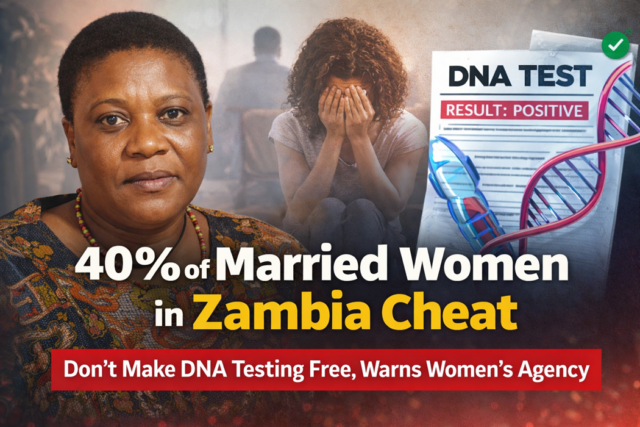
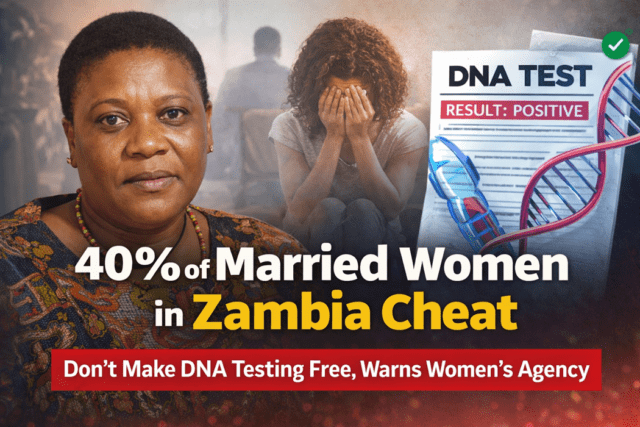
Lusaka, Zambia — The Women Empowerment Agency (WEA) has sparked national debate after strongly warning President Hakainde Hichilema’s government against making DNA testing free in Zambia. They argue that such a move could destabilize families. It could also increase divorce rates and leave many children fatherless.
Speaking in Lusaka, WEA Director Martha Tembo said free DNA testing would “do more harm than good” in a society already struggling with family breakdown, poverty, and child welfare challenges.
“Making DNA tests free will make many women hate President HH and the UPND government. This is because many marriages will collapse. Consequently, many women will be divorced and many innocent children will be left fatherless,” Tembo said.
She controversially claimed that “about 40 percent of married women cheat”. She suggested that widespread DNA testing would expose infidelity on a massive scale. This exposure could lead to serious social consequences.
– Advertisement –
Call to Adopt Tanzanian Legal Model
Tembo urged Zambia to adopt laws similar to those in Tanzania, where any child born within a legally recognized marriage is automatically considered the husband’s legal child — regardless of biological paternity.
“If a man is legally married to a woman, all children she gives birth to during that marriage should legally be his. That protects families, children, and social stability,” she said.
She added that DNA testing should be left to developed countries where strong social safety nets exist. These support single parents and vulnerable children.
“Let us leave DNA testing to developed countries. Here in Zambia, we should focus on uplifting the living standards of our people,” Tembo said.
Political Warning Ahead of 2026 Elections
In a bold political statement, the Women Empowerment Agency warned that if the government ignores their concerns, they would mobilize married women to vote against the ruling UPND party in the 2026 general elections.
“If the government fails to listen, we will have no option but to persuade all married women to vote against UPND in 2026,” Tembo warned.
Public Reaction and Controversy
The statement has triggered intense reactions across Zambia. Critics accuse the agency of promoting gender stereotypes, spreading unverified statistics, and encouraging deception within marriage. Supporters, however, argue that Tembo is raising legitimate concerns about family cohesion and the unintended social consequences of policy changes.
Legal experts have also questioned the constitutional and ethical implications. They are concerned about declaring children legally tied to men who may not be their biological fathers.
As Zambia debates the future of DNA testing policy, the issue has quickly become a flashpoint for discussions. These discussions focus on marriage, gender relations, child rights, and the role of science in society.